
Bringing engineering skills into space innovation.
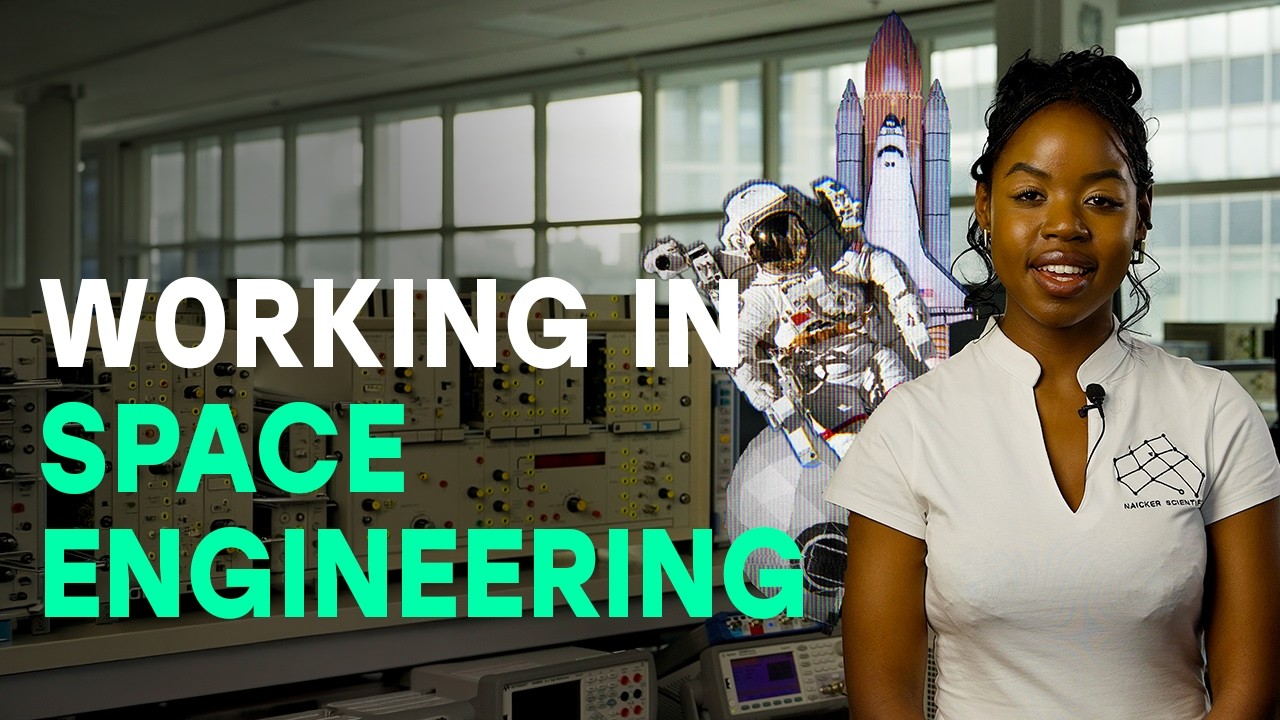
Michelle Chimwanda is an MSc Electrical and Electronic Engineering student at Sheffield Hallam and her journey into engineering has taken her across the world.
Born in Zimbabwe and raised in Norwich, she moved to China to complete her undergraduate degree in mechanical engineering at Huazhong University of Science and Technology and then returned to the UK to pursue her masters. Most recently, Michelle was recognised with the 2025 Joint Award, celebrating her achievements and contributions to electrical engineering and space innovation.
"I’ve always loved engineering, and doing a postgraduate degree was something I’d been aiming for to deepen my skills and knowledge.
"I was offered a scholarship to do a masters in China, but with the pandemic, it didn’t feel like the right time. I ended up working as a STEM teacher there for three years before coming back to the UK to pursue my postgraduate degree in electrical and electronic engineering.
"I chose Sheffield Hallam because the modules really interested me — they stood out compared to other offers I had. The university also has a great reputation, especially among international students, and Sheffield is a brilliant and affordable city for students."
Hands-on learning
Throughout her course, Michelle has had access to industry-standard labs, equipment and software from day one, giving her the opportunity to build practical skills and prepare for her career.
"During the course, we were able to take some equipment home and access software remotely so we could complete tasks in our own time. The labs were also open almost until Christmas, which gave us plenty of time to finish our work. Having that kind of access was so important.
"The course covers a vast range of topics, and some of the software we used — such as in the module modern electrical systems — was exactly what employers are looking for."
Building industry experience
Michelle’s placement at Koch Technology Solutions (KTS) gave her a real-world platform to apply her learning. In her role as an Instrumentation and Control Engineer, she has been responsible for designing and optimising control systems for industrial processes, ensuring precision and efficiency in operations.
"I applied for placements at the start of my second semester. I was really focused on finding a role that matched my interest in control and instrumentation, and that’s how I landed my role at KTS.
"I’ve been working as an Instrumentation and Control Engineer, helping check documents to ensure they align with designs for chemical plants and placing instruments, and helping design logic for control and safety systems. I also took part in hazard studies (HAZOP), where I made key suggestions about removing an interlock logic that was no longer serving its purpose and these were accepted by senior engineers. That was a really proud moment for me.
"Throughout the placement, I’ve been encouraged to deepen my knowledge. My manager has involved me in meetings and connected me with colleagues to build on what I’ve learned at university. It’s helped me massively in linking academic learning to real-world engineering challenges."
Bringing engineering skills to space projects
Alongside her studies, Michelle has also been exploring her passion for space and actively seeking out opportunities to gain experience in the field.
"I’ve always wanted to be involved in space projects, so I joined UK Students for the Exploration and Development of Space (UKSEDS), a student-led organisation supported by UK universities and the UK Space Agency. I volunteered as a project facilitation coordinator and helped organise their annual National Student Space Conference (NSSC), where I first connected with members of the British Interplanetary Society (BIS).
"Through those connections, I got involved in the Aqualunar Challenge — an exciting project being run for the first time in the UK by the UK Space Agency and the Canadian Space Agency, in partnership with Impact Canada. I’ve been working on a test rig for a water purification system designed for use on the Moon, focusing on managing electricity safely and contributing to the design of control systems. It’s been an incredible chance to apply what I’ve learnt on my course and placement, develop problem-solving skills, and explore an industry I’m really passionate about."
2025 Joint Award
Michelle’s passion for engineering and her voluntary work and contribution to space innovation were recognised with the 2025 Joint Award.
This prestigious award will give her the opportunity to attend the European Space Mechanisms and Tribology Symposium in Lausanne, Switzerland. The event will allow Michelle to engage with leading experts in spacecraft engineering, learn about advancements in space mechanisms, and establish valuable industry connections. The experience will not only enhance her technical knowledge but also bring fresh insights to her work with the British Interplanetary Society — potentially contributing to innovative solutions in control and instrumentation systems for the space sector.
"I honestly wasn’t expecting to win the award. It meant so much to know that people really valued the work I’d been doing outside of university and my placement. It was a huge confidence boost — people in the industry were vouching for me, and I was so grateful.
"I’m really looking forward to attending the symposium, meeting industry professionals, seeing what they’re working on, and learning what skills I should focus on next. It will definitely influence my future direction in engineering and space exploration."