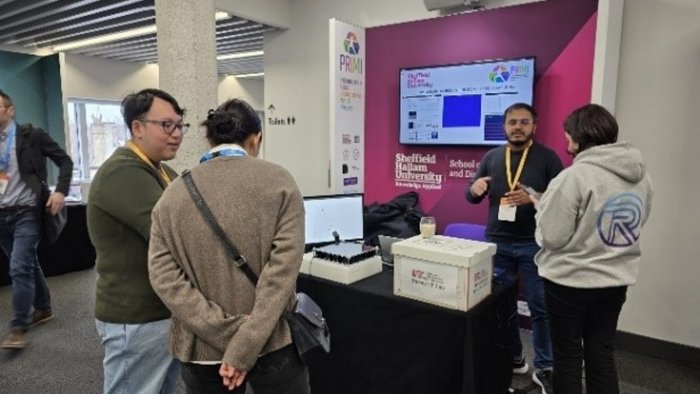
On 17-18 March, the Alan Turing Institute hosted AI UK, an event that brought together industry, academia, and the general public to discuss and demonstrate advances in using artificial intelligence to solve real-world problems. A series of talks, conversations, and showcases highlighted how AI can address environmental issues—from monitoring wildlife and optimizing energy use in city-wide ecosystems to tackling concerns about privacy, human-AI alignment, and healthcare.
The Smart Interactive Technologies (SiT) laboratory at Sheffield Hallam University also took part, presenting a popular showcase that demonstrated how neuromorphic technologies can enable sustainable AI systems. These technologies draw on biological inspiration to create architectures that learn and behave much like animal brains. They span every level of development: from sensors such as event-based cameras that operate like a retina, and specialized chips built with brain-like circuits, to neuromorphic robots that embody the active relationship animals maintain with their environment.