
In Robots We Trust: new book by Dr Samuele Vinanzi
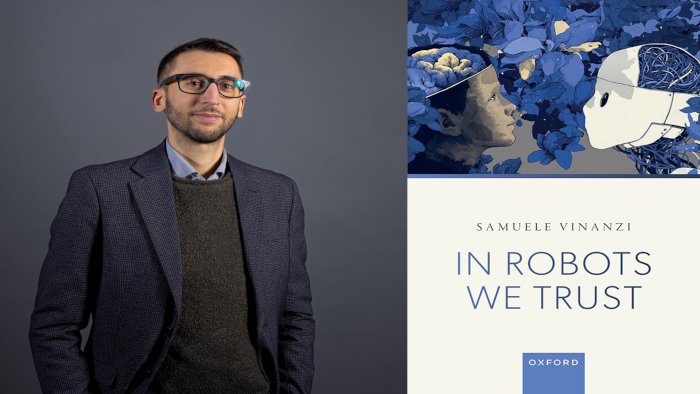
In Robots We Trust, a new popular science book by Dr Samuele Vinanzi, Senior Lecturer in the School of Computing and Digital Technologies, has just been published by Oxford University Press.
Dr Vinanzi’s research focuses on robotics and artificial intelligence, with a particular interest in Cognitive Robotics: an interdisciplinary field that combines robotics, AI, cognitive science, and psychology. His work investigates how robots can perceive, reason, and interact in ways that resemble human behaviour, with the goal of enabling meaningful social collaboration between people and machines.
The volume tackles one of the most pressing questions of our time: can we trust robots? Intelligent machines are no longer confined to laboratories or science fiction. From self-driving cars to delivery drones, they are becoming part of our everyday lives. This volume, written for a general audience, introduces the sciences of AI and robotics without assuming technical expertise, while also addressing the philosophical and ethical debates surrounding machine intelligence and cognition.
At the heart of In Robots We Trust is the contemporary challenge of trust in human-robot interactions. Why do robots raise such distinctive psychological, moral, and cultural concerns compared to other technologies? What factors shape our willingness to accept them, from their appearance and behaviour to our own social and religious backgrounds? In exploring these questions, the book also reflects on what our reactions to robots reveal about human nature itself.
A particularly thought-provoking idea developed in the book is Artificial Trust: the possibility of robots deciding whether to trust their human partners. Could technology make this feasible, and if so, should robots have the right to question our commands? Drawing on real-world examples from cutting-edge experiments in cognitive robotics, the book presents powerful and sometimes controversial ideas that are likely to shape how we live and work in the future.
In Robots We Trust is now available in physical and online bookshops. You can read a free preview on Google Books.