
About this project
Explore the people, research centres and partner organisations behind this project.
In collaboration with
South Yorkshire Sustainability Centre
A regional food system stakeholder
"On our own, we can do very little. But when businesses, communities, universities and local authorities come together with a shared purpose, the difference that can be made is enormous. This work shows that South Yorkshire is ready - not just to talk about change, but to deliver it."
Access the full report here: LINK
Get in touch
Contact the AFIC to discuss collaborations, facilities, funding and learning.
Email AFICBuilding a South Yorkshire Food Network
About this project
Explore the people, research centres and partner organisations behind this project.
In collaboration with
South Yorkshire Sustainability Centre
A regional food system stakeholder
"On our own, we can do very little. But when businesses, communities, universities and local authorities come together with a shared purpose, the difference that can be made is enormous. This work shows that South Yorkshire is ready - not just to talk about change, but to deliver it."
Access the full report here: LINK
Get in touch
Contact the AFIC to discuss collaborations, facilities, funding and learning.
Email AFICCo-Produced with Regional Stakeholders: Local voices, Real Insights
Backing the region
The South Yorkshire Food Network Feasibility Study was commissioned on behalf of the South Yorkshire Sustainability Centre (SYSC) and funded by Research England. It brought together an expert partnership spanning Sheffield Hallam University’s Advanced Food Innovation Centre, The University of Sheffield’s Institute for Sustainable Food, and Sheffield Business School.
This cross-university, academic-civic partnership was established to support SYSC and the South Yorkshire’s Mayoral Combined Authority (SYMCA) with robust, locally grounded evidence to inform strategic decision-making on food, health, sustainability and inclusive economic growth. At its heart, the project responded to a clear regional ambition: to understand whether South Yorkshire was ready for a coordinated, region-wide food network and, crucially, how such a network could be designed to deliver real impact rather than more conversation.
The Problem Beneath the Surface: Why South Yorkshire’s Food System Needed Rethinking
Food in South Yorkshire is both economically significant and socially critical, yet structurally fragmented. According to the KADA Report (2023)*, the region’s food and drink sector employs around 9,000 people across 170 businesses, generating approximately £434m in Gross Value Added (GVA), making it the second-largest manufacturing sector in the region. At the same time, diet-related ill health costs South Yorkshire an estimated £1.2bn a year, reinforcing cycles of inequality, economic inactivity and pressure on public services.
While South Yorkshire benefits from a rich ecosystem of food-related activity, this activity takes place within a system facing several longstanding and interconnected challenges. These include:
- Persistent inequalities in access to affordable, healthy food, particularly in deprived communities
- Fragmented governance structures and inconsistent policy attention to food as a strategic issue
- Insufficient support and market access for small and micro food businesses
- An accumulation of plans, meetings and initiatives, without a corresponding focus on delivery at scale
From Insights to Evidence: Building the Case for Collective Action
The project combined rigorous analysis with deep stakeholder engagement to test the feasibility of a regional food network rooted in South Yorkshire’s lived reality.
A mixed-methods approach was used to capture both breadth and depth, including:
- A region-wide survey of 56 food system stakeholders across local authorities, SMEs, community organisations, academia and policymakers
- 22 in-depth qualitative interviews to explore lived experience, credibility, barriers, and opportunities
- Advanced quantitative analysis (PCA, MCA and cluster analysis) to assess readiness for collaboration, trust dynamics and engagement profiles
This was complemented by extensive policy analysis and alignment with national and regional strategies on food, health, sustainability, and economic growth.
Crucially, the work was co-produced with stakeholders, ensuring the findings reflected the realities of operating within South Yorkshire’s food system - from small family-run producers to public health leaders and anchor institutions.
The issue was not a lack of passion, commitment, or innovation. It was the absence of a coordinating structure capable of aligning efforts, amplifying voices, and turning shared intent into tangible outcomes. Stakeholders were clear: South Yorkshire had moved beyond the need for more dialogue. What it needed next was delivery.
What the evidence told us: A Region Ready to Act
The findings revealed a powerful and encouraging picture. Across sectors and geographies, there was consistent support for the creation of a South Yorkshire Food Network. Stakeholders recognised its potential to:
- Strengthen collaboration and reduce duplication
- Improve access to resources, markets and funding – particularly for SMEs
- Align food with wider economic, health and environmental priorities
- Provide a collective voice capable of influencing policy and investment
The analysis identified four distinct stakeholder groups - from highly engaged Core Champions to a small minority of skeptical Disengaged Critics. Importantly, most organisations sat in a pragmatic middle ground: supportive of the idea, but seeking clarity, transparency and early evidence of value.
The study concluded that a regional food network in South Yorkshire is both viable and necessary, provided it is:
- Properly resourced and independently credible
- Inclusive and representative across sectors and communities
- Focused on action, outcomes and measurable impact
- Transparent in its governance and accountable in its delivery
Rather than another talking shop, stakeholders envisioned a network that could function as a regional delivery infrastructure - linking food affordability, public health, sustainability and economic resilience.
The Moment of Opportunity: From Feasibility to Delivery
The report sets out a clear roadmap for moving from evidence to action. Key next steps include:
- Commissioning a fully costed regional blueprint for the Food Network
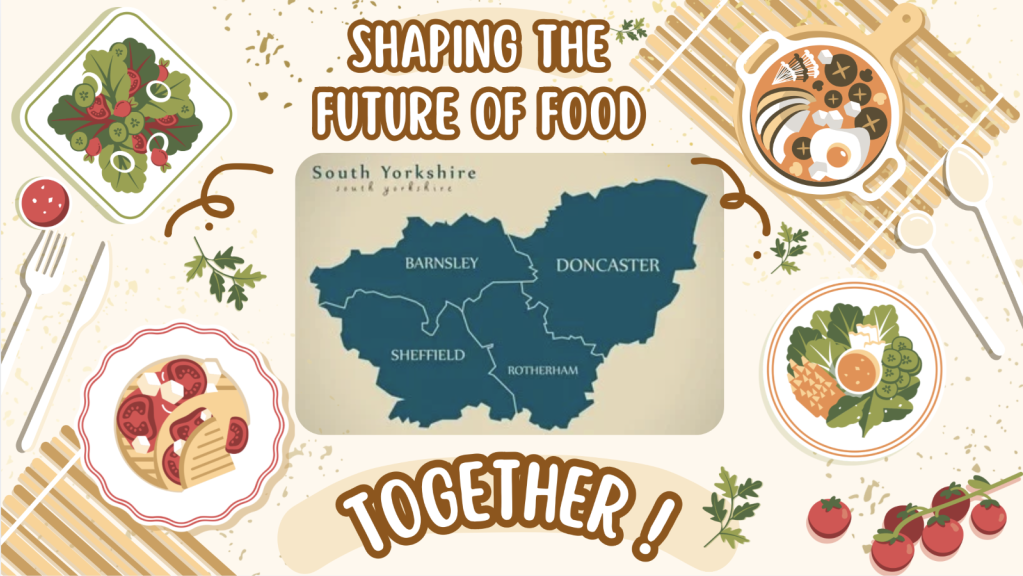
- Establishing a cross-sector Steering Group representing all four local authorities
- Securing multi-year, blended funding to ensure long-term sustainability
- Launching early pilot projects to demonstrate visible impact and build trust
- Embedding shared metrics across economic, health and environmental outcomes
If implemented, the South Yorkshire Food Network has the potential to reposition food as a strategic regional asset - supporting healthier communities, stronger local businesses and a more resilient, low-carbon economy.
*KADA (2023). Economic Analysis of the South Yorkshire Food and Drink Sector.
Unpublished report - available on request.