
Contact us
For help with a story or to find an expert
Email: pressoffice@shu.ac.uk
Phone: 01142 252811
On social media
Sheffield’s ‘citizen scientists’ photography helping to mitigate flood risk in region
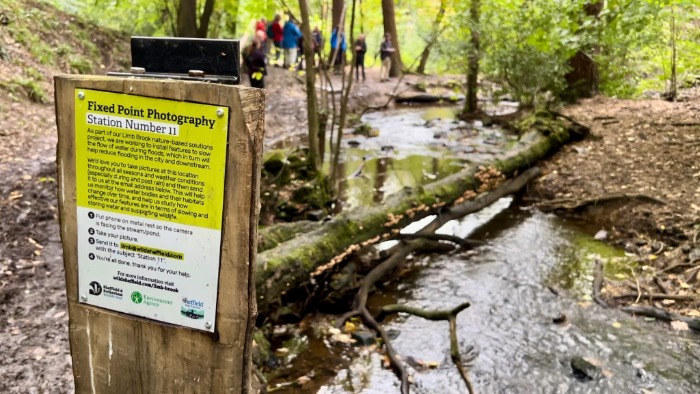
At various locations across the landscape, members of the public are being asked to stop and take photos of nature-based solutions (NBS) that have been built to manage and control excess rainwater.
The project is helping teams from Sheffield & Rotherham Wildlife Trust and the Environment Agency manage flooding interventions in the region, by more quickly and effectively identifying any issues that require action.
A new study evaluating the project from Sheffield Hallam University, has highlighted that the involvement of citizen scientists can be valuable in the success of environmental monitoring projects, such as the one at Limb Brook Valley, and now being replicated in other regions vulnerable to flooding by the Environment Agency.
Nature-based solutions (NBS) for flood risk management like ‘leaky dams’ and attenuation ponds are designed to help slow the flow of water following excess rain and storms, allowing water to be stored, or drain, into the natural landscape.
The NBS at Limb Brook Valley limit the amount of water making its way into the River Don, reducing the flooding events that communities have experienced in parts of Sheffield - and even further afield in Rotherham and Doncaster – following heavy or prolonged rain.
Over two years, Sheffield’s citizen scientists submitted over 4500 photographs of the NBS across the Lady Canning’s Plantation, Limb Brook Valley and Whirlow Fields catchment to the project. The photo updates, taken from 15 fixed points across trails in the valley, provided real-time updates which helped identify and locate issues such as dam failures or debris accumulation, and documented seasonal changes in water levels and the environment.
Mel Lacey, an Associate Professor from Sheffield Hallam’s School of Biosciences and Chemistry, and co-author of the study evaluating the progress of the project, said: “Stopping for a few seconds to take and submit a photo on your walk, sounds like such a small action, but members of the public getting involved in supporting their local environment is helping the project team make their work at Limb Brook Valley more efficient and effective.”
Monitoring and maintaining these flooding interventions is currently challenging due to the wide geographical areas that need surveying following storms or heavy rains. The process of locating and identifying any issues or dam failures can sometimes take days, and high-levels of in-person resources.
Researchers from Sheffield Hallam produced a system to automatically analyse public contributions, sorting them by location, date and adding rainfall data allowing the project team to observe real-time changes in the environment. This data is then used to quickly identify issues like debris or sediment build up and geomorphological changes such as a dam failure, so timely maintenance or improvements can be carried out.
Mel Lacey added: “Thanks to the public’s engagement, the team have been able to identify and fix issues like the failure of a leaky dam that was dislodged and washed away during Storm Babet. The data provided by the public was able to show the dam had previously slowed the speed and reduced the flow of flood water downstream during three previous storms, but rare and high-risk flooding events could dislodge and wash away the dam.”
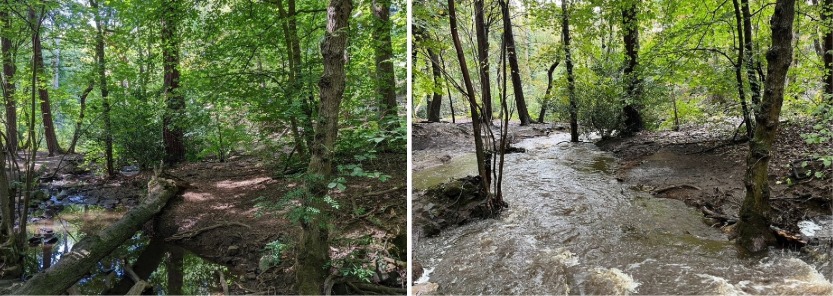
Photos taken by Sheffield's citizen scientists showing a 'leaky dam' structure at Limb Brook Valley in August 2022 (l) which aided in several flooding events, and again in October 2023 (r) after Storm Babet when the structure was overwhelmed and washed down stream. ©Sheffield and Rotherham Wildlife Trust
As well as helping to reduce flood and drought risk by slowing the flow and storing of water, natural river and flood management techniques also promote biodiversity. A more resilient river system promotes more wetland vegetation in the wild landscape, supporting habitats for wildlife throughout the area and providing a richer environment for the public to enjoy.
The success of the project means it will now be extended, with new photography locations for the public and plans to expand a new engagement platform, so Sheffield’s citizen scientists can keep up to date with how their input is helping shape the natural environment.
Mel Lacey said: “Projects like these that invite our valuable citizen scientists to take part, don’t only engage people in the nature around them, they also enrich the project team’s survey data and monitoring practices, bringing a very real benefit to the local landscape and lowering the flood risk not only for Sheffield, but further afield too.
“We will be looking at how we keep in touch with the public, so they can stay up to date with how their contributions to the project are having an impact on the valuable work by the Sheffield and Rotherham Wildlife Trust.”
Martin Reed, Environmental Adviser from the Sheffield & Rotherham Wildlife Trust, said: “The Limb Brook photo posts are a vital part of our award-nominated project. This citizen science initiative has been incredibly popular, with thousands of images capturing how our natural flood measures respond to different water levels. These photos provide a clear record of how the landscape has matured - from ponds becoming lush with vegetation, to leaky dams reshaping the channel.
“Engaging the local community has been integral to the success of this project. It has shown that creating and enhancing habitats using nature-based solutions can be efficiently delivered through partnership working at the sub-catchment scale. We will be continuing the work to deliver more positive outcomes for nature and are focused on a catchment-based approach.”
Jackie Lowe, from the Environment Agency, said: “This paper has been a productive collaboration, adding value to both practical work in the field and academic research. It has given the opportunity for data collected from the Limb Brook NBS Project to be analysed and the results used to improve the citizen science experience and quality of data we continue to collect.
“The partners involved in delivery of the Limb Brook NBS Project are now incorporating recommendations from the research and extending this learning to similar projects across our region.”
To find out more about the project at Limb Brook Valley, or how you can get involved in encouraging healthier waterways and environments for wildlife and people, visit https://www.wildsheffield.com/campaign/living-waters/
Contact us
For help with a story or to find an expert
Email: pressoffice@shu.ac.uk
Phone: 01142 252811