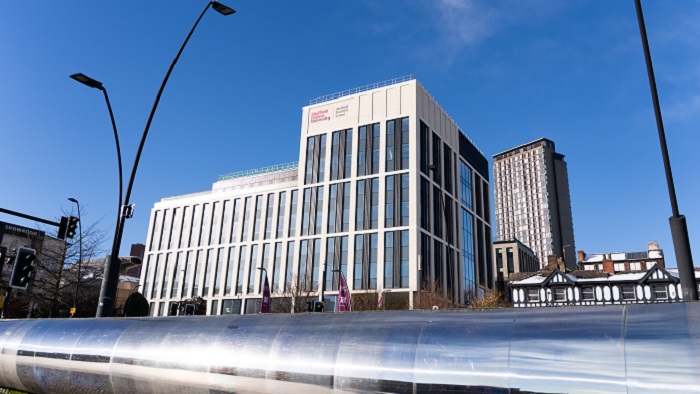
The milestone comes as Innovate UK (part of UK Research and Innovation), the government body that part funds Knowledges Transfer Partnerships marks 50 years since the first one.
Since completing its first KTP in 1985, Sheffield Hallam has partnered with more than 150 companies and delivered 210 projects, generating innovation, economic growth and sustainable solutions across diverse sectors.
KTPs are collaborative ventures funded jointly by businesses and Innovate UK that typically run for one to three years. They enable companies to access cutting-edge academic expertise while giving universities the opportunity to apply their research to real-world challenges. Graduate and postgraduate associates work at the intersection of both worlds, gaining valuable experience whilst driving innovation.
Since their launch in 1975, the UK Government has funded over 14,000 groundbreaking KTPs, uniting top businesses with researchers and graduates to solve real-world challenges, adding billions to the UK economy. From 2010 to 2020 alone, Innovate UK invested £200m in 2,000 projects, adding £2.3bn to the UK economy.
Sheffield Hallam's KTP portfolio has evolved significantly over four decades. Initially focused on manufacturing and engineering in line with Sheffield's industrial heritage, the university now tackles contemporary challenges including sustainability, artificial intelligence and advanced technologies.
Professor Conor Moss, Executive Lead for Research, Innovation and Knowledge Exchange at Sheffield Hallam University, said: "We’re proud to have reached this milestone of knowledge transfer partnerships, supporting more than 150 businesses to innovate and grow. KTPs work so well because they give businesses access to the academic excellence of a university, helping to bridge the gap between research and industry.
“We've gone from supporting traditional manufacturing industries and materials testing in our early years to working on cutting-edge projects incorporating AI and machine learning. Companies come to us with business challenges, and we help them develop prototypes into market-ready products, provide crucial data, or test innovative ideas."
Case studies in innovation
Dext Heat Recovery: Sheffield Hallam partnered with this heat recovery specialist to develop an innovative solution for commercial kitchens. The collaboration resulted in a heat recovery plate that can be installed near cookers and chargrills to capture waste heat and repurpose it to provide hot water. The technology has been successfully installed in restaurants across the UK, reducing both environmental impact and operational costs.
Gripple: This Sheffield-based engineering firm has maintained a longstanding relationship with the university spanning multiple KTPs. Sheffield Hallam helped develop Gripple's flagship wire fence fastener into a globally manufacturable product. The success sparked further collaborations, including work with the university's Design Futures group and support for spin-out company Loadhog Ltd. Gripple now employs more than 950 people across 18 locations worldwide and sponsors Sheffield Hallam's annual Enterprise Challenge business-startup competition.
Guildhawk: In a more recent partnership, Sheffield Hallam is working with this global leader in multilingual communications technology to embed AI and natural language processing techniques into machine translations. The project involves a professor of machine intelligence and a doctoral student, exploring how to train computer-generated language to sound more human and lifelike.
KTPs often mark the beginning of enduring partnerships.
Professor Moss added: "Our work with Guildhawk began with a KTP and then evolved as they worked with us to identify computer science talent to employ. Later, they joined our advisory board to help redesign our programmes. While KTPs are significant in themselves, they're very often the beginning of something quite special that benefits not just the businesses and university, but the wider community and economy too."
Approximately 800 businesses are currently involved in KTPs with around 100 academic institutions across the UK.