Led by academics from Sheffield Hallam University, the University of Hertfordshire, and Chapman University, USA, the survey captures an accurate snapshot of contemporary folk culture in England, more than 60 years after the last Survey of English Language and Folklore, that was launched in 1964.
Dr David Clarke, Associate Professor at Sheffield Hallam University who leads the survey team, said: “Our aim is to produce the first representative national survey of folklore in multicultural England to raise awareness of the value of folklore as a cultural asset.
“Far from folklore being something old fashioned, our results show that traditional beliefs and customs are a central part of modern life for millions of people. Everyone has folklore and this is reflected in the responses to our questions on supernatural beliefs and experiences.
“One surprising result is that, of those who say they have had an extraordinary experience, almost one in five have never told anyone about it, even family and close friends.”
The research has been funded by the Arts and Humanities Research Council (AHRC) and the survey was carried out by IPSOS UK.
Over the next 12 months, the NFS for England team will release further results in stages to mark key points in the folkloric year. Respondents answered questions in seven categories and the data relates to many aspects of folklore including: places and legends; nature and the natural world; lucky and unlucky objects; calendar customs (including religious festivals, Christmas, and other annual milestones); magical beliefs; and how people react to how folklore is portrayed in film, TV and social media.
The President of The Folklore Society, Professor David Hopkin, said: “‘Folklore just means the things we do, that we experience and that we believe, our personal and collective rituals, the objects we cherish, how we celebrate, and how we connect with each other through stories, jokes, dance, games and food.
“Folklore is everywhere, enriching our world, but it’s difficult to measure because it is so blended into everyday life, and that also means it is hard to value. This survey, really for the first time, supplies for England the hard data on the kinds of experiences, beliefs and practices that go under the heading ‘folklore’.”
Halloween
A first look at the findings show that in England, Bonfire Night is celebrated by more participants than Halloween (52% vs 46%), with those in the 16-24, 25-34 and 35-44 age brackets* significantly more likely to celebrate Halloween.
At age 45 onward there is a sharp decline in those celebrating Halloween, but the celebration of Bonfire Night steadily decreases with age.
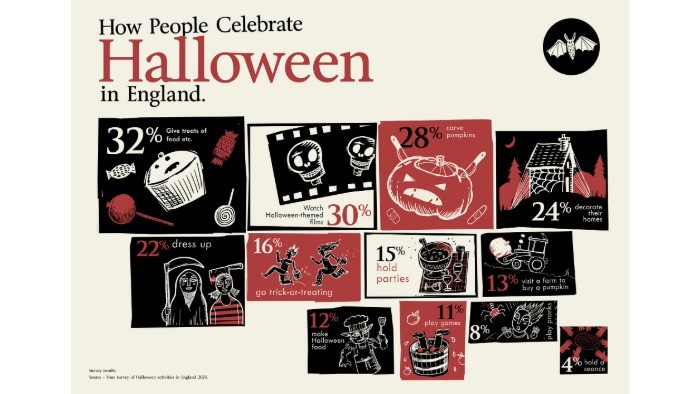
Almost 30% of respondents said they watch scary films or TV as part of their seasonal traditions, almost a third said they give out treats, and just over a quarter carve pumpkins.
When it comes to Halloween celebrations, younger people are significantly more likely to report participation in Halloween-related activities, and respondents from the North West, West Midlands and East of England are the most likely to say they always celebrate Halloween.
The Unexplained and Unexpected
As for belief in the supernatural, just over one in three people in England said that they believe in ghosts or the spirits of deceased people and those aged 25-34 were the most likely to believe in the paranormal (including ghosts, magical beings, possession, spells, psychics, angels, and demons).
Over a quarter of respondents said they believe it is possible to communicate with the dead. 16% of respondents reported that they have had an extraordinary experience and almost a fifth of those say they have never discussed this with anyone, even family or friends.
The majority of people surveyed (over 60%), whether they believed in ghosts or not, had heard a ghost story or legend related to the area they live in.
UFO sightings
Around 10% of people reported having seen a UFO or ‘something in the sky that they could not explain’, which makes people who live in England roughly half as likely to have seen a UFO than those from North America, when looking at comparable data.
24% of people said that they believe spacecraft piloted by aliens have crashed on Earth (e.g. the Roswell incident) and 27% stated they believe that the existence of aliens has been covered up by governments.
Even more people (32%), however, said that they believe that all UFO sightings can be explained, either as something natural, man-made, or as a hoax.
About the National Folklore Survey
*The survey does not examine the folklore of children and young people as those under the age of 16 are not surveyed by IPSOS.
IPSOS UK surveyed 1730 people using their iOmnibus function: a panel that is truly representative of the people of England, taking into account demographics such as age, education, gender, ethnicity, religion, region, and income level. All responses are anonymised by IPSOS. This type of survey is regularly used by HMG/NHS and other large organisations and the accuracy of the results is regarded with 99% confidence (gold standard).
https://www.nationalfolkloresurvey.co.uk/