Contact us
For help with a story or to find an expert
Email: pressoffice@shu.ac.uk
Phone: 01142 252811
On social media
Landmark trial shows prostate cancer lifestyle programme mitigates treatment side effects
Findings from ‘STAMINA’, the largest trial of its kind, published in The Lancet Oncology, show that a purpose-designed lifestyle programme offering supervised exercise, dietary advice and behavioural support delivered as part of routine cancer care, can mitigate the debilitating side effects of hormone therapy, known as medical castration, in men undergoing treatment for prostate cancer.
Funded by the National Institute for Health and Care Research (NIHR) and led by Sheffield Hallam University in partnership with by Sheffield Teaching Hospitals NHS Foundation Trust, STAMINA involves multiple NHS and academic partners across the UK, with Nuffield Health as the national delivery partner.
Analysis of the cost-effectiveness of the STAMINA programme, designed to be prescribed alongside routine prostate cancer care, found it provided benefits at a cost significantly below the threshold for NHS cancer funding.
The success in improving patients’ quality of life, in the largest randomised clinical trial of a lifestyle intervention integrated within core NHS cancer care, demonstrates that STAMINA is ready for implementation across multiple NHS Trusts, the authors say.
The trial recruited 700 men with prostate cancer across 15 NHS hospitals in England receiving androgen deprivation therapy (ADT), which lowers testosterone production, to slow the growth of prostate cancer to control the disease.
However, due to its castrate effects, ADT can cause adverse effects including fatigue, increased central obesity, loss of muscle mass, reduced bone density, cardiovascular risk, and psychological distress, all significantly affecting quality of life.
Around 600,000 men in the UK are living with prostate cancer, with around half, or 300,000, prescribed ADT at some point in their treatment pathway. The number of men living with prostate cancer has also surged by 20 per cent in the last five years, according to latest estimations.
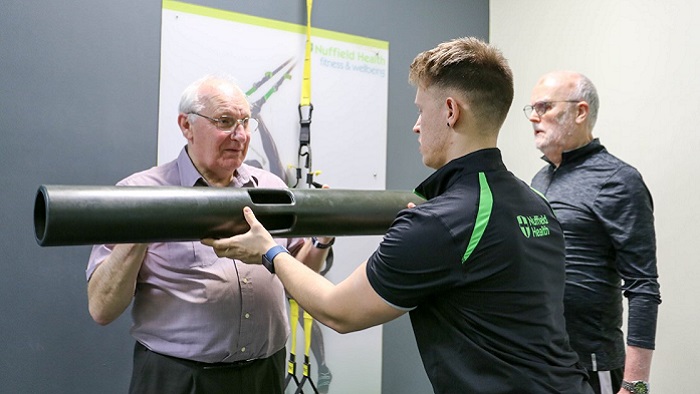
Patients on the trial received an enhanced version of routine care offered by the NHS, or the STAMINA Lifestyle Intervention. This included a combination of supervised aerobic and resistance exercise, dietary advice, and behavioural support across 18 Nuffield Health Fitness and Wellbeing clubs.
NHS staff involved in the trial received additional training to recognise men who would benefit, recommend exercise and make a referral to Nuffield Health personal trainers, who were upskilled by the STAMINA programme to work as clinical exercise specialists.
Key findings
The adherence rate to the STAMINA exercise programme was high, with over 80 per cent of men attending their scheduled sessions over 12 months. Those participants attending the programme had better cancer-specific outcomes, such as better quality of life, and reported less fatigue compared with men receiving enhanced routine care. This clinically meaningful benefit was also sustained across core physical, functional, emotional, and social wellbeing quality of life domains over the 12-month period.
Furthermore, statistical modelling undertaken by the research team showed that the intervention was cost-effective and would be less expensive to provide than National Institute for Health and Care Excellence (NICE) value-for-money for cancer treatments. The STAMINA intervention also has a very high chance of being cost-effective for up to 10 years, even when account for staff training.
On the back of the trial’s success, Nuffield Health has launched a new Cancer Activity Programme, working with Sheffield Hallam University and NHS Trusts to make a version of STAMINA available for men with prostate cancer, and planning to expand the programme to breast and bowel cancer patients, funding 50,000 places by 2030.
As the first lifestyle intervention integrated into routine cancer care at scale across the NHS in England, the STAMINA programme had an immediate impact for patients. Investigators from the study argue it should now serve as a template for integrating lifestyle interventions into cancer care in other complex health systems internationally.

Steve Pagden, 67, from Sheffield, felt in good health, and was relatively symptom free when diagnosed with prostate cancer, but as part of his treatment, was offered a place on the STAMINA Lifestyle Intervention trial.
As someone who likes to remain active, and feels relatively fit for his age, Steve found the treatment for prostate cancer challenging at times, with additional health problems, the side effects of ADT, and a tumble off his bike all affecting his fitness. He says STAMINA offered him the chance to take more control of his wellbeing during and after treatment.
“My own journey was complicated by paroxysmal atrial fibrillation (AF), attacks of which seriously disrupted my physical fitness and confidence to engage in my usual activities such as cycling. The ADT also definitely reduced my “stamina”, and for a time my twice weekly visits to the gym to participate in the trial were all I could do to try to stem what seemed a downward fitness spiral.
“STAMINA helped me realise that no one exercise is sufficient, a bit of everything is called for. It also introduced me to techniques like resistance training, the benefits of which are already widely publicised, and after completing the trial period, I continue to engage a personal trainer to provide a more bespoke approach to my training.
“As much as STAMINA offered an exercise program in which I could engage, it also offered the opportunity to meet with and befriend other participants, all on much more difficult journeys than myself, and their knowledge and support has been invaluable to me.”
What the investigators say
Professor Liam Bourke, Academic Programme Director of STAMINA at Sheffield Hallam University, said: “STAMINA is a huge achievement – it has taken us nearly two decades of incredibly hard work to get here – and it offers a definitive step-change in how lifestyle programmes should be considered and integrated comprehensively into routine prostate cancer care.
“As the largest trial of its kind ever to be conducted, and the first to be designed to work in the NHS from day one. This makes the study really unique and ensures that the positive outcomes of the research will be delivered exactly where they need to be – to NHS patients during routine care.
“The clinically meaningful results of the trial are also likely to be a conservative estimation of the benefit for patients – as the trial assessed STAMINA against ‘optimised usual care’ which is, in itself, far more than is provided usually in the NHS as standard. As such ‘real-world' benefits for patients could be of even greater magnitude. “
Professor Derek Rosario, Chief Investigator of STAMINA and Consultant Urological Surgeon at Sheffield Teaching Hospitals NHS Trust, said: “The importance of optimising quality of life for men with prostate cancer cannot be overstated. As well as the direct individual benefit, we know that optimising quality of life and mitigating fatigue through exercise has potential beneficial effects on overall survival.
“As the first lifestyle intervention integrated into routine cancer care at scale across the NHS in England, the findings of the STAMINA trial are a huge step forward and will make an immediate impact for patients, providing compelling evidence to clinicians who have been crying out for an evidence-based intervention to recommend their patients on ADT who present all the time with devastating treatment-related side effects.
“The evidence from this trial also satisfies NICE recommendations and those of expert reference groups across the world in mitigating devastating, but essential treatment-related side effects of those on ADT. I would like to thank all our patients, partners and participants for their enthusiasm and professionalism in delivering this programme.”
Dr Davina Deniszczyc, Charity and Medical Director at Nuffield Health, said: "The STAMINA trial has demonstrated that exercise can and should play a central role in cancer care. We are incredibly proud of what we have achieved with Sheffield Hallam University, NHS partners and our Fitness & Wellbeing teams in developing an evidence-based approach that helps people live well during and after treatment.
“As the first trial of its kind to be translated directly into a real-world programme at scale, our new Cancer Activity Programme marks an important step forward in making exercise a routine part of cancer care. Our ambition is to expand the programme to breast and bowel cancer and help tens of thousands more people access the benefits of exercise as medicine by 2030."
Professor Stephanie Taylor, STAMINA grant co-applicant and Director of Research at the Wolfson Institute of Population Health at Queen Mary University of London, said: “The STAMINA study set out to integrate exercise as a recognised treatment in the prostate cancer care pathway, and researchers from Queen Mary and Sheffield Hallam worked together to develop the training for the hospital staff and exercise professionals delivering the programme to promote this. Now the results show that the STAMINA Lifestyle Intervention brings considerable long-term benefits to men with prostate cancer.
“The results are a fantastic example of the kind of innovation championed in the Government's NHS 10-Year Plan, with STAMINA delivering faster access to enhanced cancer care integrated across hospital and community. It’s been an honour to be involved in this important research which should really improve the quality of the lives of men living with prostate cancer!”
STAMINA was led by Sheffield Hallam University and Sheffield Teaching Hospitals NHS Foundation Trust, working with Queen Mary University of London, the University of Leeds, the University of Sheffield, University of Bristol, University of York, University of Edinburgh, Cardiff University and Nuffield Health as the national delivery partner for the STAMINA lifestyle intervention.
Contact us
For help with a story or to find an expert
Email: pressoffice@shu.ac.uk
Phone: 01142 252811