Sheffield Hallam University is one of 15 universities, healthcare facilities and businesses that are part of the EU-funded UPLIFT consortium which aims to build the next generation of upright radiotherapy experts, addressing key questions around treatment planning, clinical workflow and equipment design.
Radiotherapy is one of the three main pillars of modern cancer treatment and has been predominantly performed with the patient in supine or prone position. Positioning the patients in upright, sitting or standing, position promises greatly reduced treatment cost, more patient comfort, and improved accuracy.
Sheffield Hallam is leading one of 19 research projects being undertaken by the UPLIFT consortium. The University has received £265,000 funding from UK Research and Innovation (UKRI) Horizon Europe Guarantee to lead the project focused on patient empowerment in collaboration with Leo Cancer Care, an innovative company specialising in medical devices for upright radiotherapy.
The project will investigate new technologies which could aid upright patient set-up processes, and facilitate patient empowerment, while maintaining the levels of accuracy necessary for radiotherapy. Examples of technologies which could be considered include virtual reality, visual displays to provide patients with additional information regarding their treatment set-ups, and game-based systems.
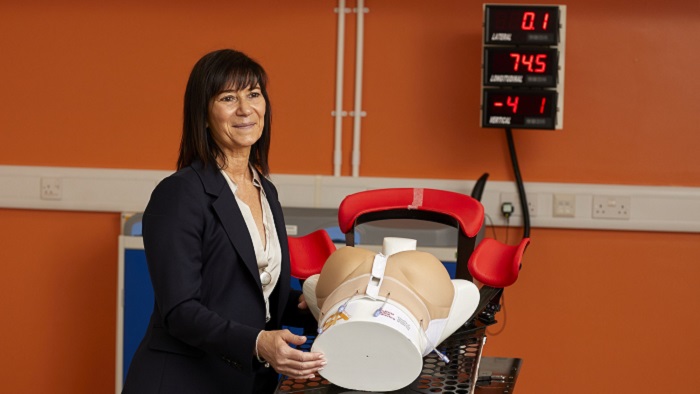
Professor of Radiotherapy and Oncology, Heidi Probst, is leading the project for Sheffield Hallam University. She spent 14-years as a therapeutic radiographer in the NHS before moving into research.
Heidi led the SuPPORT 4 All project alongside a team of health experts and designers from Sheffield Hallam to design and develop a bra that can be worn during radiotherapy for breast cancer to improve accuracy of treatment and help patients maintain dignity during treatment. She was awarded an MBE for services to radiography in 2024.
Prof Probst said: “We are pleased to be part of this unique consortium, bringing together leading institutions and organisations from across Europe to advance upright radiotherapy research and knowledge.
“We know that patients can find the process of undergoing radiotherapy disempowering, and this may hamper patients’ ability to recover quickly or return to activities of normal living.
“With the advent of upright radiotherapy there is an opportunity to investigate new patient set-up processes that may support patient empowerment, while maintaining necessary levels of accuracy and reproducibility.”
Dr Tracy Underwood, Head of Translational Research at Leo Cancer Care, said: “Having already collaborated with Prof Probst’s team at Sheffield Hallam University for several years, we are excited to extend our joint efforts through the UPLIFT doctoral training network.
“Many people who have undergone radiotherapy have shared that having more information available during their treatment could have helped to reduce their anxiety and streamline their appointments. This project aims to work with patients as partners to explore the types of information that could be helpful before, during, and after treatment, as well as the potential of new technologies to deliver that information.”
As part of the project, Wu Panzifan, will join the team as a PhD researcher based at Sheffield Hallam University. Wu’s research will focus on developing a virtual reality (VR) system for upright radiotherapy which aims to empower patients by providing real-time posture feedback, AI-driven treatment planning, and an immersive virtual environment to reduce anxiety, ultimately improving treatment accuracy and patient comfort.
Wu said: "This research is vital because traditional radiotherapy often leaves patients feeling passive and anxious. Upright radiotherapy can transform their experience, but precise positioning remains a challenge. Our VR solution will bridge this gap, ensuring both accuracy and patient empowerment, which are critical for advancing cancer care.
"What excites me most is working with this amazing European team. At Sheffield Hallam University, it will be possible to test our VR system with real patients while learning from Leo Cancer Care's engineering expertise. Having partners across Europe means we can validate ideas faster, for example, when colleagues from other countries spot an issue or suggest an improvement, we can iterate immediately. This kind of cross-border collaboration is exactly how breakthrough medical tech should be developed."
The project gets underway this month.