Contact us

For help with a story or to find an expert

Email: pressoffice@shu.ac.uk
Phone: 01142 252811

On social media

 Facebook
 Instagram
 YouTube
 Bluesky

27 April 2026

Researchers reveal “sail effect” with potential to redefine how ultra-efficient ground vehicles are designed
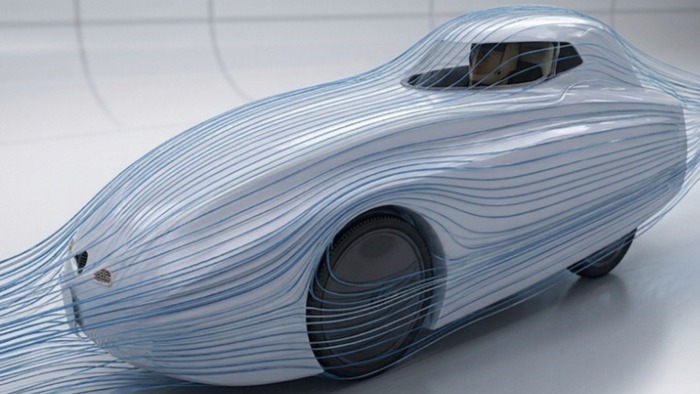
A new study has found that a streamlined, bike-like vehicle can generate forward thrust from crosswinds, uncovering a “yaw-driven sail effect” that produces negative aerodynamic drag, an insight that could inform real-world designs, including Formula One cars

Press contact: Joseph Barker | Joseph.Barker@shu.ac.uk

velomobile

The study, led by Sheffield Hallam University with partners at the Karlsruhe Institute of Technology, shows that a lightweight, bike-like vehicle can gain forward force simply by angling slightly into a crosswind. The team describe this as a “sail effect”, similar to how a sailboat uses wind to move. 

The effect is driven primarily by the vehicle’s overall shape rather than fine surface details, making it potentially applicable to real-world designs such as Formula One and high-performance sports cars. While it builds on earlier aerodynamic research, this is the first study to demonstrate the phenomenon in a practical, rider-carrying vehicle. 

Published in Physics of Fluids, the research used wind tunnel tests and computer modelling to test a scale model of a velomobile (a fully enclosed bicycle) at realistic speeds and wind angles. They found that at certain angles, around 25 degrees, the airflow shifts in a way that produces forward thrust instead of drag. 

Dr Harish Viswanathan, Senior Lecturer, School of Engineering and Built Environment, and corresponding author of the research, said: “We have shown that extreme streamlining can fundamentally reverse the aerodynamic penalty at a vehicle's rear, producing unusually high pressure at the tail. When combined with a crosswind-driven sail effect, the vehicle can even transition from resisting the airflow to being propelled by it. This research, carried out at Sheffield Hallam University and the Karlsruhe Institute of Technology and supported by DAAD, reveals a previously unknown aerodynamic pathway with the potential to redefine how ultra-efficient ground vehicles are designed.” 
 
Velomobiles are already designed to reduce air resistance, but they can be unstable in crosswinds. This research suggests those same winds could be used to improve efficiency instead. 

Ongoing work is exploring how different nose and tail shapes and boundary‑layer treatments influence the yaw‑driven sail effect while maintaining stability and rider comfort. 

Contact us

For help with a story or to find an expert

Email: pressoffice@shu.ac.uk
Phone: 01142 252811

On social media

 Facebook
 Instagram
 YouTube
 Bluesky