The question facing South Yorkshire is not whether this transformation will happen. It is whether we will help shape it – and, crucially, whether we can shape it in a way that benefits everyone.
I believe we can.
The launch of Sheffield Hallam University’s Centre of Excellence in Artificial Intelligence and Robotics (CEAIR) marks an important step towards making South Yorkshire a leader not only in technological innovation, but in ethical, inclusive and human-centred AI and robotics. The Centre brings together expertise from across the University with industry, healthcare and public-sector partners to address real-world challenges.
This is an opportunity that reaches far beyond the university campus.
South Yorkshire has a proud history of innovation, engineering and industry. We understand that technology matters because of what it enables people and communities to achieve. That heritage gives us an important advantage as we enter the age of AI.
But leadership in AI should not simply mean having the most powerful systems or the largest technology companies. It should mean asking better questions about how those systems are designed, who they serve and what impact they have.
Can we trust AI? Does it protect privacy? How will it affect people's jobs and skills? These are not questions that should be treated as obstacles to innovation. They are essential to it.
At CEAIR, we believe the future belongs to technologies that empower people rather than simply replace them.
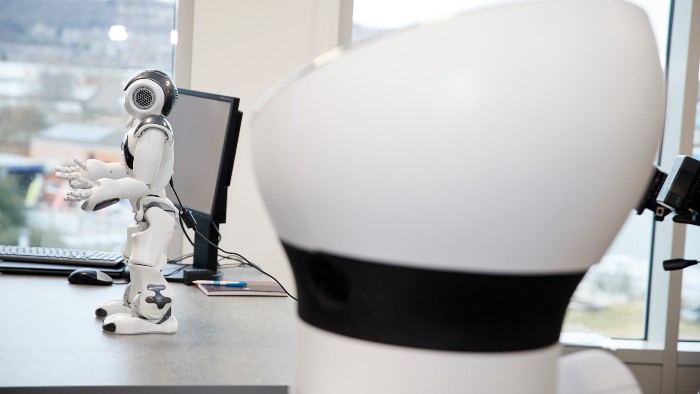
We are already putting that principle into practice. For more than a decade, researchers at Sheffield Hallam have worked with Sheffield Children’s Hospital to explore how intelligent robots can support children with disabilities. Elsewhere, our research is addressing inequalities in maternity care, exploring socially aware robots and developing trustworthy and secure autonomous systems.
Our €7.3 million PRIMI project is developing socially interactive autonomous robots that could support stroke rehabilitation, while other research is exploring how robots can learn and adapt in ways inspired by human development.
What connects these projects is not simply sophisticated technology. It is the human problem we are trying to solve. That distinction matters.
AI should help a clinician make a better decision, not remove clinical judgement. A robot should support someone recovering from illness or injury, not diminish their independence. Digital public services should become more responsive and equitable, not create new barriers for people who are already disadvantaged.
This is also why AI cannot belong to computer science alone.
The most important innovations of the next decade will emerge from collaboration between engineers, computer scientists, healthcare professionals, psychologists, social scientists, businesses, policymakers and – critically – the people who will actually use these technologies.
Our region is particularly well placed to build that model.
Through partnerships such as Sheffield Robotics, a collaboration between Sheffield Hallam and the University of Sheffield, and initiatives across the region's growing technology ecosystem, we have the ingredients to become an international reference point for responsible AI and robotics.
The opportunity is economic as well as social. Research and innovation can help businesses become more productive, create new industries and attract investment. But if we want those benefits to reach communities across South Yorkshire, we must invest in people alongside technology.
That means giving workers opportunities to develop new skills. It means helping businesses understand and adopt AI responsibly. It means ensuring young people can see themselves as creators of the technology of the future, rather than simply consumers of it.
The launch of CEAIR comes at an important moment. South Yorkshire has the talent, research expertise, industrial heritage and ambition to help shape what comes next. As Mayor Oliver Coppard said when he officially launched the Centre this week, we cannot afford to sit on the sidelines while decisions about the future are made elsewhere.
Our ambition should therefore be bigger than becoming a region that adopts AI. We should become a region that helps define what good AI looks like. That means innovation with responsibility. Economic growth with inclusion. Automation with humanity.
Our region can be at the forefront of that future. But we will only achieve it by working together – universities, businesses, public services, policymakers and communities.
AI is a means, not an end. The real opportunity is not to build machines that are increasingly capable for their own sake, but to use those capabilities to tackle some of the challenges that matter most to people.