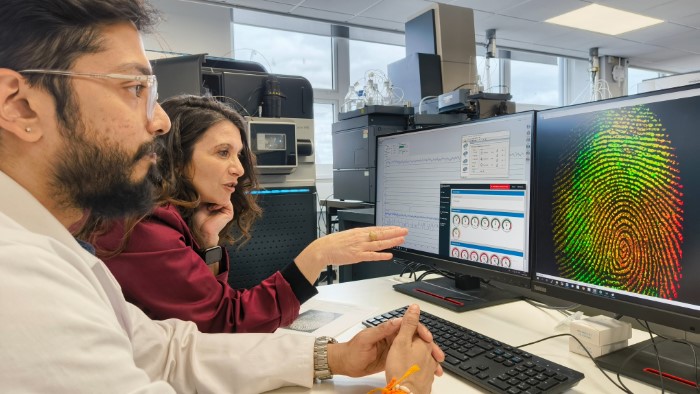
The new forensic technology, developed through a research collaboration led by Sheffield Hallam University, goes further than traditional fingerprinting techniques, utilising ‘molecular fingerprinting’ to provide molecular images of fingermarks through visualising the chemical traces left behind in a person’s sweat when they touch a surface.
The iFIS (Intelligent Fingerprint Imaging System) is the first software dedicated to fingerprint imaging using Matrix Assisted Laser Desorption Ionisation Mass Spectrometry Imaging (MALDI MSI), pioneered by Sheffield Hallam University. This newly developed smart AI-based software uses MALDI MSI technology to generate multiple images – hundreds, or potentially thousands – of the different molecules present in a fingermark, for iFIS to find high quality molecular fingerprint images in seconds.
The development of the software makes MALDI MSI fingerprinting technology accessible to the police for the first time, with iFIS increasing the likelihood that fingerprint images are viable for identification, which also includes fingermarks that may not have been previously visible to the naked eye after the application of traditional techniques.
The work to develop the new technology was led by Professor Simona Francese from Sheffield Hallam University’s Biomolecular Science Research Centre, renowned for her pioneering research in molecular fingerprinting.
She said: “Fingerprints are still a primary form of evidence in any crime, but not all fingermarks collected at scenes of crimes may be suitable for identification. According to a recent police report, only 79 per cent of fingermarks collected in a 12-month period across 43 police forces could be used for identification.
“The development of iFIS allows expert analytical chemists and police fingerprint experts to quickly recover and obtain high-quality fingerprint images to search against the Police National Database. Furthermore, it maximises the chances of providing a good quality image by stitching or super-imposing different images to complete the ridge pattern. Working together, MALDI MSI and iFIS also provides a unique opportunity to separate originally overlapping fingerprints - this is incredibly useful eliminate for example, a victim's fingermark from that of a perpetrator.”
The research underpinning the development of this software was a collaboration between Sheffield Hallam University, The University of Bradford, Molecular Discovery Ltd, global mass spectrometer manufacturer Waters Corporation Ltd and the Yorkshire and Humber Regional Scientific Support Services team based at West Yorkshire Police, who have become the first UK force to trial the new technology.
Pete Arnold, Director of Yorkshire and Humber Regional Scientific Support Services, said: “We were pleased to support the development and early testing of this innovative technology and welcome any advancement that strengthens our ability to recover evidence, protect victims, and bring offenders to justice.”
Professor Hassan Ugail, Director of the Centre for Visual Computing at the University of Bradford, led the work to develop the AI image recognition algorithm which - trained on a large dataset graded by forensic experts - that allows iFIS to process and analyse molecular images within seconds.
He said: “iFIS can automatically assess fingermarks for their suitability as evidence, even when traditional fingerprinting methods fall short. To do this whilst reducing human error, costs and processing times, gives law enforcement a powerful new tool, all from the faintest touch.”
It is estimated that iFIS could cut image processing costs by 88 per cent by reducing the processing time from 2 hours to an estimated 15 min, and report writing costs could be reduced from 1 hour to 10 min. It can deliver this whilst providing prints with the highest amount of ridge detail available for fingerprints used for identification.
Dr. Simon Cross from Molecular Discovery Ltd, said: “We are extremely happy to have brought together our Mass Spectrometry chemical software expertise along with the forensic knowledge of Sheffield Hallam University and the artificial intelligence expertise of the University of Bradford to produce iFIS and we would like to thank UK Defence Innovation for making the project possible and West Yorkshire Police for their collaboration.”
Professor Francese added: “Molecular fingerprinting is already proving its worth, having been deployed in some police investigations of major cases in the UK and overseas, and is featured as Category B process for fingerprint visualisation in the UK Government’s Fingermark Visualisation Manual.
“Although iFIS has been developed to enhance the biometric information supporting suspect identification, the technology behind it can also provide contextual information such as lifestyle, physiological, pharmacological and pathological information, all from a fingermark alone. We will continue to work to build the ‘chemical criminal profiling’ capability into iFIS in our next developments to further inform police investigations.”