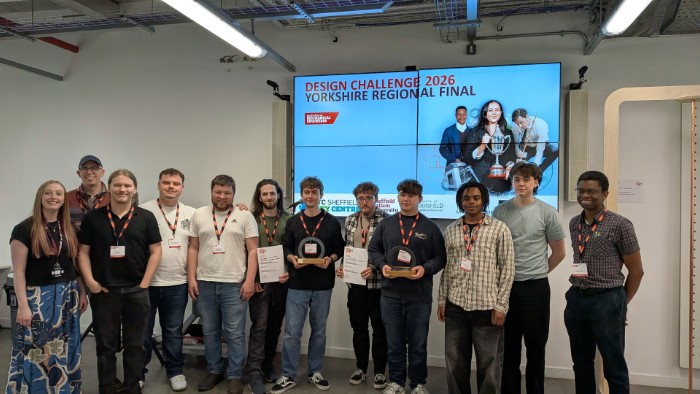
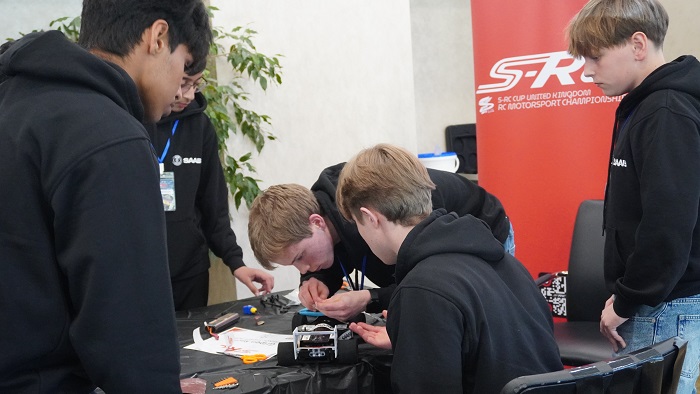
Competing against teams from the University of Huddersfield and Sheffield University Technical College (UTC), Sheffield Hallam teams won both the Foundation and Advanced categories, demonstrating technical excellence, teamwork, and professional engineering practice.
The teams were made up of foundation-, first- and second-year Mechanical Engineering students.
The winners of the Foundation category built an autonomous vehicle designed to lift a chain up a pipe, pause at the top, and return to the base of the frame, using only analogue (non-programmable) electronics. The team comprised Harry Milburn, Sam Yates, Jayden Jordan-Wells and Alex Steer.
The winners of the Advanced category built an autonomous vehicle which aimed to complete a complex, multi-stage mission using programmable electronics, demanding a higher level of systems integration and control. The team comprised Isaac Haslam, Alexander Brown-Roche, Haydn Blakemore, Jack White and Jude Black.
Isaac Haslam, Advanced category team manager, said: "The Design Challenge has been an incredibly valuable experience for me, as it bridged that gap between classroom knowledge and a real technical problem. It not only improved my application of engineering theory but also my professional skills like presentations, project documentation, and team management.”
The teams were supervised by Dr Jonathan Scholey, Dr Stephen Agha and Dr Megan Kendall.
Dr Jonathan Scholey, Senior Lecturer in Mechanical Engineering, said: “The level of technical challenge in this year’s competition is very high and to get two vehicles competing in, and winning both categories of, the regional final is fantastic. The students should be proud of their hard work, commitment and achievements in the competition.”
The IMechE Design Challenge gives students from universities and UTCs a taste of real-world engineering. Teams are challenged to design, build, present and operate a device to a strict technical specification within a defined timeframe. The challenge is designed to complement the academic curriculum, helping students to develop:
- practical engineering competence
- realistic industry experience
- employability, business and people skills