Funded by the National Institute of Health and Care Research (NIHR) and led by the Universities of Newcastle and Birmingham, the NIHR Inequalities Challenge: Maternity Disparities Consortium will unite higher education, NHS, community and voluntary organisations to close the most critical gaps in maternal care.
The NIHR has committed £50 million over five years to drive forward the vital research led by clinicians, researchers, and communities across the consortium, marking the most significant step forward in maternal health research in a generation.
The launch comes at a pivotal moment for maternity care in the UK, with national attention increasingly focused on improving safety, equity and women's experiences of care.
The Government's renewed
Women's Health Strategy highlights the need to improve care before and between pregnancies for marginalised communities, against this backdrop, the consortium will generate the evidence, interventions and research capacity needed to help translate national ambition into practical, equitable improvements for women, babies and families.
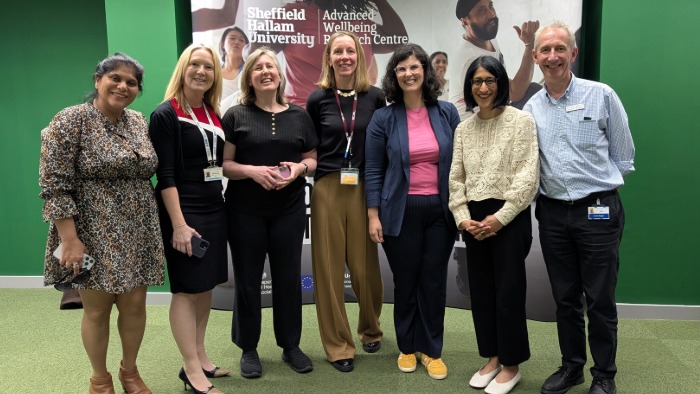
Sheffield Hallam University is a partner in the consortium, leading the “Perinatal Mental Health & Psychosocial Wellbeing (PMH) work programme within Theme 2: Pregnancy, birth and early postnatal maternal health” and co-leading “Digital, Economics, Data Linkage, Analytics and Implementation science (DELTA) Core function”. The university brings expertise in maternal health, midwifery and public health with digital technologies, artificial intelligence, behavioural science and physical activity to address inequalities through interdisciplinary, cross-sector collaboration, grounded in community engagement and partnership with charities and local authorities.
Through rigorous research and innovative approaches, the team will focus on understanding care pathways and developing innovative solutions to reduce disparities before, during and after pregnancy; with particular emphasis on maternity care models, perinatal mental health and healthy lifestyles.
The Sheffield Hallam project team, led by Professor Hora Soltani from the School of Health and Social Care, brings together expertise from across the University including Dr Marlize De Vivo (Principal Research Fellow: Emerging lead within theme 2), Dr Frankie Fair (Research Midwifery Fellow and data analyst for PMH) and Professor Alessandro Di Nuovo (Professor of Machine Learning: Co-lead for DELTA). DELTA underpins the consortium’s analytical approach, enabling the effective use of linked national data, equity-focused analysis and real-world evaluation to generate scalable, actionable improvements in maternal health outcomes.
Professor Judith Rankin OBE, Consortium Co-lead for Research and Capacity Development, Newcastle University: "This funding represents a critical opportunity to make the step change we need to improve outcomes for women and their babies. Alongside the research, the consortium will be investing in tomorrow's research leaders today to ensure we have the capacity to deliver on improving pregnancy outcomes, access to, and experience of, care."
Professor Joht Singh Chandan, Consortium Co-lead for Research, University of Birmingham, said: "National attention on maternity safety and equity has never been greater, but ambition must now be matched by evidence and implementation. Through this consortium, we will work across the UK to understand what works, for whom and in what contexts, and to ensure that research leads to practical changes in care for the women, babies and families who need them most."
Professor Hora Soltani MBE, Lead for Perinatal Mental Health and Psychosocial Wellbeing within the consortium, and the Director for Maternal and Infant Health Equity Research Centre (MIHERC) at Sheffield Hallam University, said: "We recognise this is not an easy task, given the longstanding disparities in maternity care and outcomes, but we are delighted to play a key role in advancing this ambitious NIHR Maternity Challenge programme, driving transformative change to improve equity for mothers and families while building sustainable infrastructure and capability for the future."
Key areas of research:
Before and between pregnancies (Preconception and Interpregnancy care)
The consortium will examine how women and families can be better supported before pregnancy and between pregnancies. This includes improving access to advice and care that can help people prepare for pregnancy, manage existing health conditions and reduce risks before they build up.
Pregnancy, birth and early recovery after birth
Research will focus on improving care during pregnancy, birth and the early weeks after birth. This will include work on major causes of poor maternal health, such as high blood pressure, diabetes in pregnancy, obesity, perinatal mental health and complications during recovery after birth.
Care for babies and families after birth
The consortium will develop and test better ways to support babies and families who are at higher risk of poor outcomes. This includes improving follow up care after birth, strengthening links between hospital and community services, and supporting families as they move from maternity and neonatal care into longer term child and family support.
Access, communication and experience of care
The programme will look at how services can be easier to access, easier to understand and more responsive to women and families. This includes improving communication, language support, shared decision making and the overall experience of care, particularly for those who are least well served by current systems.
Tackling racism, discrimination and unfairness
The consortium will ensure that research directly addresses racism, discrimination and other forms of unfairness that affect maternity care and outcomes. This will be built into how interventions are designed, delivered and evaluated.
Working with communities
Women, families and community organisations will help shape the research from the beginning. The consortium will work with peer researchers, charities and community partners to make sure the work reflects real experiences and is useful to the people most affected by maternity inequalities.
Using data and evidence to drive change
The programme will use data, digital tools, health economics and real-world evaluation to understand what works, for whom and in what circumstances. This will help identify practical changes that can be delivered fairly and scaled across different parts of the UK.
Maternal health inequalities remain one of the most pressing challenges facing the NHS. In the UK, black women continue to face a substantially higher risk of dying during or after pregnancy than white women, and women and families living in the most deprived communities continue to experience poorer outcomes. These inequalities are not inevitable. The NIHR Maternity Disparities Consortium will bring together clinicians, researchers, women, families and communities across the UK to develop practical, evidence-based solutions that can improve care, reduce avoidable harm and support better outcomes for mothers, babies and families.