Contact us
For help with a story or to find an expert
Email: pressoffice@shu.ac.uk
Phone: 01142 252811
On social media
Watching Christmas film and TV is just as important as putting the decorations up – National Folklore Survey reveals top 10 Christmas Traditions
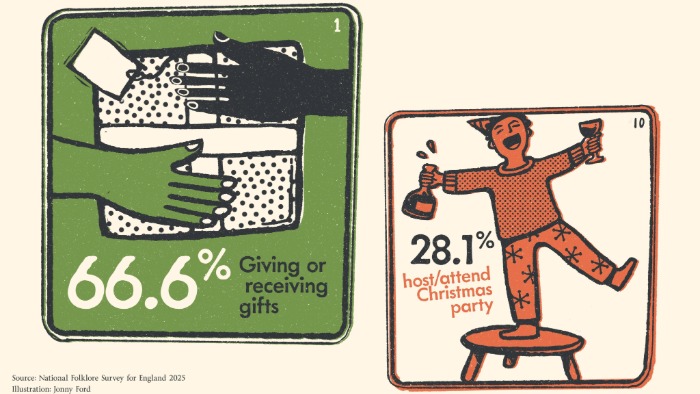
The survey found that the most popular Christmas activities were exchanging gifts (66%), having a Christmas meal (63%) and putting up a Christmas tree (58%).
The second most popular traditions, all participated in by 57% of people, were watching Christmas film and TV, decorating the house for Christmas, and visiting or hosting family and friends over the festive period.
Dr Diane A. Rodgers, Senior Lecturer in Media from Sheffield Hallam University, said: “I expected that Christmas film and TV viewing was likely to be one of the biggest participated-in festive customs, but I'm really surprised that our results show that people said it was equally as important to them as decorating their home or even visiting family and friends.
“I know lots of people go to the cinemas to see special screenings of classic films like It’s a Wonderful Life, a film which famously flopped at the box office when it was first released in 1946, and every year the popular debate of whether Die Hard (1988) counts as a Christmas film seems to resurface.”
Led by academics from Sheffield Hallam University, the University of Hertfordshire, and Chapman University, USA, the National Folklore Survey captures an accurate snapshot of contemporary folk culture in England, more than 60 years after the last Survey of English Language and Folklore, that was launched in 1964.
Dr Ceri Houlbrook, Senior Lecturer in Folklore and History from the University of Hertfordshire, said: “If we define folklore as the customs we practice, the stories we tell, and the beliefs we hold, it’s easy to see folklore in much of what we do during the Christmas period. Not everybody celebrates Christmas and, as the survey shows, those who do celebrate it don’t all practice the same customs, tell the same stories, or hold the same beliefs about it.
“All of these vary depending on a person’s age, gender, ethnicity, religion, and where in England they live. But there is one tradition that seems to cut across these categories: encouraging the belief in Father Christmas. This could be through sitting with a child as they write a letter, leaving out offerings such as mince pies, carrots or other treats on Christmas Eve in thanks to the jolly gift-giver and to fortify him for a long night ahead. More recently, it can be through digitally tracking Santa’s progress via satellite. However belief in Santa is encouraged, it demonstrates a persistent desire to keep the magic of Christmas alive.”
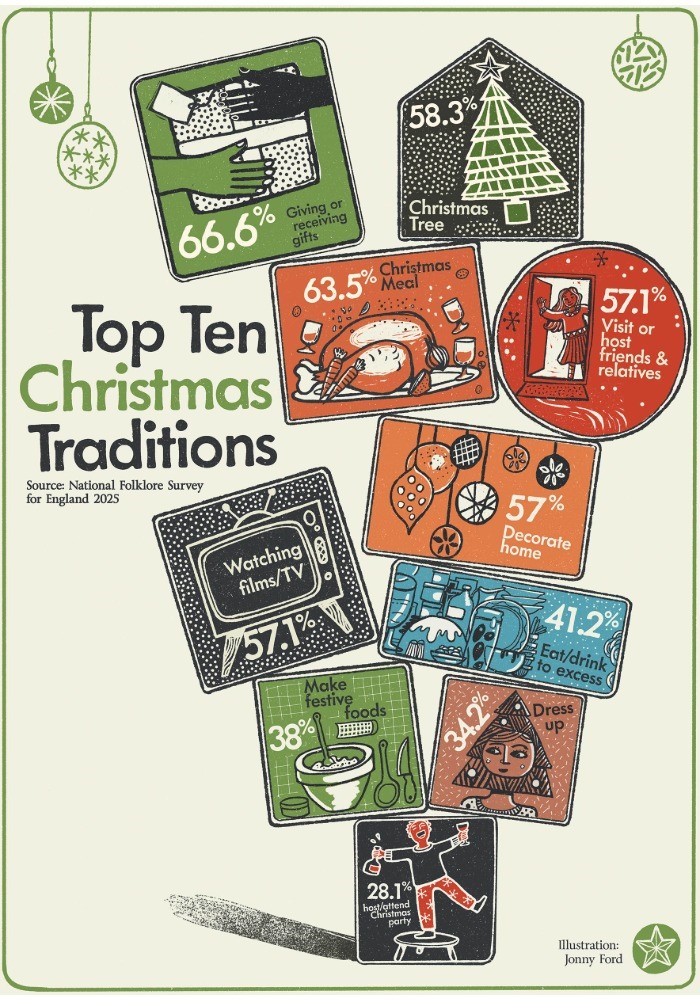
Top 10 Christmas Traditions
Findings from the survey show that the top 10 Christmas traditions in England are:
- Giving or receiving gifts 66.6%
- Having a Christmas meal 63.5%
- Decorating a Christmas Tree 58.3%
- Watching films/TV 57.1%
- Visiting or hosting friends and relatives 57.1%
- Decorating the home for Christmas 57%
- Eating/drinking to excess 41.2%
- Making festive foods 38%
- Dressing up 34.2%
- Hosting or attending a Christmas party 28.1%
The average number of Christmas traditions respondents reported they take part in was six of a list of 19 options they were given. Women were more likely to engage in more Christmas traditions, with an average of 7.6, compared to men at 5.4.
People aged 55-75 are the most likely to decorate a tree, have a Christmas meal, give gifts, watch Christmas TV and films, and visit or host family and friends – but were the least likely to participate in Secret Santa.
The youngest age group, 16-24, are the most likely to take part in Secret Santa and the most likely to report not taking part in any other Christmas activities from the list.
Of the 57% of respondents who said they watch Christmas films and TV as part of their festive activities, almost all said that this was fairly or very important to their family traditions.
Around a fifth of people said that they had adopted a new Christmas tradition because of something they had seen in a film, television or online media, with these new traditions most likely in the 25-34 age group.
Dr Diane A. Rodgers said: “One of the most interesting results was that almost 20% of people (roughly 8 million) said that they have adopted a new Christmas tradition specifically because of something they have seen in film or television.
“Think about how many people routinely wear Christmas jumpers throughout December these days, the popularisation of which I think can be directly linked to the Bridget Jones or Nativity films. That's a huge cultural impact of what we could call 'the Bridget Jones effect', especially given a new statue of the character has just been unveiled in London's Leicester Square. Other media-driven traditions might be sillier examples like 'Festivus', invented by the TV sitcom Seinfeld, which is an alternative to the commercial side of the season.”
Contact us
For help with a story or to find an expert
Email: pressoffice@shu.ac.uk
Phone: 01142 252811