

Everything you need to know...
-
Tuition fees
International/EU: £18,900 per year
-
Course duration
11 Months
-
Study location
-
Start date
September 2027
Course summary
- Gain a thorough understanding of global healthcare challenges.
- Develop knowledge, skills and values to enhance your employability.
- Build on your existing skills to become an effective healthcare professional.
- Share your knowledge and make a contribution to nursing practice.
This one year course has been designed for students who have completed a nursing diploma (or equivalent) overseas. You’ll enhance your skills while gaining a UK honours degree. You'll study modern nursing and its challenges in depth, while preparing to make a worthwhile contribution to the field.
How you learn
On this course you'll reflect on the challenges faced by modern nursing, developing the skills to innovate, lead and improve services. You’ll be encouraged to link the theory and practice of nursing. At the same time you'll help others to improve their own health, wellbeing and lives.
You’ll learn from positive and enthusiastic academic staff who have varied clinical expertise and experience. Throughout the course you'll engage in personal and professional development, with the opportunity to explore career paths.
You learn through
- workshops
- seminars
- simulation
- role play
- key skills practice
- active reflection
- discussion of case studies
- independent learning
Applied learning
Networking opportunities
Some of the modules undertaken on this course will be with UK nursing students. This provides further opportunities to explore global health issues from different perspectives.
Modules
Module and assessment information for future years is displayed as currently validated and may be liable to change. When selecting electives, your choices will be subject to the core requirements of the course. As a result, selections may be limited to a choice between one of two or more specified electives in some instances.
Final year
Compulsory modules
On completion of this module you will have in depth underpinning knowledge of the theory of clinical reasoning and through utilization of problem solving and information gathering skills you will be able to critically discuss the application of clinical decision making in practice.
INDICATIVE CONTENT
- The theories, concepts and methods that underpin patient centred clinical reasoning and decision-making processes
- The types and levels of information and their relevance to decision making and patient management
- Approaches to holistic assessment and communication strategies (including issues related to care environments, counselling, bereavement, long-term illness and disability)
- Rehabilitation, health education and health promotion for patients and carers in different environments
- Legal and ethical issues related to patient assessment and management
To develop the student's ability to lead and manage care, utilising psychological science and communication models to ensure high quality service provision for people with complex needs.
SUGGESTED INDICATIVE CONTENT
· Self-awareness and professional development in relation to leadership style, e.g. reflection and completion of self-assessment tools.
· Maintaining relationships;
o in difficult situations: refusal for treatment, raising concerns regarding standards of practice and conflict resolution;
o when managing change.
· Leadership skills to provide high quality dignified and compassionate care.
· Leadership skills for building resilience in teams.
· Leading and managing complex systems and processes
· Application of psychological theories and communication strategies for leadership.
· Developing relationships that cross professional boundaries.
· Quality assured care.
· Management skills - delegating, prioritising, preparing for autonomous practice, time management.
· Leadership and Management theories.
· Evaluating clinical risk
· Safe decision making in complex need situations
· Pharmacology
· Innovation
· Human factors training
· Student management of assessment, recognition and treatment (SMART)
· Nursing/clinical skills development
Employability attributes addressed in this module
- Professional values.
- Critical thinking.
- Personal resilience.
- Team working.
- Planning & organising.
- Problem solving.
- Communication.
- Creativity.
- Flexibility.
- Self-awareness.
- Self-management.
- Influencing & negotiation.
- Critical reflection.
- Personal Development Portfolio.
To critically apply knowledge and skills in order to respond to socio-political dimensions of Public Health for people of all ages, in all the fields of practice within a variety of care settings.
SUGGESTED GENERIC INDICATIVE CONTENT
- Public Health policy and sociological concepts.
- Health inequalities and vulnerable groups.
- Expert patient.
- Complex and diverse health and social care needs.
- Motivational interventions and interviewing.
- Communication for collaborative care.
- Partnership working with Health and Social care agencies and the voluntary and independent sectors.
- Anti discriminative practice.
- Needs of clients across the lifespan
The aim of this module is to enable you to build on previous learning and to apply knowledge and skills in utilising, generating and evaluating nursing evidence in your chosen study.
INDICATIVE CONTENT
This module will build on previous research skills gained at levels 4 and 5 and provide you with the foundations for generating and evaluating evidence in order to gain a deeper understanding of evidence based practice. You will cover the following topics
Research approaches, methods and designs; Experimental (e.g. Randomised Controlled Trials), Non - Experimental (e.g. Observational / Survey/ Longitudinal - Cohort Study), Ethnography, Phenomenology, (e.g.Narrative Enquiry, Case Studies, Action Research, Grounded Theory).
Research terms: e.g. Variables (independent, dependent, confounding), central tendency, Power, Internal consistency
Sampling: Quantitative designs; Probability (e.g. Random/Stratified), Non-Probability (e.g. Convenience), Qualitative designs (e.g. Purposive), Recruitment process.
Data collection methods/tools, e.g. Interviews(unstructured, semi-structured), Focus groups, Observation, standardised assessments/ outcome measures, Internet
Qualitative Data analysis: e.g. Thematic /Framework analysis, Content analysis, Interpretative Phenomenological analysis
Statistics and Quantitative data analysis; descriptive statistics, Inferential statistics (e.g. p-value), Measures of Level and Spread (e.g. Reliability, Validity, Range),selecting appropriate tests & scales (e.g. Chi-Square, ANOVA, t-test, Mann Whitney, Wilcoxon, Spearman, Pearson)
Literature review; using advanced databases and searches, sources of evidence, appraising evidence, approaches for quantitative literature (e.g. systematic reviews), approaches for qualitative literature (e.g. meta-analysis/ meta-synthesis), presentation of findings
Critical appraisal tools and guides: application/use, hierarchy /quality of information & evidence
Proposal: research proposal plan/ development (research question/ Hypothesis/Null Hypothesis, Aims and Objectives, Gantt chart), research design /methods, interventions/tools, sample recruitment, data collection/tools and analysis, dissemination of results etc.
Research Governance and Ethics; improving/ maintaining quality, ethical issues, confidentiality, informed consent, mental capacity, Hawthorne / Placebo effect.
Organisations; involved in research development and funding, application process, ethics
To enable you to critically evaluate service provision and appraise leadership skills which contribute to the implementation of service improvement
INDICATIVE CONTENT
- Quality improvement methodology and evaluation
- Leadership and entrepreneurial skills for collaborative service development
- Service user and carer involvement
- Contemporary policy drivers for integrated services and collaborative working
Future careers
This course prepares you for a career in
- nursing
- further studies
- specialist nursing
- education
Equipment and facilities
On this course you work with
- simulated learning environments
- clinical suites
- Oxford Medical Simulation - Virtual Reality software
We’ve invested over £100m in new facilities to help you study how and when you want. This means 24-hour libraries and study spaces designed by our students.
360 tour - nursing and midwifery facilities
Where will I study?
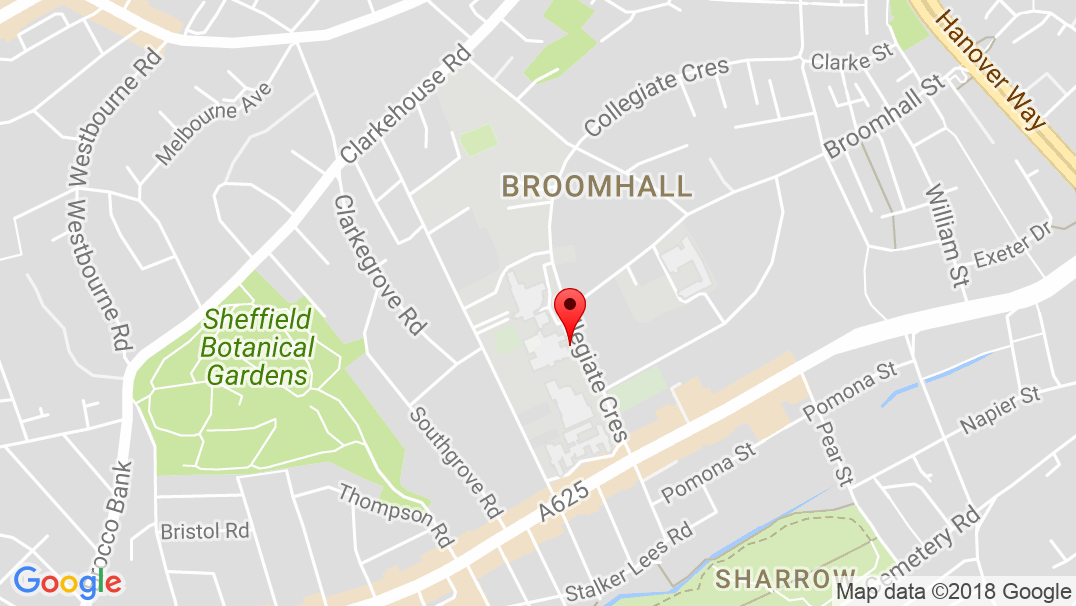
You study at Collegiate Campus through a structured mix of lectures, seminars and practical sessions as well as access to digital and online resources to support your learning.
Collegiate campus
Collegiate Campus can be found just off Ecclesall Road, a bustling student district.
Collegiate Campus map | Campus facilities

Collegiate library
Collegiate Library can be found just off Ecclesall Road. It's open 24 hours a day, every day.
Learn moreEntry requirements
All students
Normally, applicants will hold a Diploma with 70% in all years and will have passed their placement year.
International students require an IELTS score of 6.0 with a minimum of 5.5 in each skill area.
Additional information for EU/International students
If you are an International or non-UK European student, you can find out more about the country specific qualifications we accept on our international qualifications page.
For details of English language entry requirements (IELTS), please see the information for 'All students'.
Fees and funding
International students
Our tuition fee for International/EU students starting full-time study in 2027/28 is £18,900 per year.

Financial support for home/EU students
How tuition fees work, student loans and other financial support available.
Additional course costs
The links below allow you to view estimated general course additional costs, as well as costs associated with key activities on specific courses. These are estimates and are intended only as an indication of potential additional expenses. Actual costs can vary greatly depending on the choices you make during your course.
General course additional costs
Additional costs for Health and Social Care (PDF, 371.2KB)Legal information
Any offer of a place to study is subject to your acceptance of the University’s Terms and Conditions and Student Regulations.