The results from the National Folklore Survey for England released today (Monday 9 February), focus on love and luck as Valentine’s Day 2026 falls the day after a Friday the 13th.
Led by academics from Sheffield Hallam University, with the University of Hertfordshire, and Chapman University, USA, the survey captures an accurate snapshot of contemporary folk culture in England, more than 60 years after the last Survey of English Language and Folklore, that was launched in 1964.
Project lead Dr David Clarke, Associate Professor at Sheffield Hallam University, said: “Belief and traditions about love and luck are fundamental to many people because they provide a sense of agency, connection and psychological security in a world that often feels chaotic and unpredictable.”
Valentine’s Day and love
The National Folklore Survey for England found that 49% of people celebrate Valentine’s Day either always or sometimes. With those aged 16-34 most likely to celebrate, with chances of celebrating decreasing with age.
However, celebrating Valentine’s Day seems to cut across genders, regions, and ethnicities, with no significant differences in these categories.
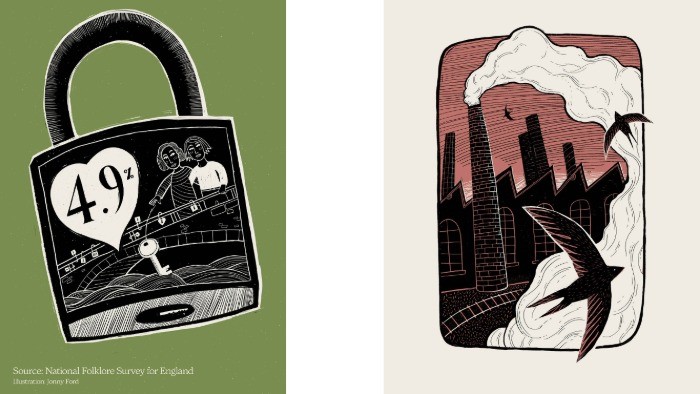
The survey also found that roughly 2 million people in England (4.9%) have attached a love-lock to a bridge, a padlock typically engraved with a couple’s names or initials as a statement of romantic commitment.
Dr Ceri Houlbrook, Lecturer in History and Folklore at the University of Hertfordshire and author of Unlocking the Love-Lock, said: “We don’t really know where and when the love-lock custom began – lots of places claim to have the “original” love-lock bridge – but we do know it became popular in the 2000s, following its appearance in an Italian teenage romance novel.
“It fascinates me that a custom sparked in another country less than two decades ago has been practiced by 2 million people in England. The other intriguing thing about our data is that it shows you’re most likely to love-lock if you live in the Northwest, and more likely if you’re Hindu, Sikh, or Muslim.”
Friday the 13th
A quarter of people in England (23.9%) believe that Friday the 13th is an unlucky day, however 8.5% of people actually believe it’s lucky when the 13th falls on a Friday.
Those most likely to believe that Friday the 13th is unlucky are women, aged 16-24, and white.
Dr David Clarke, Associate Professor at Sheffield Hallam University who leads the survey team, said: “The idea that Friday the 13th is unlucky stems from a recent combination of two older beliefs: A fear of Friday that dates back to the Middle Ages and a more recent dislike of the number 13.
“A fear that Friday was unlucky possibly stems back to the Catholic tradition that Friday was a day for penance, by the 18th century the belief had spread to the extent that many people believed that Friday was an unlucky day to be born, get married, or begin any business or journey.
“There are different explanations as to why 13 is considered unlucky in some cultures, including beliefs around the fact there were 13 people at the Last Supper, and some Pagan connotations such as there being 13 witches in a coven, or the death card being the 13th tarot Major Arcana card.”
Luck and lucky traditions
When it comes to luck and traditions, the most common ritual was touching wood, as a sign that you do or do not want something to happen, 35% of people said they did this.
This was followed by not walking under a ladder (29%) and crossing your fingers (25%).
Over 40% of people say they have carried something with them for good luck. The most common type of object carried for luck comes from nature, including things like pebbles, crystals, and shells. The second most common type of lucky object was one associated with a loved one.
Professor Owen Davies, from the University of Hertfordshire, said: “One respondent said that they carried for luck a ‘small bullet that just missed me when serving in the forces’. The ‘lucky bullet’ as a protective talisman is an old tradition in the army, with many British soldiers in the First World War carrying one with them after a near fatal shot. Sometimes it was a pocket bible or locket that absorbed or deflected the bullet which became the lucky object.”
Other beliefs around luck from the survey include: 29% of people believe that breaking a mirror is bad luck, 27% of people believe that a black cat is lucky, and 20% believe it is lucky if a bird defecates on you.
Other beliefs around birds were present in the survey findings. Over half of people (51%) say that they take some action when they see a magpie, such as saluting, or speaking to them. And 13% believe that swallows, swifts, and house martins building a nest in the eaves of your home is lucky.
Dr Ceri Houlbrook, said: “In the 19th century, there were many in England who believed swallows, swifts, and house martins brought good luck to the home by building their nests in the eaves. I’d expected this belief to have fallen away, so I was pleasantly surprised to find that 5 million people in England still believe this. It’s interesting that you’re more likely to believe this the younger you are. Likewise, the age group most likely to carry lucky objects, such as crystals, pebbles, and acorns, and leave offerings in the landscape for luck are 25-34. Does this suggest that we’re returning to beliefs around the luck or magic of the natural world?”