
Everything you need to know...
-
Tuition fees
Home: £11,490 for the course
-
Course duration
2 Years
-
Study location
-
Start date
September 2027
Course summary
- Refine your craft as a filmmaker through masterclasses and expert tutoring.
- Learn from well-connected practitioners with excellent industry ties.
- Use industry-standard equipment and creative practices in a supportive environment.
- Gain skills in research, cinematography, production, directing and screenwriting.
- Develop your professional portfolio through collaborative filmmaking projects.
This course aims to produce a new generation of filmmakers – from directors and producers to location managers, TV researchers, cinematographers, sound designers and editors. We’ll help you develop your production-based creative and technical abilities, making sure you have the critical grounding and logistical skills the film industry requires. You'll graduate as an employable and connected filmmaking practitioner.

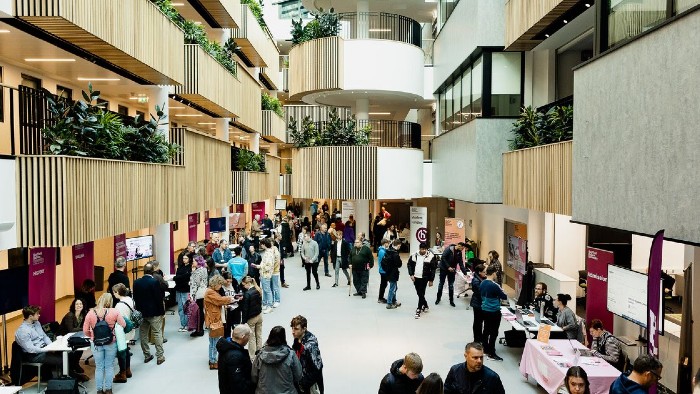
Come to an open day
Find out more at our postgraduate open days. Book now for your place.
Employability
94% of our postgraduate students are in work or further study 15 months after graduating (2023/24 Graduate Outcomes Survey)
How you learn
With a focus on producing your own film idea – underpinned by critical thinking and industry study – this course aims to create rounded filmmaking professionals. You'll work under the tutelage of practising directors, writers, editors, producers and cinematographers, and benefit from close industry connections to the likes of Creative England and Sheffield's international documentary festival Doc/Fest. You’ll receive support from the university for 18 months after graduation, helping you find work and boost your profile.
In-depth exploration of films, filmmakers and filmmaking practices from across the world will inspire and inform your development. You’ll follow an industry-standard research and development process while learning to pitch your ideas in a professional context. Working collaboratively with your peers – under the expert supervision of our staff team – you’ll make your own major film project, and present it at your own film festival.
You learn through:
- developing your own project
- production exercises
- workshops, lectures and seminars
- live projects
- independent study
- group work
- masterclasses
- attending pitching sessions
- self-reflection with learning journals
Key themes
In semester 1, you’ll take the Film Craft module, developing technical filmmaking skills with other artists in areas such as cinematography, sound, editing and collaboration. . Meanwhile, the Film Research & Development module introduces you to postgraduate-level research skills and supports you in a process of research and development towards an initial concept for your own film project.
In semester 2, you’ll continue to hone your filmmaking skills through the Technical Specialisms module, developing specialist technical skills by taking on production roles on peer or external film projects. You’ll also develop a Major Film Concept – supported by industry-focused learning and practices – culminating in a pitch presentation for your final project.
In trimester 3, you’ll develop your Major Film, under the supervision of a tutor. As part of this module, you’ll also work together to plan and deliver a short film festival, where you’ll present your own film work as the culmination of your work on the degree and as a model of industry-standard practice
Course support
You’ll be supported in your learning journey towards highly skilled, graduate-level employment through a number of key areas. These include:
- Access to our student support triangle to help with your personal, academic and career development
- Access to our Skills Centre with one-to-ones, webinars and online resources, where you can get help with planning and structuring your assignments
- Industry-specific employability activities such as live projects, learning in simulated environments and networking opportunities
Applied learning
Work placements
You’ll have opportunities to undertake work placements and get involved with projects with external partners, such as the BFI, Screen Yorkshire and DocFest.
Live projects
Your learning on this course is constantly applied to your own practice. You’ll use industry-standard practices for filmmaking and development across all modules.
At different points, you’ll engage with live briefs set by or working with local, national or global employers. As a Masters-level student, you’ll demonstrate a high level of independence, resourcefulness and rigour in your studies, developing professional skills which translate into the workplace.
Your assessments are modelled on real-world practices. These include the preparation of film work, and/or the presentation and pitching of ideas and materials, using industry-standard formats such as pitch decks, treatments, mood boards, mood reals and other ‘proof of concept’ materials.
Networking opportunities
This well-connected course benefits from excellent industry ties, including to Sheffield's world-renowned Doc/Fest.
All staff teaching across this degree have experience of professional practice, and many are currently active. Wherever possible, and in particular in the Major Film Concept module, the course draws on its industry friends and contacts to provide curriculum-enhancing guest talks, networking opportunities and feedback on your pitches.
Your course leader

Saskia Wilson
Senior LecturerSaskia is course leader and senior lecturer at Sheffield Hallam University teaching full time on BA Film and TV Production.
Modules
Important notice: The structure of this course is periodically reviewed and enhanced to provide the best possible learning experience for our students and ensure ongoing compliance with any professional, statutory and regulatory body standards. Module structure, content, delivery and assessment may change, but we expect the focus of the course and the learning outcomes to remain as described above. Following any changes, updated module information will be published on this page.
Year 1
Compulsory modules
This module will enable you to identify existing filmmaking skills and areas for development in a variety of practices, such as cinematography, sound recording, post-production editing, sound design, blocking, lighting and working with performers.
Working in our specialist studios and post-production facilities, you will make use of industry-standard equipment and emulate real-world practices, to develop and produce a short film in response to a creative brief.
You will explore a variety of collaborative approaches for working with filmmaking peers and other artists who may contribute to filmmaking processes (e.g. actors, musicians or designers), to simulate a real-world film set environment.
You’ll study topics such as:
- Technical skills audit and development
- Induction to equipment, spaces and working practices
- Short film project
- Collaborative working
This module will further develop your skills in cinematography, sound recording, post-production editing, sound design, blocking, lighting, interviewing, building sequences, and experimenting, enabling you to develop specialisms for future practice.
Following collaborative, creative and industry-standard working approaches, you will gain experience of a number of key film crew roles, and build your professional portfolio, by undertaking work on film projects in development by your peers, and externally.
You will critically reflect on your developing skills and identify areas for future development.
You'll study topics such as:
- Skills building and specialisation
- Induction to high end and specialist equipment
- Collaborative working
- Portfolio development
- Critical reflection on own practice
Final year
Compulsory modules
This module introduces you to the fundamentals of postgraduate level research. Lectures, seminars and workshops will introduce you to a broad range of films, filmmakers and filmmaking practices from around the world, as a basis from which you will be encouraged to develop your own research focus as a developing practitioner.
Alongside the development of traditional academic research skills and methodologies, you will consider research as a key part of film development and apply these practices to the development of your own original film concept.
You’ll study topics such as:
- Research methods
- Conducting literature and practice reviews
- Practice as research
- Research as film development
- Developing pitch materials
- Pitching ideas in development
Module Aim
This module enables you to fully realise an original film concept through the production of a comprehensive, high quality, new film project.
Under the supervision of specialist tutors and in collaboration with your peers and external partners, you will further develop and embed your specialism(s) as a filmmaker through industry-standard working approaches to the pre-production, production and post-production processes.
Alongside the development of your film work, you will collaborate with your peers to plan, organise and deliver a film festival, at which you will present your major film. This experience will develop your pitch style and enable you to explore ways of articulating your work.
Indicative Content:
- Tailored project supervision
- Festival planning and programming
- Project management
- Career readiness
This module embeds collaborative, creative and industry-standard working approaches that will further develop your original ideas into higher level, explorative, new film work. You will produce high quality, short-form, proof-of-concept materials that test your ideas and processes. You will be inspired by a diverse landscape of existing films, exhibitions, themes, styles and genres.
You will undertake in-depth study of pre-production processes, including scheduling, crewing, pre-visualisation, research, casting, location scouting and production design.
Engagement with industry professionals will support you in networking, career planning and pitching.
You’ll study topics such as:
- Concept development
- Contextual study
- Pre-production processes
- Pitching and presentation skills
- Career planning
Future careers
This course prepares you for a career in:
- film and television production
- film exhibition, distribution and festivals
- the broader creative industries
- marketing and communications
- teaching, academia or further study
Previous graduates of this course have gone on to work in independent production for the BBC, ITV, Channel 4, Netflix and the BFI.
Other graduates have gone on to work for companies such as:
- Working Title
- Lionsgate
- Illuminations
- Warp Films
- Tiger Aspect Productions
- True North
- Envy
- The Mill
- Spool
- 2AM Postproduction
And some have worked on feature films such as:
- Mission Impossible 7
- Everybody’s Talking About Jamie
- 1917
- Jurassic World Dominion
- You Were Never Really Here
Equipment and facilities
Our industry-standard facilities and equipment include:
- Apple and PC labs and AV edit suites with post-production software
- Avid Pro Tools, Apple Logic Pro and Adobe Creative Suite
- studios with lighting and greenscreen for shoots, set building and teaching
- Panasonic DVX200 cameras, Sony A7 series, FX6 and FS7II, and Amira
- sound equipment including Sennheiser Shotgun Microphones
- radio/lapel microphones such as the Sanken Cos11-D
- digital field recorders such as Zoom H5, Zoom F4 and F8
- experimental microphones such as the Aquarian H2A Hydrophone / contact mic, Telinga Parabolic microphones, binaural and ambisonic microphones
360 tour - film and TV facilities
Learn more about your department
Media, Arts and Communications Facilities Tour
Take a look around the media, arts and communication facilities at Sheffield Hallam University with lecturer Saskia Wilson.
Where will I study?
You study at City Campus through a structured mix of lectures, seminars and practical sessions as well as access to digital and online resources to support your learning.
City Campus
City Campus is located in the heart of Sheffield, within minutes of the train and bus stations.
City Campus map | City Campus tour

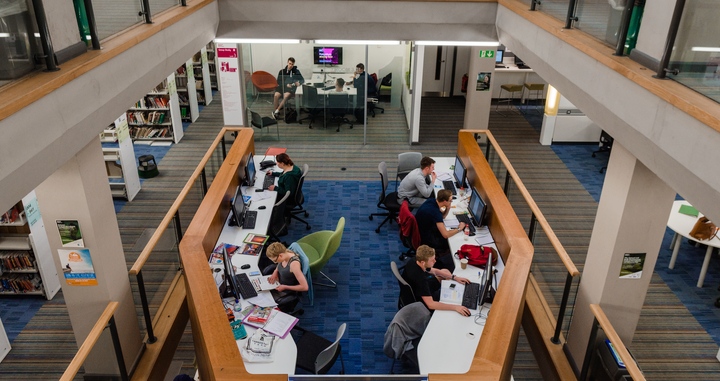
Adsetts library
Adsetts Library is located on our City Campus. It's open 24 hours a day, every day.
Explore the libraryEntry requirements
All students
An honours degree (2.2 or above) or equivalent in any subject.
An IELTS score of 6.0 with a minimum of 5.5 in all skills (or equivalent) is the standard for non-native speakers of English.
Additional information for EU/International students
This course is not open to international students who require a student visa to study in the UK. If you are an international applicant but do not require a student visa, email our Admissions Team to find out whether you’re eligible to apply.
Fees and funding
Home students
Our tuition fee for UK students starting part-time study in 2027/28 is £11,490 for the course. The tuition fee displayed above is for the full course. If the full course is more than one year in duration, the fee will be divided into annual payments which will then be rounded. This may mean the total fee you pay is slightly higher than the fee stated above. If you take a break in study or have to re-take part of the course, you may also be charged an additional fee and will be notified of this at the time. Our tuition fee for UK students starting part-time study in 2027/28 are: Year 1: £3,830 Year 2: £7,660.
If you are studying an undergraduate course, postgraduate pre-registration course or postgraduate research course over more than one academic year then your tuition fees may increase in subsequent years in line with Government regulations or UK Research and Innovation (UKRI) published fees. More information can be found in our terms and conditions under student fees regulations.

Scholarships and financial support
Find information on scholarships, bursaries and postgraduate student loans.
International scholarships up to £3000 ›
Alumni scholarships up to £2000 ›
Postgraduate loans for UK students ›
Additional course costs
The links below allow you to view estimated general course additional costs, as well as costs associated with key activities on specific courses. These are estimates and are intended only as an indication of potential additional expenses. Actual costs can vary greatly depending on the choices you make during your course.
General course additional costs
Additional costs for Sheffield Creative Industries Institute (PDF, 274.9KB)Legal information
Any offer of a place to study is subject to your acceptance of the University’s Terms and Conditions and Student Regulations.