
Everything you need to know...
-
Tuition fees
Home: £10,050 per year
International/EU: £18,900 per year -
Course duration
3 / 4 Years
-
Study location
-
Entry requirements
-
Course code
BB37
-
Start date
September 2027
-
Placement year available?
Yes
Course summary
- Learn how artificial intelligence informs strategic business decision-making.
- Understand how organisations improve performance with AI and data across leadership, strategy, HR and finance.
- Apply business and AI theory to real-world briefs, live projects and challenges.
- Build technical knowledge in data analysis, programming and AI tools.
- Become an adaptive decision-maker with practical skills and data-led thinking.
Learn from industry experts and research-active staff, with opportunities for placements and hands-on projects.
Our BSc (Hons) Business Management and Artificial Intelligence course combines core business management skills with artificial intelligence, data analytics and programming. With a strong focus on ethical and responsible application, you’ll get ready to lead change and make data-driven decisions that support business success in an AI-focused world.
If you haven’t yet met the entry requirements for the course - or you’d like extra preparation before starting degree-level study - you’re welcome to join the foundation year, which has been designed to encourage exploration and experimentation.
Employability
95% of our graduates are in work or further study 15 months after graduating (2022/23 Graduate Outcomes Survey).

Come to an open day
Discover our TEF Gold rated teaching and see why students voted Sheffield Hallam a top five university in England at the prestigious Whatuni Student Choice Awards.
Accredited by

Association to Advance Collegiate Schools of Business (AACSB)
Sheffield Business School is accredited by the Association to Advance Collegiate Schools of Business (AACSB). This internationally recognised accreditation places us among the top business schools globally.
How you learn
At Sheffield Hallam, all our courses are designed to engage you with the world and challenge you to think in new ways. You’ll get to collaborate with others, and you’ll be taught in a supportive environment where you can thrive.
The course prepares you for business roles where AI drives innovation – through applied learning, live projects and research-led teaching.
Your teaching team includes industry professionals and active academic researchers who deliver a supportive, practice-led education. The course includes real-world applied projects and supports a year-long placement, helping you develop the knowledge, experience and confidence you’ll need in your career.
You learn through:
- opportunities to engage with the external world
- problem-solving exercises
- class discussions and debates
- presentations by subject matter experts and peers
- group activities
- independent study
Follow our Sheffield Business School Instagram to see real student life, course experiences, events and what it is like to study here.
Key Themes
You’ll explore business themes such as strategic leadership, inter-cultural communication, responsible management and inclusivity. Alongside this you’ll study AI and computing subjects such as data analytics, procedural programming, software engineering and ethical AI implementation in business. You’ll also use simulations and games to explore operational challenges and strategic decisions.
Assessments are varied, inclusive and professionally aligned, with opportunities to shape your focus based on your interests.
Course-Level Support
You’ll be supported in your learning journey towards highly skilled, graduate-level employment through a number of key areas. These include:
- an academic adviser to support academic progress and personal development
- student support and careers resources during and after your studies
- our Skills Centre and library resources offering practical and technical help
- live projects, case studies and employer engagement throughout the course
- networking through the academic student society and alumni community
- continuous feedback to help build confidence and academic success
'My team has given me the autonomy to work on my own projects and lead on loads of different areas, which has helped me develop as a professional and as an individual.'
'The tools that Sheffield Hallam have for placement students and people looking for placements has been pivotal in me getting this placement at Jaguar Land Rover.'
Isaac Halls, BA (Hons) Business and Management
Applied learning
Work Placements
You’ll have the opportunity to arrange a year-long work placement in between your second and third years. This gives you valuable work experience to prepare you for your future career – as well as an Applied Professional Diploma to add to your CV.
Live Projects
You’ll undertake work experience at every level of the course. In level 4 this includes an applied project with an external organisation. At level 5 you’ll enhance your professional employability skills. At level 6 you’ll work on a live consultancy project with a client company, supported by tutors and the careers team.
Field Trips
We aim to offer field trips to a range of organisations – including local SMEs and multinational firms – helping you understand different workplace environments.
Networking Opportunities
You’ll engage with employers through guest lectures, alumni speakers, live briefs, field trips, careers events and student-led networks.
You’ll have the opportunity to take part in student competitions, and may be nominated for awards such as the Inspirational Student Award.
Student's success story

Sam Thompson, a BA (Hons) Business and Management student, gained hands-on experience on a year-long placement as an NHS Finance Officer, making a real contribution to the healthcare sector. Discover how his course and placement prepared him for a future in finance and business. Read more.
Your course leader

Lyle Odendaal
Senior LecturerLyle is a senior lecturer specialising in human resource management, leadership, and organisational development
Modules
Module and assessment information for future years is displayed as currently validated and may be liable to change. When selecting electives, your choices will be subject to the core requirements of the course. As a result, selections may be limited to a choice between one of two or more specified electives in some instances.
You will be able to complete a placement year as part of this course. See the modules table below for further information.
Year 1
Compulsory modules
This module introduces contemporary issues in business management, developing your awareness and understanding of factors affecting people and organisations in an ever-changing world. Teaching sessions will examine contemporary sources and debate current issues.
You’ll study topics such as:
-
Ethics and sustainability in business management
-
Geopolitics and globalisation
-
Changing business cultures and the role of stakeholders
-
Smart technology and big data
-
Business management research and approaches
-
Shifting communication channels
-
Economic controversies
This module introduces data analysis and the use of AI tools in a business context, using a range of software tools to help make informed ethically sound management decisions.
You’ll study topics such as:
-
Technology-driven data collection and analysis processes
-
Understand ‘data’ and analysis
-
Global strategic ethical business decision making
-
Data management practices and procedures
-
Ethical and environmental implications of data analysis and manipulation in the commercial world
This module introduces different types of businesses and organisations, focusing on operations, supply chain and marketing – developing academic literacy, business skills and future aspirations. You’ll work independently, within groups and in a real-world applied project, developing and applying academic and professional behaviours.
You’ll study topics such as:
-
Organisational types, scale and span
-
Responsible and sustainable practice
-
Business functions
-
Marketing
-
Supply chain
-
Operations management
-
Excel
-
Academic skills and advising
-
Employability and entrepreneurial advice
-
Applied reflective practice
This module provides you with the knowledge and insight to lead, develop and engage with a diverse workforce, operating across varied business contexts. You’ll also take part in a simulated international collaboration.
You’ll study topics such as:
-
Organisational behaviour and development
-
Ethical/legal/business case for equality, diversity and inclusion
-
Role of HR and line managers in developing people
-
Inclusive working environments
-
Employee engagement
-
Responsible, inclusive and ethical leadership
-
Intercultural management
-
Working and studying in other cultures
Year 2
Compulsory modules
This module will cover contemporary applications of artificial intelligence. It will give you an opportunity to explore and investigate a variety of real-world applications of AI technology in the business world. As well as investigating specific applications of AI, you will also be encouraged to design and develop your own AI applications by using and customising existing tools.
Typically, the module will cover:
-
The types of AI systems typically used in business, their advantages and drawbacks.
-
How AI can be leveraged to deliver improvements and efficiencies in the business environment, including workflows, product design, product prototyping, evaluation, advertising, human resources, chatbots, strategy development, data handling and analytics, forecasting, customer-experience, etc.
-
Evaluating fair and ethically aware AI technologies in the global business environment.
-
Specifying and developing custom AI applications using contemporary AI technologies.
This module enhances your professional development via work-related learning opportunities. You will gain interpersonal and business problem-solving skills that are key to successful graduate-level employment and learn about the business environment and the world of work.
The module will comprise teaching and individual supervision. Learners will undertake work-related activities e.g. work shadowing, volunteering, short placement, projects and so on.
Indicative content:
- Professional identity
- Reflective practice
- Problem-based research skills
- Teamwork
- Equality, Diversity and Inclusion
- Project management and report writing
- Networking
- Ethical practice
This module builds upon concepts and practical approaches introduced at level 4 and will prepare you for sandwich placement and for level 6 consultancy project.
This module develops theoretical understanding of performance management in organisations and equips you with a range of practical tools and techniques. You’ll work independently and in groups, actively interpreting and analysing both financial and non-financial performance management information.
You’ll study topics such as:
-
Financial and non-financial performance management data
-
Internal and external reporting
-
Planning and control systems
-
Accounting and control tools
-
Risk management
-
Sources and availability of finance
-
Environmental and economic analysis
-
Market forces and fair trade in a global context
This module introduces computer programming using the procedural problem-solving approach. The focus is on the design and implementation of programs using the procedural facilities of a programming language which is widely used for developing global AI and other software applications.
You’ll study topics such as:
- Procedural programming concepts: problem-solving, top-down design and functional decomposition.
- Software engineering concepts and processes such as software specification, design, implementation and testing.
- Algorithms and control structures: algorithmic design, control structures - sequence, repetition, selection.
- Procedures and functions: parameters, return values.
- Variables and Data Structures: variables and assignment.
- Basic Data Types: integer, floating point, character, Boolean, arrays.
- Python or a similar programming language used to develop artificial intelligence software.
Year 3
Compulsory modules
Module aim:
The aim of this module is to enhance students’ professional development through the completion of and reflection on meaningful work placement(s).
A work placement will provide students with opportunities to experience the realities of professional employment and experience how their course can be applied within their chosen industry setting.
The placement will:
- Allow student to apply the skills, theories and behaviours relevant and in addition to their course
- Enable students to enhance their interpersonal skills in demand by graduate employers – communication, problem-solving, creativity, resilience, team work etc
- Grow their student network and relationship building skills
- Provide student with insights into the industry and sector in which their placement occurs
- Help student make informed graduate careers choices
Indicative Content:
In this module students undertake a sandwich placement (min 24 weeks / min 21 hours per week) which is integrated, assessed and aligned to their studies.
Their personal Placement Academic Supervisor (PAS) will be their key point of contact during their placement and will encourage and support students to reflect on their experience, learning and contribution to the organisation they work for.
To demonstrate gains in professional development, students will be required to share their progress, learning and achievements with their Placement Academic Supervisor and reflect on these for the summative piece of work.
Final year
Compulsory modules
The aim of the module is to introduce students to the concepts of Business Intelligence and AI-driven data mining tools and techniques. A variety of AI-driven Business Intelligence tools and techniques, supported by relevant technologies will be covered.
Typically, this module will cover:
- Exploratory data analysis and visualisation of large data sets.
- Basic statistics and manipulation of data.
- Unsupervised and Supervised learning techniques.
- Evaluation of AI-driven data mining tools and techniques.
- Application areas may include customer retention, finance and fraud detection and others.
- The discussion and evaluation of Business Intelligence and its application to various areas of decision-making within an organisation in an ethically aware manner.
- A critical awareness of the wider sustainability issues of AI with regards the impact on the environment, including the UN SDGs.
This module will give you the opportunity to learn about and gain direct experience with an increasingly important and exciting facet of business – that of using business games and business simulations to facilitate insight and/or training into business operations.
Business simulations and business games have developed steadily from the 1970s. They provide opportunities to alter parameters to determine outcomes (cause and effect) as well offering platforms for training and scenario planning.
Typically, this module will cover:
-
Contemporary global business simulation and business game applications.
-
The benefits of using simulation and business game applications in a business context.
-
How to evaluate business simulation and business game applications.
-
How such systems work, including the effect of using data and applying artificial intelligence to these systems.
-
How to design and implement business simulations and business games using a variety of different technologies, tools and platforms.
This module applies your knowledge of contemporary business management, developing critical and analytical research skills to inform decision-making in a real-life setting. You’ll develop an individual research project with others in small groups – based on a live consultancy brief or your own venture – exploring relevant theories in large group sessions.
You’ll apply learning and skills such as:
-
Consultancy research
-
Entrepreneurial projects
-
Project design and management
-
Identifying discipline-relevant frameworks and concepts
-
Research methods, including ethics
-
Business report writing
-
Personal and professional reflection
This module enables you to critically evaluate how organisations develop and implement their strategies in a diverse, digital and global environment. We’ll look through the lens of real-life case studies that bring to life how organisations create their strategies, including applied environmental analysis in a volatile, uncertain, complex and ambiguous world.
You’ll study topics such as:
- Strategy process and its influencers in a global and digital environment
- Strategy development
- Complex organisational and environmental circumstances
- Risk analysis and mitigation
- Responsible and ethical decision-making
Future careers
You'll graduate equipped for leadership roles in industries that embrace AI transformation. The course prepares you for a career in:
- AI consultancy
- data analysis
- business intelligence
- AI project management
- digital transformation strategy

All in on your career
We promise you’ll be ready to launch your career. With employer connections, hands-on learning and lifelong career support, we’ll help make your ambition a reality.
Equipment and facilities
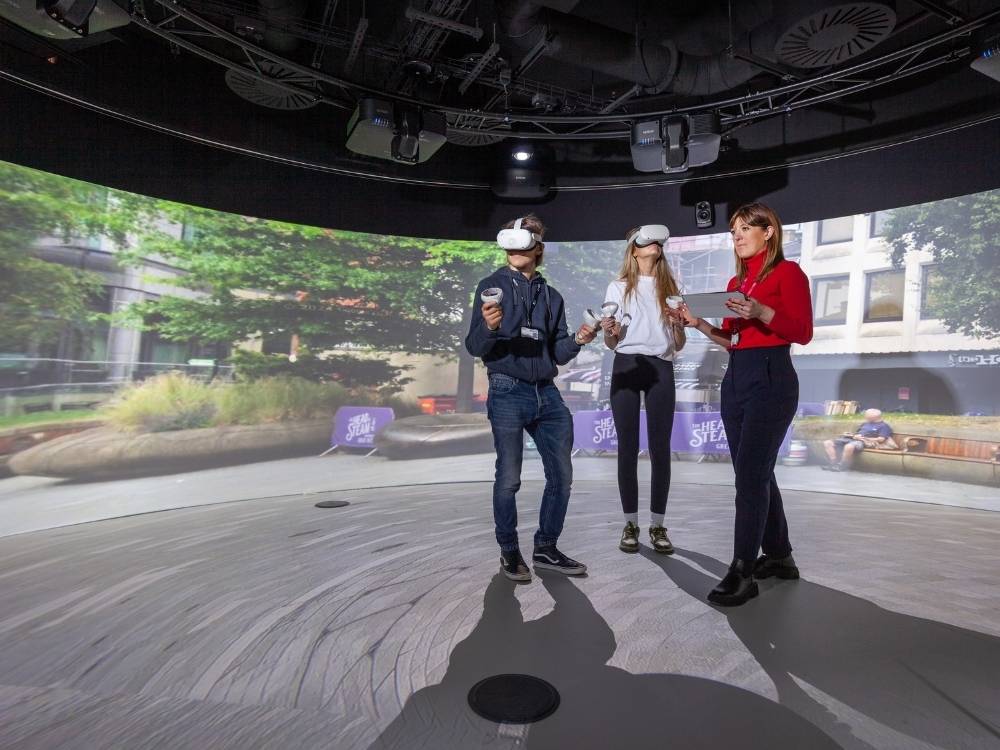
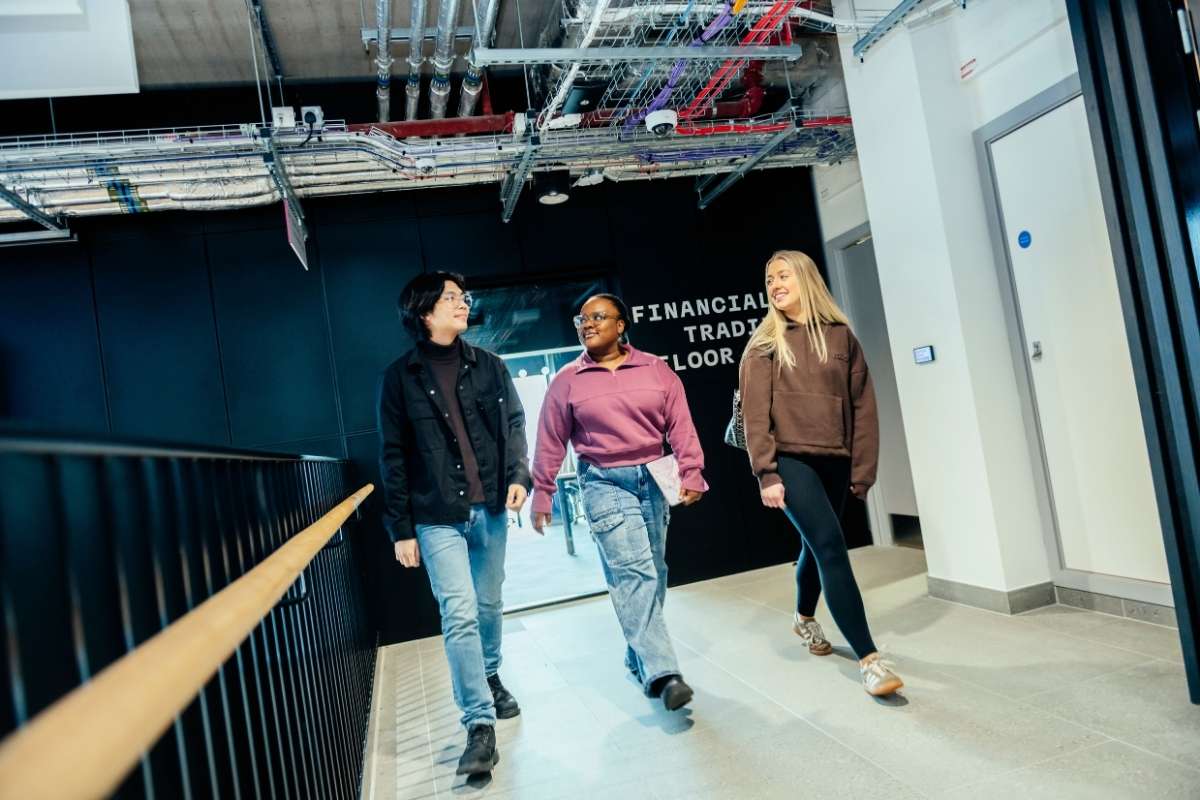
Our new state-of-the-art Sheffield Business School will be your home, offering dedicated spaces to collaborate with peers, staff, industry partners, and the wider business community through our Business Hub.
You’ll also use:
- digital and physical group teaching spaces
- IT labs for data and computing modules
- a virtual learning environment and online collaboration tools
- media and synchronous teaching platforms
Media Gallery





Where will I study?
You study at City Campus through a structured mix of lectures, seminars and practical sessions as well as access to digital and online resources to support your learning.
City Campus
City Campus is located in the heart of Sheffield, within minutes of the train and bus stations.
City Campus map | City Campus tour

Adsetts library
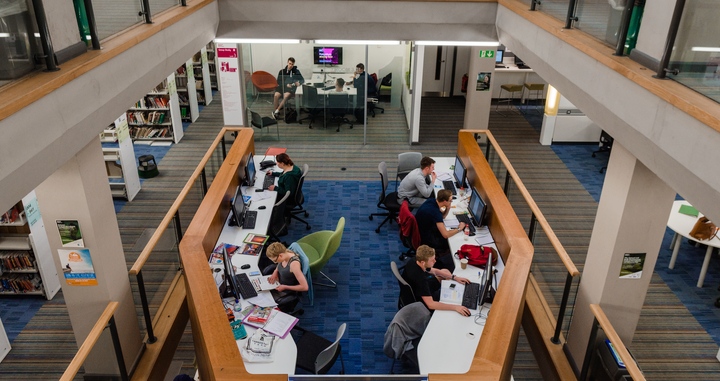
Adsetts Library is located on our City Campus. It's open 24 hours a day, every day.
Explore the libraryExplore Langsett
Explore Langsett
Make your move in our brand-new building at Sheffield Business School. Find a welcoming community where you can experience state-of-the-art facilities and gold-rated teaching.
Entry requirements
All students
UCAS points
- Standard offer: 104 UCAS points
- Contextual offer: 96 UCAS points
We make contextual offers to local applicants, applicants living in low participation areas and applicants with specific personal circumstances. Check your eligibility for a contextual offer.
This must include at least 64 points from 2 A Levels or equivalent BTEC qualifications. For example:
- BCC at A Level
- DMM in BTEC Extended Diploma.
- Merit overall from a T level qualification.
- A combination of qualifications, which may include AS levels and general studies
You can find information on making sense of UCAS tariff points here and use the UCAS tariff calculator to work out your points.
• Access - an Access to HE Diploma with at least 45 credits at level 3 and 15 credits at level 2. At least 15 level 3 credits must be at merit grade or above, from a QAA-recognised Access to HE course, or an equivalent Access to HE certificate.
If English is not your first language, you will need an IELTS score of 6.0 with a minimum of 5.5 in all skills, or equivalent.
Additional information for EU/International students
If you are an International or non-UK European student, you can find out more about the country specific qualifications we accept on our international qualifications page.
For details of English language entry requirements (IELTS), please see the information for 'All students'.
Fees and funding
Home students
Our tuition fee for UK students on full-time undergraduate courses in 2027/28 is £10,050 per year (capped at a maximum of 20% of this during your placement year). These fees are regulated by the UK government and therefore subject to change in future years.
If you are studying an undergraduate course, postgraduate pre-registration course or postgraduate research course over more than one academic year then your tuition fees may increase in subsequent years in line with Government regulations or UK Research and Innovation (UKRI) published fees. More information can be found in our terms and conditions under student fees regulations.
International students
Our tuition fee for International/EU students starting full-time study in 2027/28 is £18,900 per year (capped at a maximum of 20% of this during your placement year)

Financial support for home/EU students
How tuition fees work, student loans and other financial support available.
Additional course costs
The links below allow you to view estimated general course additional costs, as well as costs associated with key activities on specific courses. These are estimates and are intended only as an indication of potential additional expenses. Actual costs can vary greatly depending on the choices you make during your course.
General course additional costs
Additional costs for Sheffield Business School (PDF, 256.9KB)Legal information
Any offer of a place to study is subject to your acceptance of the University’s Terms and Conditions and Student Regulations.