
Everything you need to know...
-
Tuition fees
Home: £12,990 for the course
International/EU: £21,030 for the course -
Course duration
2 Years
-
Study location
-
Start date
September 2027
-
Placement year available?
Yes
Course summary
- Study cost, procurement, contract management and construction measurement.
- Examine industry theory and real-world projects with experienced professionals.
- Work on UK and international projects in cost management and sustainability.
- Refine your professional skills through interdisciplinary teamwork and a dissertation.
- Fast-track your career with a degree accredited by RICS and CIOB, preparing you for chartered status
This MSc offers a direct route into quantity surveying for both graduates and professionals transitioning into the field. You’ll develop the core technical and professional skills required in the construction sector, supported by industry accreditation. The course prepares you for roles in private and public sector surveying firms, equipping you with expertise in cost control, procurement, and contract management.
For students on the Work Experience route, a year-long placement follows the Applied International Project module, with the Professional Industry Research module completed the following year. This extended industry experience enhances research skills and career prospects.

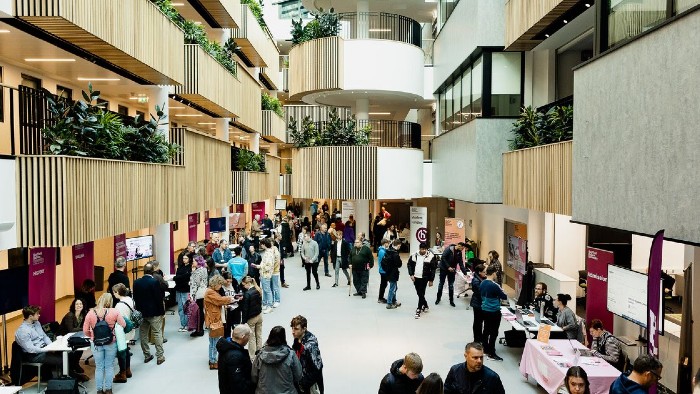
Come to an open day
Find out more at our postgraduate open days. Book now for your place.
Accredited by
Chartered Institute of Building (CIOB)
Royal Institution of Chartered Surveyors (RICS)
This course is accredited by the Royal Institution of Chartered Surveyors (RICS) and the Chartered Institute of Building (CIOB).
How you learn
The MSc Quantity Surveying course blends academic knowledge with practical skills, preparing you for a career in both UK and global markets. You’ll engage with real-world construction challenges – developing problem-solving skills in financial management, contract administration and procurement strategies.
Active, problem-based learning underpins your studies, encouraging innovation and independent thinking. Lectures introduce key concepts, which are reinforced through interactive seminars, tutorials and group discussions. You’ll learn in a diverse cohort, benefiting from peer learning and international perspectives. Site visits provide direct industry insights, while interdisciplinary field trips help you understand the broader built environment.
A virtual learning environment enhances your studies with access to online resources, technical reports and industry-standard software – such as CostX and Bluebeam. You’ll develop critical skills in data analysis, teamwork and communication, culminating in an individual dissertation that sharpens your research and analytical abilities.
You learn through:
- interactive lectures, tutorials and seminars
- problem-based learning and industry projects
- site visits and field trips
- collaborative activities and interdisciplinary teamwork
- online learning tools and industry-standard software
- coursework, reports and case studies
- presentations
- a final dissertation
Key themes
During the course you’ll develop commercial expertise in cost control, procurement and contractual agreements. You’ll learn how to assess and manage project costs effectively, while exploring sustainable construction practices and international project management. You’ll also gain experience in using industry-standard software for cost estimation, Building Information Modelling (BIM), risk management and financial planning.
Course-level support
You’ll be supported in your learning journey towards highly skilled, graduate-level employment through a number of key areas. These include:
- access to student support advisers for personal, academic and career guidance
- one-to-one sessions, webinars and online resources from our Skills Centre to help with assignments
- networking opportunities with industry professionals and guest speakers
- career support, including CV advice, interview preparation and job search assistance
Applied learning
The MSc Quantity Surveying course emphasises practical learning, ensuring you gain industry-relevant experience and graduate with the skills to succeed in the construction sector.
Live projects
Throughout the course you’ll work on live projects that reflect real construction challenges. These projects develop problem-solving skills, teamwork and professional competencies, mirroring the demands of industry practice.
Field trips
Previous field trips have taken place in Shanghai, Toronto and Berlin, with assistance from international surveying firms.
Networking opportunities
Regular guest lectures, networking events and industry workshops help you connect with leading professionals in the field. These events provide career insights and potential job opportunities with major construction firms.
Recent graduates have secured roles at leading organisations such as Rider Levett Bucknall (RLB), Gleeds, Turner & Townsend, Balfour Beatty, Arcadis, and Mott MacDonald. These industry links not only reflect the strength of the course but also create valuable networking opportunities for current students. Our strong relationships with these employers mean you’ll be regularly exposed to real-world insights and potential career pathways throughout your studies.
Work experience
You’ll have the opportunity to source a work placement for up to 12 months, where you’ll apply academic theory and your skills in a real-world setting. This hands-on experience will enhance your professional development and help you to make informed career choices after graduation. Throughout your placement, you’ll be supported to reflect on your experience and contribution to the organisation you work for. You'll also share your progress and achievements with your Placement Academic Supervisor as part of your final assessment.
Work placements are competitive and will require you to make formal applications to employers and be successful in securing an opportunity. The application process for placements takes place while you are a student with us. To support you in applying for placements, you’ll complete an additional placement preparation program that introduces you to the UK employment landscape and prepares you for the recruitment and assessment activities you will experience during that process. We also maintain a large database of placement offers that you can search to find opportunities most relevant to your course that you can apply for.
Student's success story

Sanket Pravin Adhav completed a year-long placement as a quantity surveying assistant with a construction firm, putting what he'd learnt on the course into practice in a real-world setting. Read more.
Your course leader

Modules
Important notice: The structure of this course is periodically reviewed and enhanced to provide the best possible learning experience for our students and ensure ongoing compliance with any professional, statutory and regulatory body standards. Module structure, content, delivery and assessment may change, but we expect the focus of the course and the learning outcomes to remain as described above. Following any changes, updated module information will be published on this page.
You will be able to complete a placement year as part of this course. See the modules table below for further information.
Year 1
Compulsory modules
This module develops your ability to create a feasibility study, presentation and self-reflection on the renovation of a city centre building. Working as a team member with an assigned role, from construction courses work together in a time restricted scenario, in a situation that closely resembles a workplace environment.
This is a multi-skilled module where you’ll explore the issues of effective team working, presentation skills and personal reflection on their contribution to the process.
You’ll study topics such as:
- Feasibility Study
- Building Regulations and Construction Standards
- Collaborative working
- Multi-disciplinary work
- Communication skills
- Professional and International context
- Market and regulatory conditions
- Development process
This module provides you with a solid grounding in law and professionalism to prepare you for employment in a wide range of built environment professional contexts related to your construction discipline in conformity with the requirements of the RICS and the CIOB.
You’ll study topics such as:
- English Legal System including analysing case law and statute law
- Law of tort including professional negligence & occupiers' liability
- Law of contract including formation, control of terms, breach and termination
- Law and business organisations including corporate form & insolvency
- Professional practice including employability skills, professional standards & ethics
- Economic principles related to the built environment context
- Communication, task management and dispute resolution
- Contract procurement and client needs
This module explores modern practices within the context of national and international construction. It will develop your awareness and understanding of health and safety management, the application of digital technology, building information modelling, sustainable construction and modern methods of construction.
You’ll study topics such as:
- Construction health and safety performance and construction health and safety law
- Principles and practice of health and safety risk assessment
- H&S management case studies
- Context, definitions and concepts of building information modelling (BIM)
- National and international BIM requirements, implementation, industry standards and information management processes
- Digital technology/software application within construction design and management
- Application of traditional and modern methods of construction for domestic and commercial substructures and superstructures
- Building regulations, sustainability principles and rating tools
This module will advance your professional development through the completion of, and reflection on, meaningful work experience. In this module, you will undertake a work experience (minimum duration and expectations as per HESA regulations). Your personal Placement Academic Supervisor (PAS) will be your key point of contact during your work experience and will support you in reflecting on your experience, learning and contribution to the placement organisation.
The placement will:
- Allow you to apply the skills, theories and behaviours relevant to, and in addition to, your course
- Enable you to enhance your interpersonal skills in demand by graduate employers - communication, problem solving, creativity, resilience, teamwork, etc.
- Grow your network and relationship-building skills
- Provide you with insights into the industry and sector
This module will evaluate the procurement strategies available and critically appraise those options based on the client’s requirements. The module will also provide in-depth knowledge of the contractual procedures used when administering the contract, paying particular attention to time, cost and quality issues while making responsible use of AI-enabled tools (e.g., document analysis, tender analytics, predictive risk indicators) to support evidence-based decisions.
You’ll study topics such as:
- Overview of the procurement strategies used within the industry
- Analysis of the standard forms of contract available and when, and when not, to use them
- Tender procedures, analysis and reporting
- Contract preparation, roles and responsibilities under the contract
- Contract administration issues relating to time, cost, quality and risk allocation
This module develops your comprehensive knowledge and skills in financial and cost management, enabling you to prepare quantitative and descriptive specifications in construction and civil engineering projects. It aligns with Royal Institution of Chartered Surveyors standards and embeds the ethical, transparent and effective use of AI-enabled tools including CostX for 2D/3D and BIM model-based measurement to enhance accuracy and efficiency across the project lifecycle.
You’ll study topics such as:
- Project investment appraisal methods and cash management strategies
- Preparation and analysis of financial statements, including ratio analysis
- Cost planning throughout the design stage, initial and whole-life costing, and sustainable costing,
- Value engineering and design economics
- Risk management strategies, including contractor tender bids and cost controls
- Financial cash flow and cost monitoring for both clients and contractors
- Measurement techniques and taking-off procedures for building and civil engineering work
- Compilation of bills of quantities, specification writing and preambles for material and workmanship
Final year
Compulsory modules
This module focuses on developing your research skills by guiding you through the process of planning and conducting an independent research study within your chosen area of the built environment.
You’ll study topics such as:
- Choosing a research topic based upon reflection and career goals
- Critical evaluation of sources
- Understanding intellectual property, data re-use rights and information governance
- Research skills
- Gathering and preparing existing data
- Communicating findings
- Evidence-based decision making
- Data analysis
Future careers
This course prepares you for a career in:
- chartered quantity surveying
- cost management
- commercial management
- contract administration
- project management
- estimating
- claims consultancy
- procurement management
- construction cost consultancy
- risk management
Graduates have secured roles with leading companies, including:
- Turner & Townsend
- Balfour Beatty
- Rider Levett Bucknall (RLB)
- Arcadis
- Mott MacDonald
- Henry Boot
- Bowmer & Kirkland
- Faithful+Gould
- Sweco
- Cushman & Wakefield
- Gleeds
Equipment and facilities
You’ll study in modern lecture theatres accommodating large groups, as well as seminar rooms and IT suites designed for interactive learning. Sheffield’s active construction sites provide valuable learning experiences through site visits.
Teaching is supported by audiovisual resources, recorded lectures and online materials accessible via Blackboard Ultra. Industry-standard software and specialist equipment help you develop essential technical skills.
Current resources include:
- Blackboard Ultra for online learning and recorded lectures
- 24/7 access to library resources
- CostX and Bluebeam software for cost estimation and project planning
- virtual reality equipment for immersive learning experiences
- 3D laser scanners for surveying and digital modelling
- IT suites with specialist software
- printing and digital design resources
This combination of industry-focused teaching, applied learning and state-of-the-art facilities ensures you’ll graduate ready for a successful career in quantity surveying.
Where will I study?
You study at City Campus through a structured mix of lectures, seminars and practical sessions as well as access to digital and online resources to support your learning.
City Campus
City Campus is located in the heart of Sheffield, within minutes of the train and bus stations.
City Campus map | City Campus tour


Adsetts library
Adsetts Library is located on our City Campus. It's open 24 hours a day, every day.
Explore the libraryExplore Redmires
Explore Redmires
Study in the new Redmires building – home to law, social sciences and architecture at Sheffield Hallam University.
Entry requirements
All students
Minimum 2:2 degree or equivalent in any discipline.
We welcome applications from candidates who may not meet the exact academic entry requirements but have significant relevant experience, on application you will be referred to our course leader, who will evaluate your experience, this may involve an informal conversation either in person or by other media.
If English is not your first language you typically need an IELTS 6.5 overall score with a minimum of 6.0 in all other skills or equivalent.
Additional information for EU/International students
If you are an International or non-UK European student, you can find out more about the country specific qualifications we accept on our international qualifications page.
For details of English language entry requirements (IELTS), please see the information for 'All students'.
Fees and funding
Home students
Our tuition fee for UK students starting full-time study in 2027/28 is £12,990 for the course. The tuition fee displayed above is for the full course. For this work experience route, your fees will be payable over two years, based on credits studied per year. The fee includes dedicated employability support to help you prepare for work experience. It does not guarantee you a placement and if a placement is not secured the work experience fee will still be charged. If a placement is not secured you will transfer to the standard version of the course to complete your remaining credits, where the balance of your course fees will be due in year one in line with completing the course.
If you are studying an undergraduate course, postgraduate pre-registration course or postgraduate research course over more than one academic year then your tuition fees may increase in subsequent years in line with Government regulations or UK Research and Innovation (UKRI) published fees. More information can be found in our terms and conditions under student fees regulations.
International students
Our tuition fee for International/EU students starting full-time study in 2027/28 is £21,030 for the course. The tuition fee displayed above is for the full course. For this work experience route, your fees will be payable over two years, based on credits studied per year. The fee includes dedicated employability support to help you prepare for work experience. It does not guarantee you a placement and if a placement is not secured the work experience fee will still be charged. If a placement is not secured you will transfer to the standard shorter version of the course to complete your remaining credits. We will inform the Home Office and the course end date on your visa will be adjusted accordingly. The balance of your course fees will be due in year one in line with completing the course.

Scholarships and financial support
Find information on scholarships, bursaries and postgraduate student loans.
International scholarships up to £3000 ›
Alumni scholarships up to £2000 ›
Postgraduate loans for UK students ›
Additional course costs
The links below allow you to view estimated general course additional costs, as well as costs associated with key activities on specific courses. These are estimates and are intended only as an indication of potential additional expenses. Actual costs can vary greatly depending on the choices you make during your course.
General course additional costs
Additional costs for School of Engineering and Built Environment (PDF, 253.6KB)Legal information
Any offer of a place to study is subject to your acceptance of the University’s Terms and Conditions and Student Regulations.