Everything you need to know...
-
What is the fee?
Home: See fees section below
International/EU: £18,000 per year -
How long will I study?
1 Year
-
Where will I study?
-
What is the UCAS code?
BB11
-
When do I start?
September 2026
Course summary
- Become a professional mechanical engineer from day one.
- Apply your skills by completing industry-linked projects and placements.
- Develop the techniques to design, analyse, simulate and test mechanical systems.
- Create engineering solutions for the optimal performance of mechanical systems.
- Enhance your versatility with multidisciplinary insights into mechanical engineering.
This course prepares you for diverse engineering roles – with a practice-based approach to mechanical science, design, systems, engineering practice, materials, and manufacture. You’ll emerge as a highly-skilled graduate – ready to provide optimal and sustainable solutions to future problems across the industry.
The course enables students to convert their existing qualifications into a BEng Mechanical Engineering honours degree.
This top-up award is suitable if you have a foundation degree or HND and are aiming to develop your qualification to degree level.
Come to an open day
Find out more at our postgraduate open days. Book now for your place.
How you learn
This course is designed for you to gain experience as a professional engineer from day one, developing technical and professional skills from the very start. The multidisciplinary nature of mechanical engineering means you’ll work collaboratively with professionals from other engineering disciplines, further enhancing your versatility in the field.
You’ll engage in a variety of learning activities as you progress through the course.The balance of these activities changes at each level of study to encourage you to become increasingly independent learners, developing the ability to take the initiative, plan, organise and complete programmes of work – as an individual, a leader and a member of a team.
You learn through:
- Diverse lectures emphasising peer collaboration
- Tutorials to practise and apply your knowledge ahead of assessments
- Hands-on lab experience including computational modelling and simulation
- Q&A and discussions for self-assessment and understanding
- Support sessions for receiving feedback and preparing for assessments
- Teamwork activities for collaboration in an innovative environment
- Project-based learning to apply knowledge, creativity, design, critical analysis and professional skills to real-world projects
Course topics
The course adopts an applied problem-based and research-informed approach, and is based on core subject areas. These include mechanical engineering design, solid mechanics, dynamics, thermofluids, engineering practice, materials, manufacturing and engineering mathematics.
As you advance in the course, the modules will focus on applying mechanical engineering principles to real-world industrial challenges – emphasising the strength of mechanical systems through design and advanced computational engineering tools.
Your final-year project is your chance to demonstrate independent learning and establish a foundation for your future career.
Course support
Throughout the course, feedback is provided through various channels, enabling crucial reflection and action for your continued learning.
You’ll be supported in your learning journey towards highly skilled, graduate level employment. This includes:
- Access to our student support triangle to help with your personal, academic and career development
- Access to our Skills Centre with one to ones, webinars, and online resources, where you can get help with planning and structuring your assignments
- The Engineering Café, a weekly drop-in session where you can ask questions and get advice from academics
- A dedicated Maths and Stats Support drop-in session that runs twice a week
- Support sessions where you receive advice and feedback
Applied learning
Work placements
You’ll have the opportunity to arrange a year-long work placement in between your second and third years. This gives you valuable work experience to prepare you for your future career – and allows you to graduate with an Applied Professional Diploma to add to your CV.
While you’re on placement you’ll develop and apply your skills – from mechanical design to manufacturing, the strength of mechanical components, and from the production to the backend design of mechanical systems.
Previous students have worked at organisations such as Rolls-Royce, Airbus UK, Bentley Motors, Lockheed Martin, BMW Manufacturing and McLaren Racing Limited. Placement years involve an application process to secure your position, which your tutors and our Careers and Employability Team will support you with.
Live projects
You’ll gain experience of live projects at every level of the course. Projects range from hands-on lab sessions run by external organisations to practical group projects where you’ll present your findings to our industrial partners.
Previous students have worked on real projects like designing a removable connecting system for poured concrete at Build-Lite UK, as well as evaluating the suitability of polystyrene for their materials recycling. They’ve also explored methods to catch and sort number plates using flow store at Jepson & Co Ltd. And they’ve worked to solve a manufacturing challenge alongside process engineers at the McLaren Composite Technology Centre (MCTC).
Networking opportunities
Throughout the course there are numerous opportunities for you to engage with career management, career fairs and workshops, employer presentations, visits and professional advisers.
We also arrange on-campus guest lectures and seminars from local employers and relevant professional bodies – such as the Institute of Mechanical Engineers (IMechE) – plus world-class researchers in mechanical engineering science.
Field trips
You’ll have chances to visit leading engineering companies and local museums, exploring real engineering settings and learning about their operations.
Competitions
We encourage you to get involved in the SHU Racing Team, where you can apply your skills and knowledge to build, test and design race cars – as well as taking part in racing against other universities at Silverstone.
Course leaders and tutors
Ashfaq Khan
Course Leader and Senior Lecturer in Mechanical EngineeringStaff profile for Dr Ashfaq Khan
Modules
Important notice: The structure of this course is periodically reviewed and enhanced to provide the best possible learning experience for our students and ensure ongoing compliance with any professional, statutory and regulatory body standards. Module structure, content, delivery and assessment may change, but we expect the focus of the course and the learning outcomes to remain as described above. Following any changes, updated module information will be published on this page.
Final year
Compulsory modules
Module Aim:
This module aims to develop subject expertise and critical thinking skills in the domain of advanced thermodynamics, structural analysis and numerical simulations, such as applied computational fluid dynamics (CFD) and finite element analysis (FEA), relevant to real world engineering problems.
You will study topics such as:
-
Computational Fluid Dynamics (CFD)
-
Finite Element Analysis (FEA)
-
Thermal & Fluid Machines/Devices
-
Structural mechanics
Your individual final year project is the apex of your academic journey, offering a platform to apply the wealth of knowledge and skills gathered throughout your degree to real-world linked problems. This module requires your creativity, problem-solving capabilities, and the ability to navigate new material independently in whichever field you choose to specialise in.
This module allows you to:
-
Undertake in-depth research in a topic of your choosing
-
The opportunity to work alongside cutting-edge researchers
-
Create a body of work that can support you into further study, or work in a field that interests you
Develop solid foundations for undertaking a self-managed academic research project. On this module you will develop the skills and understanding you will need to complete your dissertation project to the highest level. Through lectures, guided reading and one-to-one discussions with your project supervisor you will design a path through to successful completion of an extensive research project including developing the project management skills you will need to achieve this.
You’ll study topics such as
- The life cycle of a project
- Reviewing academic literature
- Quality management
- Project management techniques and tools
- Research ethics
- Intellectual property rights
The module explores fundamental principles of engineering design. You will develop understanding of the principles of design of components and assemblies and also be aware of sustainability and ethics within the design process.
You will study topics such as:
-
Design approaches
-
Conceptual design tools
-
Detailed design tools
-
Prototyping, evaluation and optimisation tools
-
Sustainability, ethic and economic factors
Future careers
This course prepares you for a career in:
- Mechanical design
- Mechanical system/structural analysis
- Energy/power
- Renewable energy systems
- Manufacturing and production
- Automotive industry
- Aerospace industry
Previous graduates of this course have gone on to work for:
- AgustaWestland
- Airbus UK
- Bentley Motors
- Bosch
- JCB
- Lockheed Martin
- Pirelli Tyres Ltd Carlisle
- Rolls-Royce
Equipment and facilities
You’ll have access to a wide range of hardware and equipment, including Computer-aided design (CAD) software such as SolidWorks to create accurate prototypes of product designs – plus analysis software such as Fluent, Abaqus, Ansys and Matlab.
You’ll study and develop your skills in 11,500 square feet of cutting-edge teaching space, laboratories and workshops, with facilities including:
- Industry-standard software and tools
- Finite Element Analysis software
- Computational Fluid Dynamics software
- Engineering laboratories and state-of-the-art equipment
- Additive manufacturing (3D printing)
- Wind tunnels
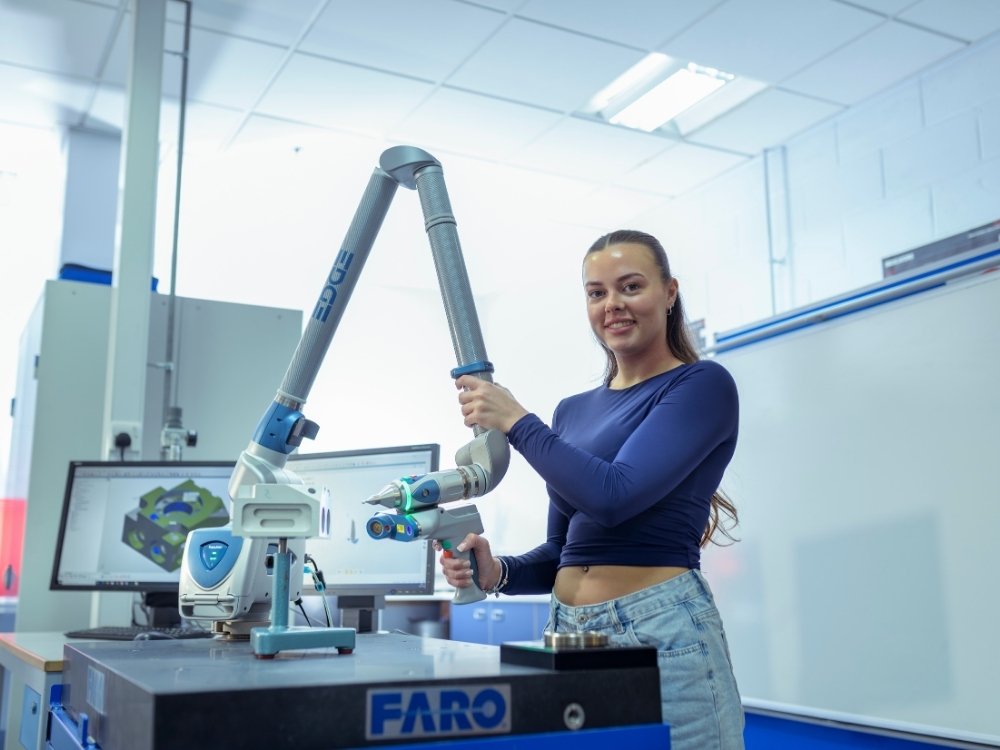
- Laser scanning
- A flight simulator
- Rapid prototyping equipment
- A robotics and automation laboratory
- An automotive workshop for engine testing
- A structural integrity laboratory
- A materials testing laboratory
- Manufacturing workshops
Media Gallery
Where will I study?
You study at City Campus through a structured mix of lectures, seminars and practical sessions as well as access to digital and online resources to support your learning.
City Campus
City Campus is located in the heart of Sheffield, within minutes of the train and bus stations.
City Campus map | City Campus tour
Adsetts library
Adsetts Library is located on our City Campus. It's open 24 hours a day, every day.
Learn moreEntry requirements
All students
You normally need a BTEC Higher National Diploma or a Foundation Degree in a relevant subject or equivalent.
If English is not your first language you must have an IELTS score of 6.0 with a minimum of 5.5 in all skills or equivalent.
Additional information for EU/International students
If you are an International or non-UK European student, you can find out more about the country specific qualifications we accept on our international qualifications page.
For details of English language entry requirements (IELTS), please see the information for 'All students'.
Fees and funding
Home students
Tuition fees for 2026/27 are not yet confirmed. Our tuition fee for UK students studying full-time in 2025/26 is £9,535 for the course. These fees are regulated by the UK government and therefore subject to change in future years.
If you are studying an undergraduate course, postgraduate pre-registration course or postgraduate research course over more than one academic year then your tuition fees may increase in subsequent years in line with Government regulations or UK Research and Innovation (UKRI) published fees. More information can be found in our terms and conditions under student fees regulations.
International students
Our tuition fee for International/EU students starting full-time study in 2026/27 is £18,000 per year.
Financial support for home/EU students
How tuition fees work, student loans and other financial support available.
Additional course costs
The links below allow you to view estimated general course additional costs, as well as costs associated with key activities on specific courses. These are estimates and are intended only as an indication of potential additional expenses. Actual costs can vary greatly depending on the choices you make during your course.
General course additional costs
Additional costs for School of Engineering and Built Environment (PDF, 607KB)Legal information
Any offer of a place to study is subject to your acceptance of the University’s Terms and Conditions and Student Regulations.