Year of Entry 2026/27
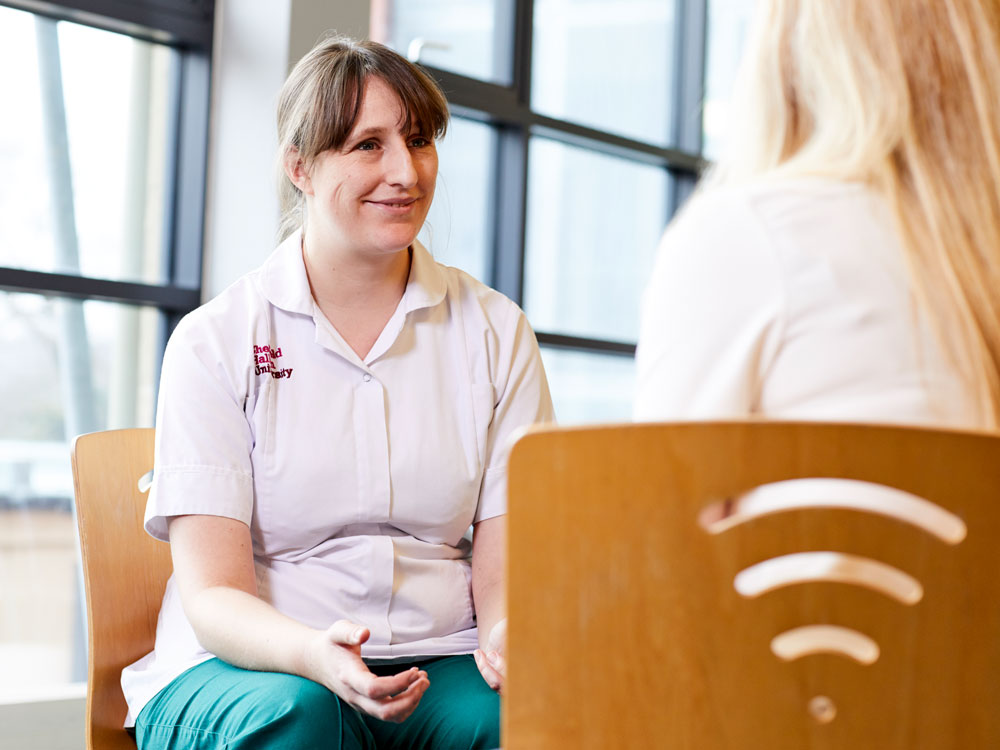
Medical professionals having a conversation

BSc (Honours)

Occupational Therapy with Foundation Year

Course full Full-time Occupational therapy

Learn to assist people facing trauma, disability and illness to achieve independence – gaining a degree that prepares you to register to practise as an occupational therapist, with an initial foundation year to prepare for the course.

This course is now full for 2026

Sorry, there are no places left on this course starting in 2026.

Please see other courses with places available.


Everything you need to know...

  • Pound sign

    What is the fee?

    Home: £9,790 per year
    International/EU: £19,500 per year

  • Time

    How long will I study?

    4 Years

  • Location

    Where will I study?

    Collegiate Campus

  • Bookmark

    What are the entry requirements?

    64 UCAS Points

  • Checkmark

    What is the UCAS code?

    BB15

  • Date

    When do I start?

    September 2026


Course summary

  • Develop your understanding of the role of occupation for health and wellbeing. 
  • Explore how occupational engagement is shaped environmentally and personally.
  • Deliver person-centred occupational therapy inclusively and collaboratively.
  • Apply your learning in a range of stimulating practice-based placements. 
  • Employ creative adaptations of everyday activities to enhance health, wellbeing and quality of life.

Aligned with professional and ethical standards, this course trains you as an occupational therapist who meets the contemporary needs of diverse populations. You’ll support people to take part in what they want, need, and are expected to do – modifying occupation and environment to maximise health and wellbeing. You’ll connect with their lived experiences, collaborating to enhance occupational performance and recommend meaningful activities.

The Foundation Year course is designed for anyone who feels they would benefit from extra preparation before undertaking degree-level study or who does not meet the entry requirements for the BSc (Hons) course (due to lower predicted grades or lower performance at a selection event). The academic staff leading selection event processes are well placed to advice on the benefits of additional study or wider preparation in advance of joining a degree course.


HSC bursary image

Health and social care funding

Home fee-paying students can access a non-repayable maintenance grant of at least £5,000 per year (excluding the foundation year). You may also be eligible for additional financial support based on your circumstances.

Learn more

Employability

95% of our graduates are in work or further study 15 months after graduating (2022/23 Graduate Outcomes Survey).

ug open day with tef logo final

Come to an open day

Visit us to learn more about our gold-rated teaching and why we were awarded the highest possible rating in the Teaching Excellence Framework.

Book your open day place

How you learn

Our course is designed around a set of key principles, enabling you to engage with the world and collaborate with others. We’ll challenge you to think in new ways and provide you with a supportive environment in which you can thrive. 

Teaching and learning is enriched by research, meaning you’ll develop research and inquiry skills over the programme. You’ll be supported to develop academically and professionally throughout the course, building your learning, assessment and practice skills. 

You’ll also have opportunities to learn with other health and social care students, understanding how to work collaboratively with other professions. We’ll provide you with the knowledge, skills and values to enhance your employability so you’ll be ready for future practice. 

You learn through:  

  • Seminars, lectures and practical sessions 
  • Remote learning and digital learning packages  
  • Work-related learning  
  • Independent learning  
  • Applied learning 

Key Themes

The curriculum is designed to scaffold and develop your knowledge, skills and confidence as you progress through the course. 

In your first year you’ll build a strong knowledge base of occupational therapy. In your second year you’ll be able to apply your learning to practice-based learning experiences while embracing more complexity and criticality. Then in your final year you’ll advance into practice and prepare to work as a colleague.

Course Support

You’ll be supported in your learning journey towards highly skilled, graduate-level employment through several key areas. These include: 

  • Access to specialist support services to help with your personal, academic and career development.
  • Access to our Skills Centre with one to ones, webinars and online resources, where you can get help with planning and structuring your assignments 
  • Specific employability activities such as live projects, learning in simulated environments and networking/volunteering opportunities
Student View

Hear our BSc (Hons) Occupational Therapy student Amelia discuss how she is making a difference to people's lives and why she chose to study for a career in occupational therapy.

Applied learning

Live Projects 

You’ll apply the theory you study to practice-based learning experiences. These will help you to develop critical and ethical approaches to your practice, preparing you to become a life-long, competent professional. These experiences are compulsory to achieve the course’s practice-based learning outcomes. They’ll help you build your skills, confidence, creativity, resilience, integrity and curiosity. 

You’ll have a range of experiences linked to the Royal College of Occupational Therapists’ pillars of practice: professional practice, facilitation of learning, leadership and evidence, research and development. These will prepare you to be a confident practitioner.  

Work Placements 

You’ll have mandatory placements at all levels of study. They’ll take place in various practice-based learning environments, reflecting the diverse ways occupational therapy services are currently delivered. This might include blended learning experiences, real-world experiences of services delivered face-to-face to service users, and be connected to the aforementioned pillars of practice.  

We’ll ensure that the practice-based learning element of your course complies with the requirements of the Professional and Statutory Regulatory Body (PSRB) governing the occupational therapy profession. By the end of your course, you’ll have the opportunity to demonstrate that you meet the requirements to register as an occupational therapist.

Networking Opportunities

You’ll have the opportunity to get involved with SHOUT,  Sheffield Hallam’s academic society for occupational therapy, plus other healthcare students and professionals who are interested in occupational therapy.

You’ll benefit from guest lecturers from a variety of healthcare backgrounds, as well as employer presentations. You’ll have opportunities to meet with clinicians who lecture within the modules, and we have excellent links with employers to promote job opportunities.

We also seek to enhance your learning with extra-curricular activities, which may include recruitment or professional development activities.

Course leaders and tutors

No photo of Kayleigh Evans found
Kayleigh Evans
Lecturer

Kayleigh Evans is a lecturer in nursing at Sheffield Hallam University

Modules

Important notice: The structure of this course is periodically reviewed and enhanced to provide the best possible learning experience for our students and ensure ongoing compliance with any professional, statutory and regulatory body standards. Module structure, content, delivery and assessment may change, but we expect the focus of the course and the learning outcomes to remain as described above. Following any changes, updated module information will be published on this page.

Year 1

Compulsory modules

Module
Credits
Assessment
Year 2

Compulsory modules

Module
Credits
Assessment
Year 3

Compulsory modules

Module
Credits
Assessment
Final year

Compulsory modules

Module
Credits
Assessment


Future careers

Upon full completion of the course, you’ll have the opportunity to show your eligibility to apply for registration with Health and Care Professions Council, allowing you to practise as an occupational therapist.

Previous graduates of this course have gone on to work for:  

  • The NHS 
  • Local authority social services 
  • Extended scope areas 
  • Schools 
  • Private practices 
  • Charities 
  • Other health and social care environments 
  • International roles
  • Teaching 
  • Research
Man smiling

All in on your career

We promise you’ll be ready to launch your career. With employer connections, hands-on learning and lifelong career support, we’ll help make your ambition a reality.

Our career promise

Equipment and facilities

Delivery of teaching on campus is in a range of classrooms and practical spaces, which include:  

  • Modern teaching facilities with specialist rooms  
  • Practice rooms and simulated ward environments 
  • Home environments
  • A range of innovative equipment, e.g. for anatomy teaching
  • Using a range of specialist software to facilitate learning 

We’ve invested over £100m in new facilities to help you study how and when you want. This means 24-hour libraries and study spaces designed by our students.


360 tour - occupational therapy facilities

Health and social care facilities tour

Learn what it's like to study health and social care at our Collegiate Campus from our adult nursing student Alex.

Media Gallery

Where will I study?

You study at Collegiate Campus through a structured mix of lectures, seminars and practical sessions as well as access to digital and online resources to support your learning.

Collegiate campus

Collegiate Campus can be found just off Ecclesall Road, a bustling student district.

Collegiate Campus map | Campus facilities 


Collegiate Campus map
Location

Collegiate Crescent
Sheffield
S10 2BP

Get directions
Students outside Collegiate Library
Collegiate library

Collegiate Library can be found just off Ecclesall Road. It's open 24 hours a day, every day.

Learn more

Entry requirements

All students

UCAS points

  • 64

This must include at least 24 (Grade D) from one A level or equivalent BTEC National qualifications. For example:

  • DDE at A Level.
  • MPP in BTEC Extended Diploma
  • Pass overall from a T level qualification with D or E from core
  • A combination of qualifications, which may include AS levels and EPQ.

You can find information on making sense of UCAS tariff points here and use the UCAS tariff calculator to work out your points.

GCSE

  • Science at grade C or 4 or equivalents*
  • Maths at grade D or 4 or equivalents**
  • English Language or Literature at grade C or 4 or equivalents***

*GCSE Science equivalents

  • OCR Science level 2
  • Science units gained on a level 3 BTEC or OCR National Diploma or Extended Diploma qualification
  • Science credits gained on Access to Higher Education Diplomas (at least 12 credits at level 2 or 6 credits gained at level 3)
  • Science equivalency test from www.equivalencytesting.co.uk

**GCSE Maths equivalents

  • Level 2 Key Skills/ Application of Number/ Level 2 Maths credits from an Access course
  • Maths equivalency test from www.equivalencytesting.co.uk

***GCSE English equivalents

  • Level 2 Literacy
  • Level 2 Key Skills

• Access - an Access to HE Diploma from a QAA recognised Access to HE course in a science based subject. Normally we require 15 credits at level 2 and 45 at level 3.

If English is not your first language, you will need an IELTS score of 7.0 or above, with a minimum score of 6.5 in each skill.

Non-academic entry requirements

Before enrolling you must complete all the professional requirements that are mandatory as part of entry for the course:

Occupational Health Screening

Satisfactory medical clearance, by completion of a health screening assessment, will be a condition of your offer and you cannot enrol on your course without it. This occupational health screening will be provided by the University free of charge and ensures that you meet the medical fitness to train in your profession as per professional and regulatory body requirements and the Higher Education Occupational Practitioners (HEOPs) standards.

As part of this assessment, you are expected to provide all relevant, truthful and accurate information to ensure a safe environment for yourself and patients/service users

If there is any change to your health during your course, you must notify the University immediately so that we that we can undertake an assessment/reassessment to ensure you continue to meet the medical fitness to train in your profession.

Immunisations

All students must comply with the immunisation requirements of the programme in line with the Department of Health (DoH) Green Book standards / current guidelines or equivalent evidence-based standards, which must be met to undertake placements and continue on the course. The NHS updates the list of vaccinations required and these may change over the course of your programme of study.

To remain enrolled, you must complete your full immunisation programme as outlined in the Universities Immunisation Policy.

Self-Declaration

Completion of a Sheffield Hallam University Suitability Self-Declaration form will be condition of your offer and you cannot enrol without completing it. You must fully declare the following information:

  • Unfiltered criminal convictions, cautions, reprimands or warnings. This includes convictions considered as ‘spent’ as an Enhanced DBS Criminal record check (required for this course) will show. For further information on unfiltered offences and Disclosing your criminal record please see the Disclosure and Barring Service website and refer to information on Unlock.
  • Involvement in disciplinary proceedings during paid or voluntary employment or education establishments.
  • Involvement with safeguarding proceedings, social services or related organisations.
  • If you have ever been removed from another programme as a result of your behaviour or would have been removed if you had not left the programme.

Disclosure Barring Service (DBS)

Completion of an Enhanced DBS criminal record application will be a condition of your offer. This is a legal requirement for anyone involved in contact with children or vulnerable adults engaging in regulated activity. This check will be provided by the university free of charge. You will need to present valid identity documents as part of the application process. Please refer to the ID checking guidelines for further information.

Positive Disclosures will be reviewed by the Fitness to Practise Operational Group and/or Criminal Records Consultative Panel in conjunction with your Self-Declaration form.

You must inform the University immediately of any changes to your criminal record after your DBS certificate is issued so that we can consider the change and confirm whether you remain suitable to continue your application/studies.

Overseas Criminal Record Check

Applicants who have been resident outside of the UK for 12 months or more (whether continuously or in total) in the last 10 years, while aged 18 or over must provide an overseas criminal record check. Further information on obtaining an overseas criminal record check.

Mandatory Training

Students must complete mandatory training prior to attending placement. Failure to complete this training may result in delayed progression to the next level of study or withdrawal from the course.

Placement hours – Nursing and Midwifery courses only

Students must complete a certain number of hours per level of study. This will be communicated to you by the course team. Failure to meet these hours may result in delayed progression to the next level of study or withdrawal from the course.

Disability support

We strongly recommend that you tell us about any long term health conditions, learning difficulty or disability you may have. This is so we can assess whether we can deliver the course in such a way that you can meet standards of proficiency and take part without disadvantage both in University and on placement.

You can contact our University student support staff and explore any issues you may have.

The Disability Disclosure booklet provides information for students and will help you understand the importance of disclosing your disability at the earliest possible stage. This is so you can be assessed for the support you may require to succeed on the course.


Additional information for EU/International students

If you are an International or non-UK European student, you can find out more about the country specific qualifications we accept on our international qualifications page.

For details of English language entry requirements (IELTS), please see the information for 'All students'.


Fees and funding

Home students

Our tuition fee for UK students on full-time undergraduate degree courses in 2026/27 is £9,790 per year. These fees are regulated by the UK government and therefore subject to change in future years. The NHS Learning Support Fund offers a non-repayable training grant of £5,000 per year to all eligible new and current pre-registration students. The first year of this course (foundation year) is not included in this grant. You may also be eligible for additional financial support based on your circumstances up to the value of around £5,000. This includes parental support, travel/accommodation expenses and a financial hardship fund. Find out about health and social care funding options.

If you are studying an undergraduate course, postgraduate pre-registration course or postgraduate research course over more than one academic year then your tuition fees may increase in subsequent years in line with Government regulations or UK Research and Innovation (UKRI) published fees. More information can be found in our terms and conditions under student fees regulations.

International students

Our tuition fee for International/EU students starting full-time study in 2026/27 is £19,500, which includes an annual placement supplement of £1,500.

Additional course costs

The links below allow you to view estimated general course additional costs, as well as costs associated with key activities on specific courses. These are estimates and are intended only as an indication of potential additional expenses. Actual costs can vary greatly depending on the choices you make during your course.

General course additional costs

Additional costs for Health and Social Care (PDF, 298KB)

Legal information

Any offer of a place to study is subject to your acceptance of the University’s Terms and Conditions and Student Regulations.


Why choose us?

A trophy icon

Teaching

Rated Gold in the 2023 Teaching Excellence Framework (TEF) for the outstanding quality of our teaching and graduate outcomes

A British pound currency icon

Funding

Home students can access a non-repayable maintenance grant of at least £5,000 per year, eligibility applies

An office building icon

Training

We are one of the largest training providers of health and social care in the UK, giving you access to cross-discipline learning

Where next?

Want to know more about Sheffield Hallam? Get your questions answered with our tips, guides and information.

An open day attendee holding a guidebook and in discussion with a member of Sheffield Hallam staff

Chat to a student

Speak to our students about the course you're interested in or student life.

Chat now
An illustration of a smartphone screen showing the digital prospectus homepage. The phone is surrounded by colourful cartoon stickers.

Explore a prospectus

Find out more about studying at Sheffield Hallam. Order a print prospectus or visit our digital version.

Order a prospectus
Accommodation buildings

Find accommodation

We guarantee accommodation for all first year students. All of our halls are in popular student areas, and close to our campuses.

Find your home from home

Cancel event

Are you sure you want to cancel your place on Saturday 12 November?

Close