
Everything you need to know...
-
Tuition fees
Home: £10,940 for the course
International/EU: £21,375 for the course -
Course duration
20 Months
-
Study location
-
Start date
January 2027
Course summary
- Deepen your understanding and skills in physiotherapy practice.
- Gain a Masters qualification to demonstrate your specialist knowledge.
- Prepare for advanced, independent or clinical leadership roles.
Aimed at qualified physiotherapists, this course gives you a balance of clinical and academic skills, ensuring an authentic experience and the opportunity to develop knowledge that’s directly transferable to your practice. As you increase your clinical skills and critical evaluation of practice, you’ll be preparing for clinical leadership roles or independent practice.

Come to an open day
Find out more at our postgraduate open days. Book now for your place.
How you learn
On this course you’ll focus on different elements of clinical practice. We’ll encourage you to apply your learning to the setting you work in or would like to specialise in. Your assessments are designed to replicate challenges you may face within the workplace – and you’ll learn from enthusiastic tutors who are experienced physiotherapists.
You’ll learn through
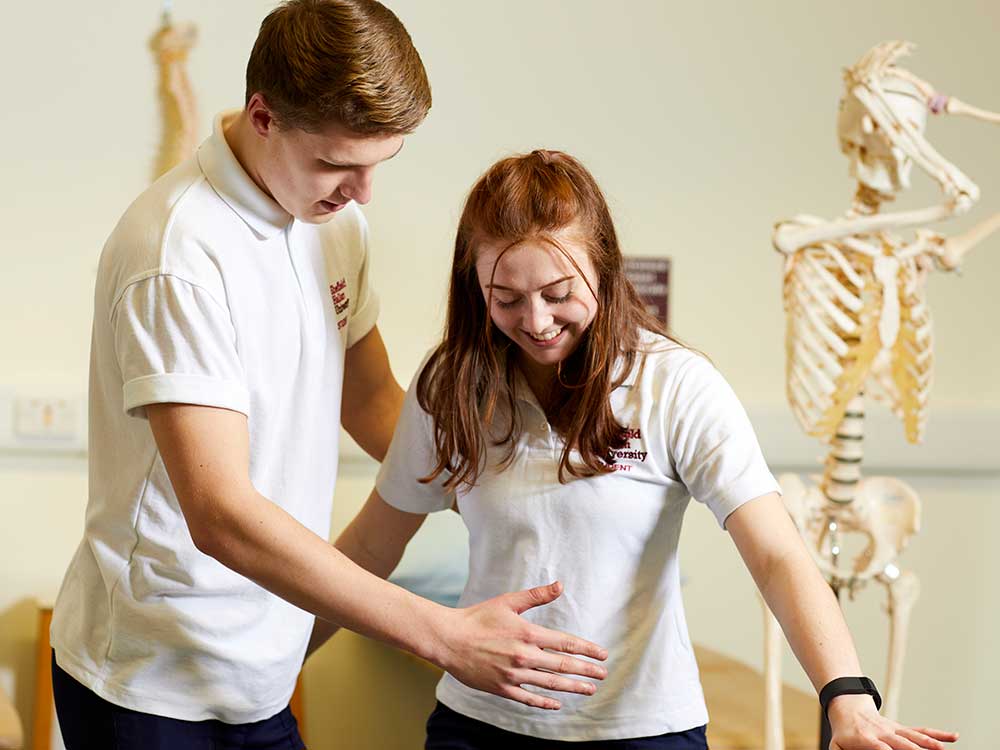
- practical sessions
- lectures
- seminars
- tutorials
- presentations
- practical assessments
- vivas
- written assessments
Applied learning
You’ll have access to opportunities to develop your skills and apply your learning with qualified and practising physiotherapists. These opportunities are built into the course and our applied approach to learning.
Your course leader

Peter Hanley
Part-time Senior Lecturer-Practitioner PhysiotherapyI combine the roles of a part-time Senior Lecturer Sheffield Hallam University Physiotherapy Department with an Extended Practitioner role for the South West Yorkshi … Read more
Modules
Module and assessment information for future years is displayed as currently validated and may be liable to change. When selecting electives, your choices will be subject to the core requirements of the course. As a result, selections may be limited to a choice between one of two or more specified electives in some instances.
Year 1
Compulsory modules
The aim of this module is to advance students’ clinical competence within physiotherapeutic practice across the key specialisms in physiotherapy through critical engagement with contemporary evidence and reflective evaluation of clinical reasoning. You will critically explore key healthcare issues and develop existing clinical reasoning skills in evidenced based physiotherapeutic management. This module also focuses on developing your critical understanding and application of quantitative research methodologies and methods.
Module content:
Quantitative research methods for investigating effectiveness, prognosis and diagnosis.
Models of clinical reasoning and integration of evidence into decision making.
The bio-psychosocial approach and application to practice.
Clinical assessment and treatment skills across specialisms.
Pathology and pathophysiology.
Practical handling skills.
Evidenced based practice application.
Psychosocially informed management and impact on outcomes.
This module explores the theoretical foundations of research, including paradigms, methodologies, and methods, to support critical evaluation of evidence that informs physiotherapy practice. It introduces key principles and processes that underpin research activity in professional contexts, encouraging students to consider inclusive and ethical approaches to inquiry. Learners will challenge their understanding of research design by developing a proposal that prepares them for their dissertation project, fostering confidence in applying research to real-world clinical and academic settings.
Module content:
Research paradigms, methodologies, and context
Developing research questions and proposals
Primary and secondary research approaches
Data collection and analysis methods
Ethics and research governance
Inclusive and service user perspectives in research
Understanding and applying research methods
Critical engagement with evidence to inform practice
The module aims to develop skills and understanding around the facilitating physical activity in clinical populations and in using specific exercise for addressing therapeutic goals.
You’ll study topics such as:
Principles of exercise prescription and physiology
Exercise application in specific health conditions
Risk assessment and safety in physical activity
Biopsychosocial impacts of exercise on health
Behaviour change strategies and health literacy
Barriers and enablers to exercise engagement
Guidelines for physical activity and patient-centred prescription
Critical appraisal of qualitative evidence and patient experience
Elective modules
This module explores advanced neurorehabilitation and challenges students to re-evaluate contemporary neuroscience in the context of complex neurological conditions. It introduces applied neurophysiology and evidence-based interventions, including adjunct technologies, to enhance assessment, treatment planning, and rehabilitation outcomes. Students will engage with current research and clinical practices, applying theoretical knowledge to practical scenarios. Through academic discourse, peer collaboration, and reflective learning, students will thrive by developing clinical reasoning and decision-making skills. The module promotes a holistic, person-centred approach to neurological physiotherapy, encouraging learners to collaborate in practical sessions and digital environments. By challenging assumptions and integrating emerging evidence, students will be prepared to contribute confidently to neurological rehabilitation across diverse clinical settings.
Module content:
Motor control / Neuroplasticity
Applied neurophysiology in recovery and rehabilitation
Assessment and management of spasticity
Managing complex neurological conditions
Exercise prescription and facilitation skills
Adjunct interventions
Clinical skills workshops for hands-on practice
Integration of theory into neurological rehabilitation
This module will enable you to develop your critical application and evaluation of the theory and
evidence relevant to the management of spinal neuro-musculoskeletal movement
disorders (NMSD), and enhance your understanding of the patient's role in their own
recovery.
Module content:
Assessment of patients with spinal neuro-musculoskeletal movement disorders dysfunction and disorders.
Spinal red flags and serious pathology identification and management.
Critical neurological screening and problem identification and Safety netting
Synthesis of the evidence-base in relation to spinal pathology, assessment and management
Exploring and applying contemporary management approaches for these patients, for example:
patient self-management purposive exercise, general exercise for fitness
fearless movement
a range of manual and movement therapeutic interventions,
functional rehabilitation strategies for patients with spinal pathology.
Clear demonstration of engagement with relevant literature and evidence.
This module challenges students to critically re-evaluate contemporary pain neuroscience, encouraging them to question established assumptions and explore emerging perspectives. It introduces a broad understanding of the multidimensional nature of pain and promotes critical awareness of current non-pharmacological pain management strategies. Through academic discourse, evidence critique, and practical application, students will thrive by developing the ability to apply pain management principles effectively in clinical practice, contributing to person-centred and evidence-informed care.
Module Content:
Neurophysiology, pain theories, and models
Influences on pain assessment and interpretation
Therapeutic strategies for pain management
Patient-led self-management approaches
Lifestyle factors and pain perception
Cognitive interventions and meaningful activity
Modifiable and non-modifiable factors affecting pain
Final year
Compulsory modules
This module focuses upon independent research for students working towards a full Award at Master's Level, in their chosen programme.
Students are allocated a designated supervisor to support them in undertaking an independent exploration of an appropriate project relevant to their professional practice. Students may conduct either primary or secondary research to explore complex and impactful themes, contributing to professional practice through dissemination and informed recommendations.
Module Content:
Relevant content will vary according to the student’s chosen research methodology; however common elements include exploration of:
Background and context of chosen theme, contextualising the Research Question
Individual Research Question design using recognised tools
Select and justify chosen methodology
Gain approval for Ethical and Research Governance for professional practice, from the University and any organisation in relation to data.
Data analysis, management, and security
Collate, Synthesise and evaluate evidence
Explore the impact and create recommendations for practice and research dissemination
Future careers
When you graduate you’ll be prepared for clinical leadership roles or to work more independently – developing independent private practices or moving into advanced or extended scope roles. Some graduates pursue research or teaching careers in the UK or internationally, many going onto PhD study.
Students who join the course without registering with the Health and Care Professions Council (HCPC) – you could now apply for this to gain work experience in the UK during and after the course. While automatic registration isn’t guaranteed when you complete the course, the learning opportunities provided align to the HCPC standards.
Equipment and facilities
On this course you work with
- specialist facilities for teaching physiotherapy skills, designed to mimic a typical UK therapy clinic, with specialist plinths and therapy equipment
- excellent audio-visual facilities to support learning in every classroom
- extensive library resources both on-campus and online
We’ve invested over £100m in new facilities to help you study how and when you want. This means 24-hour libraries and study spaces designed by our students.
Learn more about your department
Health and Social Care Facilities Tour
Learn what it's like to study health and social care at our Collegiate Campus from our adult nursing student Alex.
Where will I study?
You study at Collegiate Campus through a structured mix of lectures, seminars and practical sessions as well as access to digital and online resources to support your learning.
Collegiate campus
Collegiate Campus can be found just off Ecclesall Road, a bustling student district.
Collegiate Campus map | Campus facilities


Collegiate library
Collegiate Library can be found just off Ecclesall Road. It's open 24 hours a day, every day.
Learn moreEntry requirements
All students
Academic Qualifications: Applicants will hold a degree / diploma / equivalent qualification in Physiotherapy, typically of 2.1 or above.
Other formally certified qualifications: Applicants must be qualified to practice physiotherapy in their country of origin and are usually required to provide one reference of their capability for postgraduate study. Post-qualification clinical physiotherapy experience is welcomed, it is not essential.
Level of English language capability: If English is not your first language you must have an IELTS score of 6.5 with a minimum of 6.0 in each skill area.
Entry profile: Applicants need to be committed to post graduate study and capable of development into a self-motivated, reflective professional.
Applicants should be prepared to explore theoretical, clinical and evidence based concepts within group activities and will be required to demonstrate effective communication and team work skills.
Verification that applicants fulfil the criteria will be sought via the applicants' references, their curriculum vitae and the supporting statement in their application.
Personal Statements must demonstrate commitment to professional development, effective communication and teamwork skills and self-motivation.
Non-standard entry requirements: Some flexibility maybe exercised to the admissions criteria for students wishing to study individual modules. Some variation in terms of professional background and education maybe accepted and applicants will be considered individually by the course admissions team.
Additional information for EU/International students
If you are an International or non-UK European student, you can find out more about the country specific qualifications we accept on our international qualifications page.
For details of English language entry requirements (IELTS), please see the information for 'All students'.
Fees and funding
Home students
Our tuition fee for UK students starting full-time study in 2026/27 is £10,940 for the course. The tuition fee displayed above is for the full course. If the full course is more than one year in duration, the fee will be divided into annual payments which will then be rounded. This may mean the total fee you pay is slightly higher than the fee stated above. If you take a break in study or have to re-take part of the course, you may also be charged an additional fee and will be notified of this at the time. Our tuition fee for UK students starting full-time study in 2026/27 are: Year 1: £7,295, Year 2: £3,650.
If you are studying an undergraduate course, postgraduate pre-registration course or postgraduate research course over more than one academic year then your tuition fees may increase in subsequent years in line with Government regulations or UK Research and Innovation (UKRI) published fees. More information can be found in our terms and conditions under student fees regulations.
International students
Our tuition fee for International/EU students starting full-time study in 2026/27 is £21,375 for the course. The tuition fee displayed above is for the full course. If the full course is more than one year in duration, the fee will be divided into annual payments which will then be rounded. This may mean the total fee you pay is slightly higher than the fee stated above. If you take a break in study or have to re-take part of the course, you may also be charged an additional fee and will be notified of this at the time.

Scholarships and financial support
Find information on scholarships, bursaries and postgraduate student loans.
International scholarships up to £3000 ›
Alumni scholarships up to £2000 ›
Postgraduate loans for UK students ›
Additional course costs
The links below allow you to view estimated general course additional costs, as well as costs associated with key activities on specific courses. These are estimates and are intended only as an indication of potential additional expenses. Actual costs can vary greatly depending on the choices you make during your course.
General course additional costs
Additional costs for Health and Social Care (PDF, 391.9KB)Legal information
Any offer of a place to study is subject to your acceptance of the University’s Terms and Conditions and Student Regulations.