
Everything you need to know...
-
Tuition fees
Home: £11,490 for the course
International/EU: £19,530 for the course -
Course duration
1 Year
-
Study location
-
Start date
September 2027
Course summary
- Gain a critical understanding of the theory and practice of international relations.
- Explore the political, cultural, social and economic crises facing the world today.
- Learn how patterns of power, knowledge and inequality are reproduced globally.
- Develop practical expertise in non-violent communication and conflict resolution.
This course examines the complex worlds we live in. You’ll explore issues of power, race, class, gender and geography to challenge how knowledge about contemporary international relations is produced. By studying topics such as terrorism, war, security and peace-building, you’ll gain critical and practical skills to understand how global crises manifest and can be overcome.
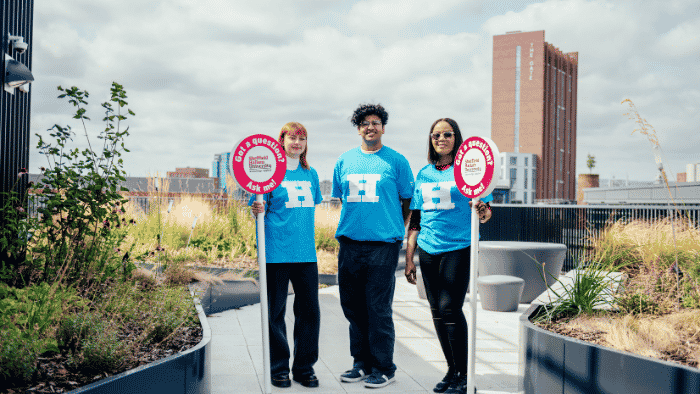
Come to an open day
Find out more at our postgraduate open days. Book now for your place.
How you learn
The course is structured to facilitate deep learning, listening and communication skills, with a core focus on dialogue building rather than debate. You’ll learn practical, reflective and evaluative skills to think differently about the world’s problems and their possible solutions.
You’ll discuss international relations and global crises with our expert academics and your fellow students. You’ll analyse contemporary international issues in-depth, critically examining the discipline of international relations itself to unpack the relationship between theory and practice.
Teaching on the degree is informed by our team's ongoing research expertise. We use consistent block-teaching times, helping you plan your commitments outside of university.
You learn through:
- interactive workshops
- lectures and seminars
- independent study
- personal supervision for the independent project
- practical activities and group work
- special guest lectures
Key themes
Throughout the course you’ll learn critical and practical skills, helping you make sense of the complexities and contradictions of world politics. Modules cover the origins of international relations alongside key events, issues and crises of the past and present. You’ll learn why we should seek to decolonise and decentre how knowledge about international relations is produced and reproduced.
All modules provide a solid knowledge foundation upon which you can fulfil your potential, whether you’re new or returning to the discipline of international relations.
Course support
You’ll be supported in your learning journey towards highly skilled employment through a number of key areas. These include
- access to specialist support services to help with your personal, academic and career development
- access to our Skills Centre with one to ones, webinars and online resources, where you can get help with planning and structuring your assignments
- dedicated one-to-one supervision support with your independent research project
Applied learning
Throughout the course, your learning, research, and assessments will be tied to real-world issues within international relations. You’ll produce portfolios of work that explore and analyse these issues from theoretical and practical perspectives, learning to communicate these complex ideas in a supportive environment.
In the module Peacebuilding Communication, you’ll develop practical expertise such as non-violent communication, mediation and conflict resolution skills. You’ll also undertake an independent project where you’ll apply the learning and skills you’ve developed. You’ll produce either a dissertation on a topic of your choosing, or a high-level critical policy evaluation of an international intervention designed to address a contemporary global crisis. Within this module you’ll work with other students to organise a conference.
Networking Opportunities
You’ll be part of an active community in the politics and international relations subject group, our department and the wider university. In the subject group we’ll conduct research projects and publish academic books and articles in areas such as:
- charity and community work
- the European Union and NATO
- international migration
- the politics of welfare, terrorism, and counterterrorism
- the political theory of new social movements
- gender, war and security studies
Throughout the course you'll interact with academics and specialists in your field. The course features several special events with guest speakers, including those working in the field of politics and international relations. Through the Sociology and Politics Seminar Series you’ll meet researchers working on a range of social, political and international issues.
Course leaders and tutors

Matthew Hurley
Senior Lecturer in Politics & International RelationsLecturer in Politics (International Relations)
Modules
Important notice: The structure of this course is periodically reviewed and enhanced to provide the best possible learning experience for our students and ensure ongoing compliance with any professional, statutory and regulatory body standards. Module structure, content, delivery and assessment may change, but we expect the focus of the course and the learning outcomes to remain as described above. Following any changes, updated module information will be published on this page.
Final year
Compulsory modules
This module challenges you to develop, demonstrate and reflect upon range of skills learned throughout the course by producing a thesis on a chosen topic or a critical analysis of a policy intervention designed to address a contemporary international crisis. This module centres individual, independent research, the development of valid arguments, a sound research or policy evaluation design and the critical use of appropriate literature to develop critical reflection and evaluation skills which can applied more broadly to the world of work.
You’ll study topics such as:
- Designing and delivering a thesis
- Designing and delivering a critical policy analysis
- Research and reflexive methods.
- Independent research and learning skills development.
This module provides you with in-depth knowledge of the role emotions and needs play in peacebuilding. Through critical engagement with non-violent communication theory and skills development training, you will work to identify the underlying human needs and strategies that can block productive dialogue at personal, national and international levels. You will develop practical skills to facilitate beneficial climates for negotiation, decision-making, solution-finding, and developing positive outcomes in the field.
You’ll study topics such as:
- Peacebuilding from the International to the Local
- Understanding Basic Universal Feelings and Needs in a Global Context
- Non-Violent Communication Theory
- Non-Violent Communication Skills Training
This module challenges you to think critically about issues of integration and security within contemporary international relations through an exploration of regional attempts by states to cooperate and the violence enacted by non-state actors. The module critically examines and evaluates successes, tensions and crises within the European Union as a project of regional cooperation by states. This is juxtaposed with an in-depth study of terrorism, its effects and victims as both a national and international (in)security phenomenon and the ability of states to respond to this type of violence.
You’ll study topics such as:
- Theories of Integration in International Relations
- Economic, Political and Social Cooperation and Ever Closer Union
- The EU and Multi-Dimensional Crises
- Terrorism in Theory and practice
- Anti-State, Religious and International Terrorisms
- State Policing and Military Responses to Terrorism
This module provides you with an advanced understanding of contemporary international relations in theory and practice. You will explore and critically evaluate the role and place of key actors, issues and concepts in relation to contemporary global crises. In doing so, the complex histories and legacies of IR within the social sciences will be examined, including what it means to effectively decolonise the discipline.
You’ll study topics such as:
- International Relations Theory in practice
- War, (In)Security and Power
- International Organisations and Non-State Actors
- Decolonising and Decentering International Relations
- Race, Racism and Class
- Gender and Sexualities
- Human Rights, Social Movements and IR ‘from below’
- The State, Borders, Migration and Citizenship
This module explores welfare provision in different settings from around the world in a changing and challenging international context. You will be introduced to perspectives that view the welfare state as a separate type of state formation and how this challenges IR theory. You will critically examine and evaluate key theory and concepts associated with the study of welfare across a range of international case studies, exploring how these relate to ideas of nation-state building and legitimacy in international relations.
You’ll study topics such as:
- Welfare States in International Society
- Globalisation, Corporate Power and Social Institutions
- International Organisations, Development and International Aid
- Climate Change and Global Environmental Justice
- Migration, Labour Markets and Border Control Policies
- Global Pandemics, Welfare Regimes and International Relations
Future careers
This course prepares you for a career in:
- non-governmental organisations
- international organisations
- the voluntary sector
- the civil service
- parliamentary or political research
- international development
- political think tanks
- teaching
- a wide range of graduate schemes across different professions with an international focus
- further academic study, such as PhD research
Equipment and facilities
You’ll have access to excellent facilities and learning resources, including an on-campus library. The interactive workshops, lectures and seminars take place in well-equipped classrooms, supported by dedicated virtual-learning platforms.
You’ll also access our 24-hour libraries and study spaces designed by our students.
Where will I study?
You study at City Campus through a structured mix of lectures, seminars and practical sessions as well as access to digital and online resources to support your learning.
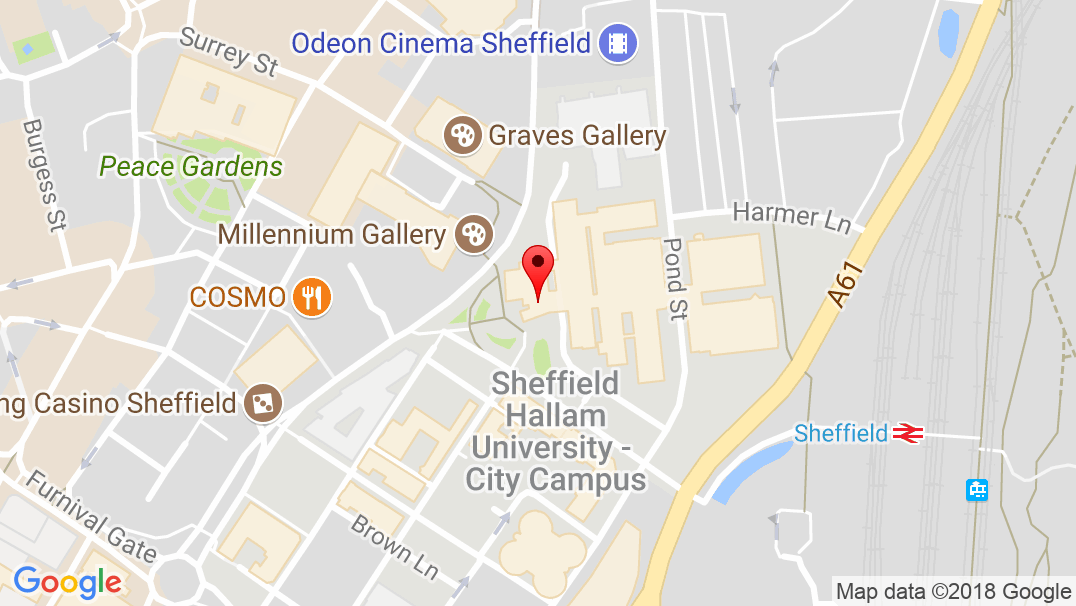
City Campus
City Campus is located in the heart of Sheffield, within minutes of the train and bus stations.
City Campus map | City Campus tour
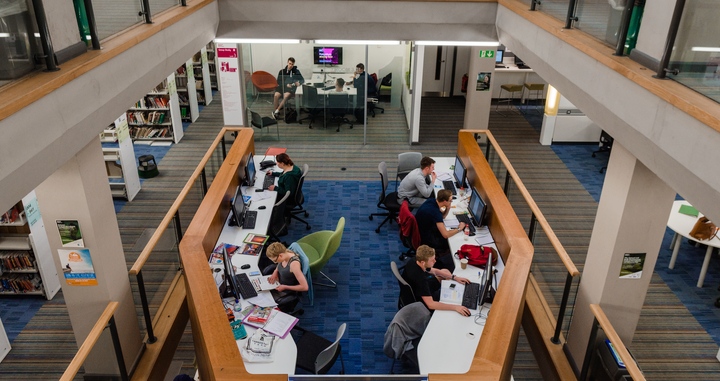
Adsetts library
Adsetts Library is located on our City Campus. It's open 24 hours a day, every day.
Explore the libraryExplore Redmires
Explore Redmires
Study in the new Redmires building – home to law, social sciences and architecture at Sheffield Hallam University.
Entry requirements
All students
A UK undergraduate degree at 2:2 or above in international relations, politics, or related field (or an equivalent overseas qualification). It is expected that students are proficient in the English language and, where appropriate, have an overall 6.5 in IELTS, with a minimum of 6.0 in writing. In some circumstances, students without traditional undergraduate qualifications will be considered. It is envisaged that these applicants will have relevant work experience.
Additional information for EU/International students
If you are an International or non-UK European student, you can find out more about the country specific qualifications we accept on our international qualifications page.
For details of English language entry requirements (IELTS), please see the information for 'All students'.
Fees and funding
Home students
Our tuition fee for UK students starting full-time study in 2027/28 is £11,490 for the course.
If you are studying an undergraduate course, postgraduate pre-registration course or postgraduate research course over more than one academic year then your tuition fees may increase in subsequent years in line with Government regulations or UK Research and Innovation (UKRI) published fees. More information can be found in our terms and conditions under student fees regulations.
International students
Our tuition fee for International/EU students starting full-time study in 2027/28 is £19,530 for the course.

Scholarships and financial support
Find information on scholarships, bursaries and postgraduate student loans.
International scholarships up to £3000 ›
Alumni scholarships up to £2000 ›
Postgraduate loans for UK students ›
Additional course costs
The links below allow you to view estimated general course additional costs, as well as costs associated with key activities on specific courses. These are estimates and are intended only as an indication of potential additional expenses. Actual costs can vary greatly depending on the choices you make during your course.
General course additional costs
Additional costs for Sheffield Institute of Social Sciences (PDF, 250.4KB)Legal information
Any offer of a place to study is subject to your acceptance of the University’s Terms and Conditions and Student Regulations.