
Everything you need to know...
-
Tuition fees
Home: £20,100 for the course
International/EU: £37,800 for the course -
Course duration
3 Years
-
Study location
-
Start date
September 2027
Course summary
- Participate in an innovative learning experience focussing on critical design, ecological attitudes and the role of architecture in society.
- Explore diverse, cutting-edge forms of architectural practice.
- Develop a global understanding of the subject.
- Engage in exciting projects alongside diverse communities, organisations and architects.
On this three-year course you will develop a sophisticated and progressive approach to architectural design. Teaching and design projects are centred on a set of priorities that include social and ethical architectural practice, user and community participation, environmental sustainability, ecological forms of construction, and innovative and alternative models of architectural practice. The course promotes and delivers excellence in building and urban design, and explores architecture as a complex, interdisciplinary and dynamic ecology. You’ll graduate not only with a Part 2 architecture qualification, but with a rigorously developed and creatively explored position within the discipline.
The course shares common modules with the 2-year full-time MArch course and the Degree Apprenticeship MArch course and is designed for students who want to work alongside their study.

Come to an open day
Find out more at our postgraduate open days. Book now for your place.
Accredited by

Architects Registration Board (ARB)
Royal Institute of British Architects (RIBA)
This MArch Architecture course is accredited by the Architects Registration Board (ARB) and meets the requirements for Part 2.
To use the title ‘architect’ in the UK, you must be registered with ARB. The usual route includes ARB prescribed UK qualifications at Part 1, Part 2 and Part 3, plus at least 24 months of practical training experience. ARB accreditation is reviewed regularly and depends on the University continuing to meet ARB standards and accreditation conditions.
Employability
94% of our postgraduate students are in work or further study 15 months after graduating (2023/24 Graduate Outcomes Survey)
How you learn
You'll experience creative studio teaching culture, and develop critical skills for a future career in architecture.
We use our extensive local, national and international networks of architects to inspire and inform your work — allowing you to explore the subject in all its diversity.
The course provides a friendly, supportive and yet challenging experience, to which your own input and expertise is essential. Based around principles of collaboration, the course has three main agendas: The Praxis of Architecture, Social and Political Design, and Ecological Architecture.
You learn through
- design portfolio
- lectures
- workshop sessions
- coursework
- exhibitions
- essays and reports
- field trips and practice visits
Applied learning
Live projects
All of the design modules are embedded in existing communities, in the UK or abroad, and your design project will engage directly with these conditions before exploring creative future scenarios and architectural strategies and interventions. You will work with a range of actors including local community members, architects and other design professionals, artists and local authorities.
Field trips
Throughout the course, you’ll undertake field trips to witness a diverse range of architectural projects and organisations who work at the cutting edge of architectural practice and debate.
Networking opportunities
The school's national and international network allows you many opportunities to network with students, academics and practising architects. The Praxis trip to London provides the opportunity to visit a range of leading, innovative, architectural practices.
Your course leader

Dr Goran Vodicka
Senior Lecturer in ArchitectureDr Goran Vodicka, Senior Lecturer in Architecture at Sheffield Hallam University
Modules
Module and assessment information for future years is displayed as currently validated and may be liable to change. When selecting electives, your choices will be subject to the core requirements of the course. As a result, selections may be limited to a choice between one of two or more specified electives in some instances.
Year 1
Compulsory modules
This module will introduce you to MArch agendas and methodologies.
Introducing a studio agenda—situation, theory, methods, and problem framing—within a transdisciplinary research context, Design Lab 1 embeds you in discourses and practices that are seeking to address pressing and complex societal and environmental concerns.
Engaging with ecological thinking, environmental and technical design are positioned as intertwined with social, political, and economic systems. Through iterative site-based work, you will establish a critical and experimental emerging position as an architectural designer. The module prepares you to become an ethical future leader in architecture and related fields, while building the essential skills and knowledge required for advanced study.
Indicative content:
Introduction to design research tools that draw on arts and humanities, architectural, and environmental design research methods, such as surveying and mapping, scenario making, exploratory making and testing.
Ecological thinking and the interdependency of decision-making in the production of architecture.
Debates in the field of ecology and their relevance to the role and practice of architects, urbanists, and other spatial practitioners.
Technical, construction and environmental design and ways to embed ecological and social responsibilities.
Forms of representation that enable you to both rigorously test and communicate final architectural interventions.
Establishment of a personal and professional ethical and critical position.
This module will extend your architectural design competencies, requiring you to develop ambitious adaptive reuse projects, that take an ecologically and culturally informed position and approach to spatial production.
This is developed through analytical engagement with contemporary and historical architectural precedents, enabling you to build a robust and nuanced understanding of architectural and urban context through critical and creative engagement. The module equips you with the critical design research skills to recognise design as part of complex interdependent ecological, socio-political and economic systems, and to strategically and ethically respond through engaging with, and developing design-research tools.
Indicative content:
Adaptive reuse strategies, including alternative and critical approaches.
Design-research to establish ecological frameworks and development approaches.
Project mapping and scenarios.
Extended design research tools such as situated drawings and precedent analysis.
Urban networks, flows and systems of sustainable and ethical structure, materials and construction.
Ecological approaches to technical and environmental design (building physics, comfort and energy).
Statutory frameworks of health and life safety, including fire safety design strategies.
Guided and self-directed reading of critical architectural theory.
Year 2
Compulsory modules
This module builds on the framework of methods and skills established through completion of ‘Knowledge Space’ and brings these into communication with architectural and urban histories and theories, and theories from the creative arts and social sciences.
The module will enable you to develop a critical academic study, communicating rigorous, speculative and creative research and proposition. It provides continued opportunity for you to explore subjects of personal interest and allows independence within the course.
The module will support you to develop critical understanding of how the boundaries of disciplinary knowledge are advanced through applied research, both within the academy and in practice, and how research may be used in different contexts to creatively synthesise complex environmental, social, and spatial issues.
This module runs in parallel with Design Lab 4, where you will develop and communicate your final thesis project. Exploration Space is conceptualised as a more open module in terms of the form of the outputs, allowing you to develop a range of modes of communication and appreciating the value of research in multiple creative forms.
You may choose to align your research to Design Lab 4, but this is not a requirement.
Indicative content:
architectural and urban histories and theories
theories from the creative arts and social sciences
histories and theories of race, gender, sexuality and class
theories related to the climate emergency
interdisciplinary perspectives
diverse methodologies
modes of synthesising and analysing data
creative communication of research
This module will provide you with the opportunity to explore subjects of personal interest and demonstrate creative and critical independence.
This module will support you to develop critical understanding of how the boundaries of disciplinary knowledge are advanced through research both within the academy and in practice, and how research can be used in different contexts to creatively synthesise understanding of complex environmental, social, and spatial issues.
Indicative content
Opportunities to interrogate how disciplinary knowledge in architecture is shaped, and to see yourself as an active participant in this ongoing process.
Research methods and methodologies from across the architectural humanities, building sciences and creative practice, contextualised in relationship to architectural theory and practice.
Architectural ethnographic research methods; creative performative methods; listening and event-based methods; approaches to environmental modelling and testing; post occupancy evaluation; transdisciplinary and participatory methods; conceptualising and evaluating social value.
Methods to refine and deepen your ability to critically evaluate the quality of knowledge sources.
How to locate and evaluate evidence that may be incomplete or contradictory, and to undertake study at and informed by the forefront of the academic and professional disciplines.
Develop a rigorous, speculative and creative student-determined research proposal (for further development in the ‘Exploration Space: Developing Your Trajectory’ module).
This module will develop an understanding that contemporary ideas and practices are all located in a historical (as well as political and cultural) trajectory. It embeds the relevance of studying historical architectural theory and history to the production of contemporary or future-facing architectural practice, expanding your understanding of practice in the contemporary context as something more diverse than is often acknowledged. Praxis refers to an understanding of architecture as both theoretical and practical discipline.
The module is designed to prepare you for postgraduate architectural design, as well as to develop academic research and writing.
Indicative content:
Introduction to 20th Century, international and contemporary cutting edge and alternative critical architectural theory, history and practice.
Critical reflection on these practices, challenging embedded narratives through decolonial critique and global perspectives.
Different ways of practicing architecture, reflecting on the politics and power embedded in the production of the built environment with reference to histories of participatory practice, protest and dissent.
Production of an illustrated critical essay, focusing on an architect, architectural practice or collective, exploring professional and ethical concerns and discussing the interplay between theory and practice in their work.
Development of career aspirations through deeper understanding of the history of the profession and a range of contemporary and future-facing architectural practice.
This module will develop one of the key agendas of the course, which is to interrogate the continually evolving and expanding nature of architectural practice.
The module will introduce cultural, theoretical and practical issues relating to contemporary architectural practice, and explore how regulatory, organisational and contractual structures and business models shape practitioner approaches.
Indicative content:
Through module teaching you will be encouraged to consider a rich array of examples of architectural practice, and their intersection with construction and creative industries.
You will critically reflect on practice to build awareness of your professional values and agendas, testing and interrogating approaches to developing your own praxis.
A series of lectures and seminars will critically explore the nature of contemporary architectural practice, including: the history of the profession; professional responsibilities and duties of care; ethical issues of practice; practice organisation and business skills; management approaches; inter-disciplinary practice and collaboration in practice.
You will complete a short work experience placement as part of the module and will consider research topics in relation to this experience.
Work placements will be self-initiated by you, and it can be undertaken within an architectural organisation/ firm or related industry, or within architectural education/research contexts. This latter option may include for example: exploring aspects of architectural knowledge production such as events (ie industry roundtable); practitioner interviews; thematic podcast/film; hands-on building experience; skills for retrofitting etc.
Final year
Compulsory modules
This module supports you to develop a design brief and proposition which presents a stepping up in complexity, in terms of scale of project, programmatic elements incorporated and connection to contemporary practice. It enables you to gain the knowledge and understanding of management and practice elements to meet PSRB requirements.
This module will support you to devise and shape the scenario, brief and programme for your design thesis project and to integrate key issues and competencies from practice.
You will actively apply and integrate a spectrum of knowledge into the design process enabling a deep understanding of the subject and of related disciplines. The module promotes embedded critical thinking and reflection to interrogate and challenge prevailing practice and values, leading to creative concepts for a changing profession.
Indicative content:
This module is focussed around the development of an architectural design thesis project, through the shaping of a scenario and spatial proposition. It provides you with a framework to develop an ambitious architectural design proposition, holistically integrating different aspects of architectural knowledge - cultural, aesthetic, technical, environmental and regulatory.
Your design projects will be informed by relevant and contemporary discourses on architectural design theory, sustainable design and construction methods.
You will engage deeply and critically with the urban context, through site visits, informed site selection and research of and with project actors and agents. Projects are explored in their wider spatial context, engaging with key principles of urban design, placemaking and landscape.
A parallel delivery of integrated Professional Practice learning supports you to critically reflect on architectural practice and management, regulatory codes and procedures, and your relationship to the design process.
Key issues addressed are those of contemporary architectural practice, including professional, social, economic and legal aspects, office procedures and business skills, codes of practice and standards.
You position your work through consideration of values and professional ethics, challenging current practice and looking to future shifts and alternatives.
This module will support you to develop a self-directed design thesis project within devised module themes, and to present an ambitious, sophisticated and complex architectural design proposal in response to the brief and programme you defined in Design Lab 3.
You will actively apply a spectrum of knowledge through developing and documenting your design process. You will produce designs that integrate the artistic, spatial, environmental, social and experiential aspects of a building with the technical requirements of its construction, responding to statutory frameworks.
The module will support you to produce a resolved, complex architectural proposal, integrating principles of ecological thinking and environmental design. It will enable you to demonstrate the understanding and abilities in design, construction and fire and life safety to meet PSRB requirements.
The module promotes embedded critical thinking and reflection to challenge prevailing practice and values, leading to creative concepts for an uncertain future. It provides a platform for lifelong learning and professional development, and hones holistic design skills in preparation for professional practice.
The module will be delivered in design studio and through blended learning, through lectures, seminars, workshops, tutorials and independent study.
Indicative content:
This module constitutes the culmination of the design component of the MArch in Architecture course, in which you develop an ambitious thesis design project.
Projects will integrate different aspects of architectural knowledge - cultural, aesthetic, technical, environmental and regulatory.
Projects are explored in their wider spatial context, engaging with key principles of urban design, placemaking and landscape.
Methodologies for constructional and environmental design, including building physics, life-cycle analysis, sustainable specification, performance standards and regenerative design methods.
Application of fire and life safety into your design project, identifying current guidance and regulations and applying the knowledge of the critical role this plays in the architectural design process to further shape your proposals.
Future careers
This course prepares you for a career in
- architecture
- design
- planning and urban design
- various spatial practices
- research and academia
- construction
Equipment and facilities
On this course you work with
- fully equipped design studios with extended access in the evenings and weekends
- modelling workshops with laser cutters, 3D printers and a range of woodworking and metal working tools
- Adobe Suite software (including Photoshop, Illustrator and InDesign) image and movie editing software
- rendering software including Rhino and Grasshopper.
- Computer Aided Design (CAD) software
- Building Information Modelling (BIM) software
- energy and environmental modelling software
Where will I study?
You study at City Campus through a structured mix of lectures, seminars and practical sessions as well as access to digital and online resources to support your learning.
City Campus
City Campus is located in the heart of Sheffield, within minutes of the train and bus stations.
City Campus map | City Campus tour

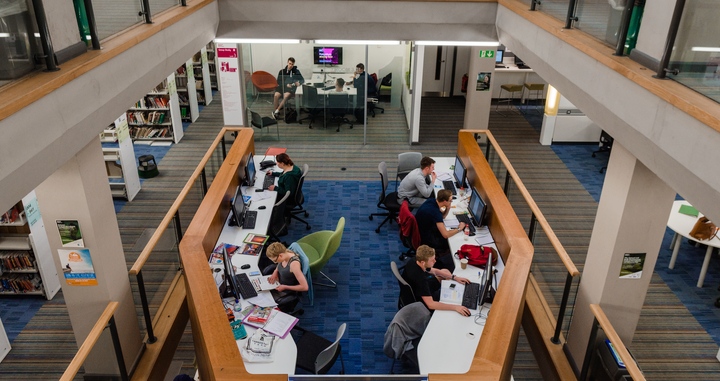
Adsetts library
Adsetts Library is located on our City Campus. It's open 24 hours a day, every day.
Explore the libraryEntry requirements
All students
Typically an Honours degree in Architecture, 2:2 or above, with RIBA Part 1 validation and ARB prescription, or Equivalent European qualifications, satisfying the EU Architects Directive 85/384/EEC.
In addition to the above, in all cases, suitability for entry will be judged by panel interview with presentation of design portfolio of academic work and where relevant, practice based work.
International or non-EU applicants will need to have a qualification from one of the RIBA Validated International Schools. A high level of English language competence will be required to complete the award successfully.
If the language in which the first degree was taught is not English then typically IELTS 6.5 will be required.
For entry onto the 2-year route of the course typically students would have had some experience of architectural practice, normally 6-12 months, but we are able to consider applications from students without practical experience.
Additional information for EU/International students
If you are an International or non-UK European student, you can find out more about the country specific qualifications we accept on our international qualifications page.
For details of English language entry requirements (IELTS), please see the information for 'All students'.
Fees and funding
Home students
Our tuition fee for UK students starting part-time study in 2027/28 is £20,100 for the course. These fees are regulated by the UK government and therefore subject to change in future years. The tuition fee displayed above is for the full course. If the full course is more than one year in duration, the fee will be divided into annual payments which will then be rounded. This may mean the total fee you pay is slightly higher than the fee stated above. If you take a break in study or have to re-take part of the course, you may also be charged an additional fee and will be notified of this at the time. Our tuition fee for UK students starting part-time study in 2027/28 is £6,700 per year (based on studying 80 credits per year).
If you are studying an undergraduate course, postgraduate pre-registration course or postgraduate research course over more than one academic year then your tuition fees may increase in subsequent years in line with Government regulations or UK Research and Innovation (UKRI) published fees. More information can be found in our terms and conditions under student fees regulations.
International students
This course is not eligible for full-time Tier4 visa sponsorship. International students may apply for part-time Tier 4 sponsorship on an individual basis. Please contact Admissions for further advice. Our tuition fee for International/EU students starting part-time study in 2027/28 is £37,800 for the course. The tuition fee displayed above is for the full course. If the full course is more than one year in duration, the fee will be divided into annual payments which will then be rounded. This may mean the total fee you pay is slightly higher than the fee stated above. If you take a break in study or have to re-take part of the course, you may also be charged an additional fee and will be notified of this at the time. Our tuition fee for International/EU students starting part-time study in 2027/28 is £12,600 per year (based on studying 80 credits per year).

Scholarships and financial support
Find information on scholarships, bursaries and postgraduate student loans.
International scholarships up to £3000 ›
Alumni scholarships up to £2000 ›
Postgraduate loans for UK students ›
Additional course costs
The links below allow you to view estimated general course additional costs, as well as costs associated with key activities on specific courses. These are estimates and are intended only as an indication of potential additional expenses. Actual costs can vary greatly depending on the choices you make during your course.
General course additional costs
Additional costs for Sheffield Creative Industries Institute (PDF, 274.9KB)Legal information
Any offer of a place to study is subject to your acceptance of the University’s Terms and Conditions and Student Regulations.