Everything you need to know...
-
What is the fee?
Home: £11,940 for the course
International/EU: £20,700 for the course -
How long will I study?
1 Year
-
Where will I study?
-
When do I start?
September 2026
Course summary
- Undertake taught modules and an extended research project in a professional lab.
- Explore the principles behind environmental, industrial and medical microbiology.
- Learn how microorganisms cause disease and interact with the immune system.
- Discover how bacteria and fungi are used as tools across various industries.
- Develop your lab skills, from experimental design to advanced microbiological techniques.
The MRes course focuses on research skills while exploring molecular microbiology, infectious diseases, prevention and treatment, and the biotechnological applications of microorganisms. You'll gain the theoretical knowledge and practical expertise needed for careers in microbiology across healthcare, industry and research.
To complete additional theory modules, see our MSc Molecular Microbiology course.
Come to an open day
Find out more at our postgraduate open days. Book now for your place.
How you learn
You’ll study in an engaging and supportive environment, designed to develop your independence, critical thinking and professional skills. The course follows our Hallam Model, ensuring an applied, collaborative and industry-relevant approach to your learning.
Lectures introduce key concepts, with interactive discussions and problem-solving exercises to encourage deeper learning. You'll engage with recent scientific developments and apply theoretical knowledge in practical settings. Key skills are embedded in your modules and research project – including scientific writing, literature and database searching, data handling and critical analysis.
You’ll progress from tutor-led to student-centred learning, encouraging independence and professional growth. You’ll receive continuous guidance and constructive feedback to support your academic journey.
You learn through:
- lectures and seminars
- interactive workshops
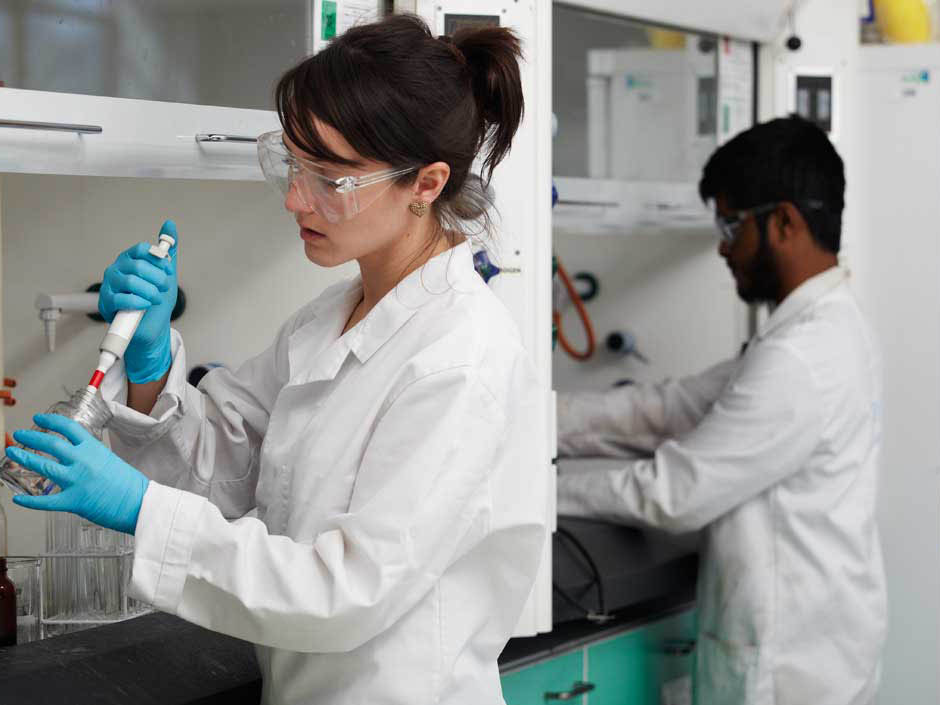
- practical laboratory classes
- an extended independent research project
- small group academic tutorials
Key themes
On the MRes programme you’ll undertake an extended research project within the area of molecular microbiology. Working alongside leading experts you’ll gain a range of practical skills, developing an in-depth knowledge of their theoretical underpinnings. You’ll also complete a written dissertation outlining your research findings.
Course-level support
You’ll be supported in your learning journey towards highly skilled, graduate-level employment through a number of key areas. These include:
- access to academic and career development support
- one-to-one guidance from student support advisers
- online and in-person resources from the Skills Centre, including assignment planning and structuring assistance
Applied learning
Networking opportunities
You'll have opportunities to connect with industry professionals through guest lectures, career fairs, mentoring schemes and leadership programmes – helping you build valuable industry connections and enhance your employability.
Course leaders and tutors
Sarah Forbes
Senior lecturer microbiology, MSc/MRes Molecular Microbiology, MSc/MRes Biomedical Laboratory ScienceI am a lecturer in biomedical sciences working within the fields of antimicrobial chemotherapy and microbial ecology
Modules
Important notice: The structure of this course is periodically reviewed and enhanced to provide the best possible learning experience for our students and ensure ongoing compliance with any professional, statutory and regulatory body standards. Module structure, content, delivery and assessment may change, but we expect the focus of the course and the learning outcomes to remain as described above. Following any changes, updated module information will be published on this page.
Final year
Compulsory modules
This module aims to equip you with both practical skills and theoretical knowledge of laboratory-based research and examine the important issues that make good laboratory practice. Within the programme, this module will prepare you for the semester two laboratory module and the semester three independent research project.
You’ll study topics such as:
• Fundamental practical laboratory training (including reagent preparation, accuracy and precision in performing experiments, health and safety) which will be underpinned by subject module theoretical knowledge.
• A range of course focussed laboratory methodologies and, where appropriate, other practical procedures.
• Effective communication and presentation skills development via the preparation of visual and written work in an appropriate context.
• Introduction to ethical issues and foundations of scientific integrity forming the implications of good laboratory practice.
• Understand and apply fundamental statistical methods for data analysis.
• Employability skills and career preparation (including CV development, application process).
This module explores the fundamental principles of microbiology on a molecular level that underpins both environmental and medical microbiology. How microbes sense their environment will be explored and how this information alters the microbes on the levels of the transcriptome, proteome and metabolome with be investigated. The virulence mechanisms and strategies that microorganisms apply throughout the infection cycle will be examined. Including, how the pathogen comes into contact with the host, how it establishes infection, the direct and indirect toxic effects on the host caused by the pathogen and strategies that can be employed to mitigate these effects will all be discussed. This will be supported by key knowledge surrounding microbial structure, metabolism and virulence with relevant lab classes, seminars and lectures.
You’ll study topics such as:
- Prokaryotic cellular physiology
- Transcriptional control systems
- Microbial metabolism
- Cell signalling pathways
- Biofilms
- Viral physiology and pathogenesis
- Factors affecting transmission of a pathogen from host to host, from the environment to the host or from vector to host
- Attachment and invasion of host cells/host tissue by microorganisms
- The secretion of toxins or other extracellular virulence factors
- Microbial evasion of the host immunological response
- The development and spread of antimicrobial resistance
- The use of vaccines, antibiotics and other therapeutic approaches for the prevention and/or treatment of infection
This module helps you develop the skills to plan and design your research project. You’ll learn how to review existing research, create a clear research proposal, and build a strong foundation for your experimental study. By the end, you’ll know how to turn research ideas into a well-structured academic project.
You’ll study topics such as:
• Conduct an independent literature review to enhance critical analysis and understanding of research topics.
• Design a structured research proposal with clear aims, ethical considerations, and safety protocols.
• Develop practical lab skills through structured experiments, including data analysis and troubleshooting.
• Understand and apply statistical methods for data analysis.
• Gain an understanding of the ethical and appropriate use of artificial intelligence in research.
• Help identify and articulate your employability skills.
Engaging with these core areas will prepare you for the demands of independent research and professional scientific practice.
This module provides an immersive research experience, enabling you to conduct a substantial, focused research project. Tailored to your specific degree programme, the project will challenge you to transform theoretical knowledge into practical scientific investigation.
You’ll study topics such as:
• Hands-on acquisition of advanced laboratory techniques and practical research skills
• In-depth critical analysis of experimental results, developing sophisticated scientific reasoning
• Preparation of a professional, article-style written research report demonstrating scholarly communication
• Development of oral scientific communication skills through project presentation.
• Active engagement with the research community, participating in collaborative research environments.
The module integrates practical research experience with critical academic skills, preparing you for advanced scientific research and professional scientific communication. By the conclusion of this project, you will have demonstrated independent research capabilities and contributed meaningful insights to your specific research field.
Future careers
This course prepares you for a career in:
- the pharmaceutical industry
- the industrial biotechnology sector
- food and beverage industries
- PhD study
Previous graduates have gone on to work for:
- Public Health England
- AstraZeneca
- Qiagen
- the NHS
Equipment and facilities
Teaching takes place in lecture theatres, seminar rooms and specialist laboratory facilities. Through our virtual learning environment Blackboard you’ll be able to access learning materials, interactive resources and course information – both on-campus and remotely.
You’ll have access to industry-standard equipment, gaining hands-on experience in scenario-based practical sessions. You’ll gain the technical expertise and practical experience needed for a career in microbiology, using facilities such as:
- award-winning cell culture suites
- aseptic microbiology facilities
- high-powered fluorescent microscopes for cell and tissue analysis
- state-of-the-art mass spectrometry equipment
- molecular biology facilities allowing quantification of nucleic acids and proteins
- an extensive range of analytical equipment, such as high-performance liquid chromatography (HPLC) and gas chromatography (GC)
360 tour - biosciences and chemistry facilities
Where will I study?
You study at City Campus through a structured mix of lectures, seminars and practical sessions as well as access to digital and online resources to support your learning.
City Campus
City Campus is located in the heart of Sheffield, within minutes of the train and bus stations.
City Campus map | City Campus tour
Adsetts library
Adsetts Library is located on our City Campus. It's open 24 hours a day, every day.
Learn moreLearn more about your department
Biosciences and Chemistry Facilities Tour
Take a look around the biosciences and chemistry facilities at Sheffield Hallam University with senior lecturer and recruitment lead Dr Susan Campbell.
Entry requirements
All students
A 2:1 in a relevant Honours degree is normally accepted as the entry requirement for the course. Applicants with alternative qualifications with academic attainment or skills in subjects which are directly relevant to the course will also be considered.
To be successful on this course, you must have relevant practical laboratory experience. Details of your laboratory experience must be specifically detailed in your personal statement and verified by one of your referees.
If English is not your first language you will need an IELTS score of 6.0 with a minimum of 5.5 in all skills, or a recognised equivalent.
Additional information for EU/International students
If you are an International or non-UK European student, you can find out more about the country specific qualifications we accept on our international qualifications page.
For details of English language entry requirements (IELTS), please see the information for 'All students'.
Fees and funding
Home students
Our tuition fee for UK students starting full-time study in 2026/27 is £11,940 for the course. The tuition fee displayed above is for the full course. If the full course is more than one year in duration, the fee will be divided into annual payments which will then be rounded. This may mean the total fee you pay is slightly higher than the fee stated above. If you take a break in study or have to re-take part of the course, you may also be charged an additional fee and will be notified of this at the time.
If you are studying an undergraduate course, postgraduate pre-registration course or postgraduate research course over more than one academic year then your tuition fees may increase in subsequent years in line with Government regulations or UK Research and Innovation (UKRI) published fees. More information can be found in our terms and conditions under student fees regulations.
International students
Our tuition fee for International/EU students starting full-time study in 2026/27 is £20,700 for the course. The tuition fee displayed above is for the full course. If the full course is more than one year in duration, the fee will be divided into annual payments which will then be rounded. This may mean the total fee you pay is slightly higher than the fee stated above. If you take a break in study or have to re-take part of the course, you may also be charged an additional fee and will be notified of this at the time.
Scholarships and financial support
Find information on scholarships, bursaries and postgraduate student loans.
International scholarships up to £3000 ›
Alumni scholarships up to £2000 ›
Postgraduate loans for UK students ›
Additional course costs
The links below allow you to view estimated general course additional costs, as well as costs associated with key activities on specific courses. These are estimates and are intended only as an indication of potential additional expenses. Actual costs can vary greatly depending on the choices you make during your course.
General course additional costs
Additional costs for Biosciences and Chemistry (PDF, 600.1KB)Legal information
Any offer of a place to study is subject to your acceptance of the University’s Terms and Conditions and Student Regulations.