

Everything you need to know...
-
Tuition fees
Home: £10,050 per year
International/EU: £18,900 per year -
Course duration
3 / 4 Years
-
Study location
-
Entry requirements
-
Course code
D050
-
Start date
September 2027
-
Placement year available?
Yes
Course summary
- Learn skills needed for contemporary game development.
- Gain a deep understanding of a range of theories, techniques and ethical issues required to work in game development related fields.
- Learn how to develop computer games using rigorous methods and processes.
- Develop a portfolio of commercial-quality work in the computer games and related industries.
By studying computer games technologies, you will be equipped with the skills required by industry to build computer games. Such games may be based on mobile platforms or work on traditional PC computers. You will work on the latest game development platforms, use the latest software, and work with like-minded people to achieve your career goals.
Employability
95% of UK graduates are in work or further study 15 months after graduating (2023/24 Graduate Outcomes Survey).

Come to an open day
Discover our TEF Gold rated teaching and see why students voted Sheffield Hallam a top five university in England at the prestigious Whatuni Student Choice Awards.

South Yorkshire Institute of Technology
As a partner of the South Yorkshire Institute of Technology, we offer high-quality technical education across multiple STEM subject areas.
How you learn
This BSc (Hons) Computer Games Technologies course is carefully structured to help you develop your skills and experience in the development of computer games. You’ll gain skills in critical thinking as well, so you can successfully reflect on your own work and appraise other people’s. This will give you the ability to evaluate your own progress and determine your own career goals.
We’ll begin by providing you with game development techniques – such as basic programming using C# and how to create games with 2D graphics. You’ll use industry-standard game development platforms including Unity and Unreal Engine, and you’ll explore game scripting and game development processes.
In your second year, you’ll apply your learning to solve the kinds of problems game developers face. Here you’ll learn about the technologies used to develop 3D games, as well as developing your own substantial game products. Then in your final year you’ll explore more advanced game development techniques and programming skills. You’ll also be encouraged to develop a substantial product that reflects your learning.
You’ll learn through everything you need to know about building computer games via:
- group work
- lectures and seminars
- technical workshops in computer labs
- independent learning
- practice-based learning and group work
Course support
You will be supported in your learning journey towards highly skilled, graduate level employment through several key areas. These include
- access to specialist support services to help with your personal, academic and career development
- access to our Skills Centre with one to ones and online resources, where you can get help with planning and structuring your assignments
- industry-specific employability activities such as live projects, learning in simulated environments and networking opportunities
Student's success story
BSc Computer Games Technologies students have made history with Racecar Crashers becoming the first UK student-made game released on the PlayStation Store. Built on a fully custom C++ engine, this high energy multiplayer PS5 racer showcases the real-world skills and creativity of Sheffield Hallam graduates.
Applied learning
Advance your career in computer games with a work placement
On this BSc (Hons) Computer Games Technologies course, you’ll have the opportunity to complete a year-long work placement between your second and third year. A placement is widely recognised as the gold standard opportunity to gain personal and professional development through real-world experience.
You will be encouraged to take up this opportunity, as it will benefit your long-term career prospects and salary level, as well as your academic achievements and degree classification. Your course will prepare you to succeed in your placement and you will be supported throughout it.
Your placement will allow you to apply the knowledge and skills gained on your course in the areas of game development and gameplay programming.
Students from similar courses have worked with companies such as
- Sony (SIEE)
- Sumo Digital
- Team17
- SN Systems
- SI Games
- Autodesk
Your placement year will allow you to gain an Applied Professional Diploma in addition to your degree which will enhance your graduate profile and give you the edge with future employers.
You’ll also be supported to take advantage of work experience opportunities throughout your course, through access to a range of support activities, resources, and employer events from your Employability Team. This will further enhance your employability skillset, confidence, and opportunity-awareness to help you succeed in your career after graduating.
Gain practical experience through live projects
During your computer games technologies degree you’ll have access to the Steel Minions Development Studio which is an in-house games publishing company run by course tutors and staffed by students. Here, students release their own projects commercially and connect with external publishers, research and commercial clients.
Steel Minions provides commercial and research projects for you to work on – either internally or for external clients. Examples range from research projects in ballistics impact visualisation and educational games, through to commercial games on PlayStation 4, PC and mobile devices for companies like Sumo Digital, Sony and Owlerton Stadium.
Steel Minions also provides mentoring to students who decide to create their own game development company during their placement year – and gives feedback to students working on game projects throughout the course.
Networking opportunities
In addition to learning in classrooms and computer labs, you’ll be able to engage with industry professionals and practitioners. They’ll give a variety of live talks on technical topics, career building and employability advice.
Competitions
You’ll be encouraged and supported to enter your work into student competitions – such as the TIGA Games Industry Awards – where we have a proven track record of competition success. These competitions provide valuable experience in interacting with games industry professionals.
Student's success story

BSc (Hons) Computer Science for Games student James Smith took a year-long placement as a programmer for video game developer Sumo Digital. Find out how he used his placement to put the skills he learnt on his course into practice. Read more
Your course leader

Paul Parry
Subject Group Leader for Applied ComputingAt present I teach C++ programming at final year undergraduate and masters levels. I also teach game software project management methods on the BSc Game Software De … Read more
Modules
Important notice: The structure of this course is periodically reviewed and enhanced to provide the best possible learning experience for our students and ensure ongoing compliance with any professional, statutory and regulatory body standards. Module structure, content, delivery and assessment may change, but we expect the focus of the course and the learning outcomes to remain as described above. Following any changes, updated module information will be published on this page.
You will be able to complete a placement year as part of this course. See the modules table below for further information.
Year 1
Compulsory modules
This module will give students the opportunity to develop games and related software artefacts in a project-based-learning context.
Students will apply relevant skills in both individual- and team-based project work under staff supervision. Importantly, students will be encouraged and supported to form and work in interdisciplinary teams.
Projects will comprise the development of 2D or 3D games (or parts thereof) and/or other software to support their development.
Part of this module will focus on LSEPI (Legal, Social, Ethical and Professional Issues) in the context of both the games industry and the wider IT industry. Moreover, the module will address the appropriate application of AI in games programming. We will cover AI prompt construction for generative AI, how to interpret the results from AI systems, and ethical and intellectual property implications.
The module will also cover the practical application of project-management and project-planning techniques, such as agile development and Scrum, the use of project tracking and scheduling software, and version control.
This module represents the Work Experience Module for this level of study. The type of work experience students will undertake here is an applied project.
This module introduces students to the key concepts of computer architectures and the mathematical and numerical concepts that underpin these.
The aim of the module is to give students a clear understanding of the relationship between computer software and the hardware on which it executes.
The module will cover topics such as:
Discrete Mathematics
Sets, relations, and functions.
Basic logic: propositional and predicate.
Basics of counting: cardinality, basic combinatorics, recurrence, and modular arithmetic.
Proof techniques: structure, induction, counterexamples, contradiction.
Graphs and trees.
Discrete probability.
Data organisation: data structures, e.g., arrays, lists and trees.
Matrices - basic ideas and concepts.
Mathematics of cryptography.
Basics of Computer Systems
Hexadecimal and binary number systems.
Floating point and other number systems.
Basic logic gates.
Elementary Boolean algebra.
Applications of logic circuits.
Generalised Computer Systems Architectures
Overview of a typical modern computer systems.
Central Processing Units (CPU).
Graphics Processing Units (GPU).
Memory systems.
Machine code and programming in a low-level assembler.
The role of the operating system.
This module introduces computer programming. It will focus on the design and implementation of software using the procedural facilities of programming languages. The ideas and techniques taught in the module are widely used in developing games and graphical applications as well as other large-scale software systems.
The module will cover topics such as:
Software engineering concepts such as top-down design, abstraction and functional decomposition.
The software development process, including specification, design, implementation and testing techniques.
Algorithms and control structures.
Procedures and functions.
Variables, data types, data structures and basic object orientation.
Dealing with the input/output of strings and files.
Program quality, including production of understandable and maintainable code, code readability and documentation.
Software tools and integrated development environments (IDEs): compilers, debuggers, libraries.
Using programming languages such as C++.
Software design techniques such as UML and flowcharts.
Source control.
This module will cover the use of contemporary game development tools and game engines. It will provide students with an opportunity to create game applications using a mix of game engines and rudimentary programming techniques.
Typically, the module will cover:
The use of industry standard game development platforms and engines such as Unreal Engine and Unity.
Programming skills sufficient to develop basic games using industry standard languages, such as C#.
Fundamental programming concepts such as sequence, selection and iteration.
Software engineering techniques such as functional decomposition and top-down design.
How to combine pre-made art assets in the development of basic games.
Responding to in-game events using tools and programming techniques.
Project management techniques such as agile development, asset management and project tracking.
Year 2
Compulsory modules
This module will give students the opportunity to further develop their programming and game development skills. The module will provide opportunities to develop game(s) and use associated software tools in the process. Moreover, the module will demonstrate and encourage students to engage in modern game development practices which include all elements of the game development lifecycle, doing so in small groups.
The overall aim is to facilitate an environment for students to experience ideation, design, implementation and testing of new games in a way that reflects contemporary industry practices.
This module represents the Work Experience Module for this level of study. The type of work experience students will undertake here is an applied project.
Typically, the module will cover:
Developing 2D or 3D game products in accordance with recognised industry-standard development lifecycles and processes, such as agile development and version control, in a team-based context.
Further development of programming skills using C++, lua and/or C#, or other scripting approaches.
Game testing and evaluation.
Use game development platforms such as DirectX, Vulkan, Unity or Unreal to develop game applications.
Integrate art and sound assets.
Students will apply relevant skills in team-based project work under staff supervision. Importantly, students will be encouraged and supported to form and work in interdisciplinary teams.
Part of this module will address professional issues in the games industry such as coding tests, assessment centres and interview practice.
This module represents the Work Experience Module for this level of study. The type of work experience students will undertake here is an applied project.
This module continues to develop a student’s programming skills. It covers the object-oriented programming (OOP) paradigm in depth.
The module typically covers:
Fundamental object-oriented programming concepts such as encapsulation, inheritance, polymorphism, message passing and abstraction.
How to apply the OOP concepts using modern programming languages such as C++ and/or C#.
Using OOP to design and develop large-scale software systems.
Benefits and challenges of the OOP approach.
Impact of OOP on the software development lifecycle.
OOP in game development.
Software reuse as facilitated by OOP.
Using software engineering techniques and practices such as source control and software design including class diagrams, in the development of software systems.
This module will also prepare students for their placement year through the creation of an online portfolio, cover letters, CV and other documentation to assist their placement applications.
Software executes on hardware. An understanding of the synthesis of these two technologies, often mediated by a programming language, allows software developers to optimate program behaviour. This module provides students with skills to exploit various optimisation methods in practical situations.
The module will typically cover:
Hand-made and compiler generated optimisation methods.
The role of compilers in generating and optimising code.
Optimising C++ code on Intel/AMD x86 platforms.
Using compiler switches.
Inline assembly.
Performance monitoring and measurement.
Hardware facilities for optimising code execution.
The use of tools, such as timers, profilers, debuggers, disassemblers and tuners, to optimise code.
Elective modules
This module will develop the student’s understanding of game design. It will cover the intricacies of designing playable and enjoyable videogames, with a focus on how gameplay can be created through game mechanics. The module will be practical in nature and will support the student in creating working games (or parts thereof) that demonstrate these mechanics and designs.
The module will typically cover:
Specific game mechanics in contemporary game designs, such as FPS move/shoot, RPG inventory, card drawing, puzzles, XP/Level systems, action/platformer movement, vehicle movement,.
Using advanced sub-systems available within game engines, such as Niagara particles, MetaSounds, World Partition, Behaviour Trees, animation systems.
Exploring mobile game design paradigms, including programming for mobile specific technologies such as accelerometers and gyroscopes.
Building some of the more common game mechanics, how to critique these, and examples of innovative game mechanics.
Appropriate programming techniques that are used in creating such game mechanics.
This module will extend student’s knowledge of mathematics, graphics algorithms and programming. It introduces a range of graphical modelling and rendering techniques that underpin all graphical representations, including computer games. The module will cover how to implement these techniques using a contemporary programming language to create graphical applications.
The module will typically topics such as:
Co-ordinate systems, including model-, world- and normalised coordinates.
2D and 3D geometry, including points, vectors, lines, planes, polyhedral and normals.
Transformations, including homogeneous coordinates, rotation, translation, reflection, scaling and shear in 2D and 3D spaces, combined operations and viewing transformations.
Projections mathematics, including perspective, parallel, centre of projection and view plane.
Culling and clipping algorithms.
Mapping to a viewport.
Rendering, including scan conversion and hidden line/surface removal.
Mathematics of illumination models and shading techniques.
Octrees and quadtrees.
3D object representations.
Simulation of physical/real world, including modelling motion and collision detection.
Techniques for efficient rendering.
Graphics programming with a language such as C++.
Year 3
Compulsory modules
Module aim:
The aim of this module is to enhance students’ professional development through the completion of and reflection on meaningful work placement(s).
A work placement will provide students with opportunities to experience the realities of professional employment and experience how their course can be applied within their chosen industry setting. The placement will:
- Allow student to apply the skills, theories and behaviours relevant and in addition to their course
- Enable students to enhance their interpersonal skills in demand by graduate employers – communication, problem-solving, creativity, resilience, team work etc.
- Grow their student network and relationship building skills.
- Provide student with insights into the industry and sector in which their placement occurs
- Help student make informed graduate careers choices.
Indicative Content:
In this module students undertake a sandwich placement (min 24 weeks / min 21 hours per week) which is integrated, assessed and aligned to their studies.
Their personal Placement Academic Supervisor (PAS) will be their key point of contact during their placement and will encourage and support students to reflect on their experience, learning and contribution to the organisation they work for.
To demonstrate gains in professional development, students will be required to share their progress, learning and achievements with their Placement Academic Supervisor and reflect on these for the summative piece of work.
Final year
Compulsory modules
This module will give students the opportunity to further develop their programming and game development skills. The module will provide opportunities to develop substantial game(s) and use associated software tools in the process. Moreover, the module will demonstrate and encourage students to engage in modern game development practices, form interdisciplinary teams and institute rigorous project management across all elements of the game development lifecycle.
The overall aim is to facilitate an environment for students to experience in-depth ideation, design, implementation and testing of new games in a realistic way which reflects contemporary industry practices.
Typically, the module will cover:
Developing 2D or 3D game products in accordance with recognised industry-standard development lifecycles, processes and techniques.
Managing projects, task allocation in teams, estimating task and project duration, critical paths, documenting project progress and project oversight.
Further development of programming skills using C++ and/or C#, or other scripting approaches and tools.
Game testing and evaluation.
Use low level graphics APIs such as DirectX, Vulkan to develop game applications.
Integrate art and sound assets.
Students will apply relevant skills in team-based project work under staff supervision. Importantly, students will be encouraged and supported to form and work in interdisciplinary teams.
This module represents the Work Experience Module for this level of study. The type of work experience students will undertake here is an applied project.
This module is a research project of your choice – you’ll identify a computer-based problem, investigate the requirements, analyse results of research undertaken and design, and develop and evaluate a solution to that problem. You’ll then evaluate the project’s success, your learnings and opportunities for further work.
You’ll apply skills and learning such as:
- Ideation and planning a larger-scale project
- Information gathering and literature reviews
- The selection of tools, techniques or methods
- Implementation, testing and user evaluation
- Critical reflection on project deliverables, success or failure
- Referencing and citation techniques
- Legal, social, and ethical considerations
- Security and confidentiality
- Sustainable development and deployment
- Employability skills and attributes
Elective modules
This module will expand the student’s skillset by enabling them to work on native console platforms such as PlayStation 4 and 5.
The module will typically cover:
High performance game engine development approaches.
Low-level rendering techniques and concepts in the context of games console application development.
Native asset management workflows, including sprite loading, model loading, dynamic texture assignment & hardware optimised formats.
Texture mapping using UV coordinates and advanced techniques such as texture tiling and scrolling/animated textures.
Data-driven development techniques, such as external asset pipelines and level data integration
The extension of a provided PlayStation engine framework, encouraging modular, scalable, and designer-friendly system design.
Application of industry-standard tools and libraries for parsing, asset management, and content creation (e.g., Assimp, TinyOBJ, TinyXML, texture packing tools).
This module explores the deeper conceptual and technical features of software implementation techniques using the C++ programming language specifically. The module covers a range of contemporary programming techniques such as optimisation, multithreading, generic programming and others that contribute to building modern software systems.
The module will typically cover:
The standard template library and its structure, API and operation, STL containers, algorithms, iterators.
Developing new STL containers.
Templates in C++, writing generic code, inheritance and templates.
C++ optimisation techniques.
Multithreading in C++.
Exceptional situations and undefined behaviours.
Secure programming.
The focus of this module is the design and implementation of a software artefact in the context of virtual or augmented reality (VR/AR). The module will cover the use of XR design and development paradigms.
The module will typically cover:
Developing knowledge and awareness of XR (virtual, augmented and mixed reality) software and hardware.
Researching the ethical, social and health-related impacts of XR.
Applying current development methodologies to plan and create an XR deliverable.
Best practices for user centric navigation in VR.
XR distribution platforms and target audiences.
Applications of XR for gaming, serious games and simulations.
Haptic technologies and the future of XR.
This module covers the use of game engines and game development platforms. Specifically, it will teach students how to deal with situations when there is a need to extend the features of the existing platform. Typically, this will be undertaken using programming and scripting to create plugins or other additional middleware.
The module will typically cover:
Programming and scripting techniques appropriate for extending game engines.
Taking into account technological limitations and availability of features inherent in development tools.
Enhancing and evaluating advanced features of contemporary game development platforms, such as Unity and/or Godot.
Future careers
This course prepares you for a career in
- game development
- game design
- gameplay programming
- quality assurance testing

All in on your career
We promise you’ll be ready to launch your career. With employer connections, hands-on learning and lifelong career support, we’ll help make your ambition a reality.
Equipment and facilities
On this course you work with
- high-spec computers and graphics cards in our dedicated games laboratories
- PlayStation 4 and PlayStation 5 development kits
- State-of-the-art-machine software and application development environments
- modern Virtual Reality headsets
We’ve invested over £100m in new facilities to help you study how and when you want. This means 24-hour libraries and study spaces designed by our students.
Media Gallery
-
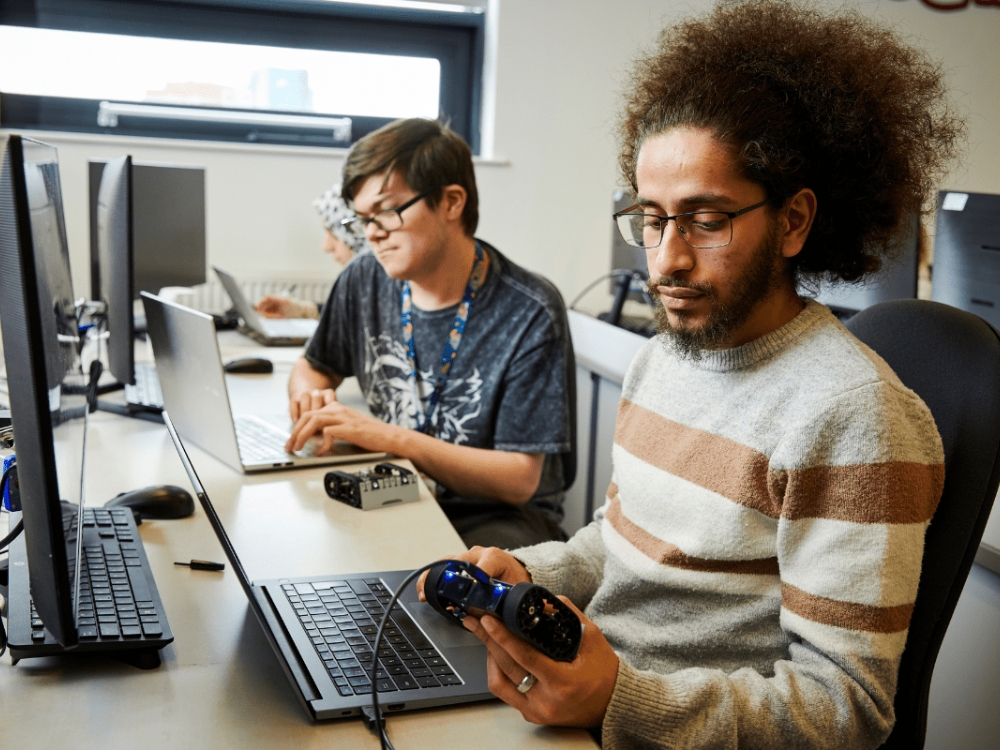
Computing Development -
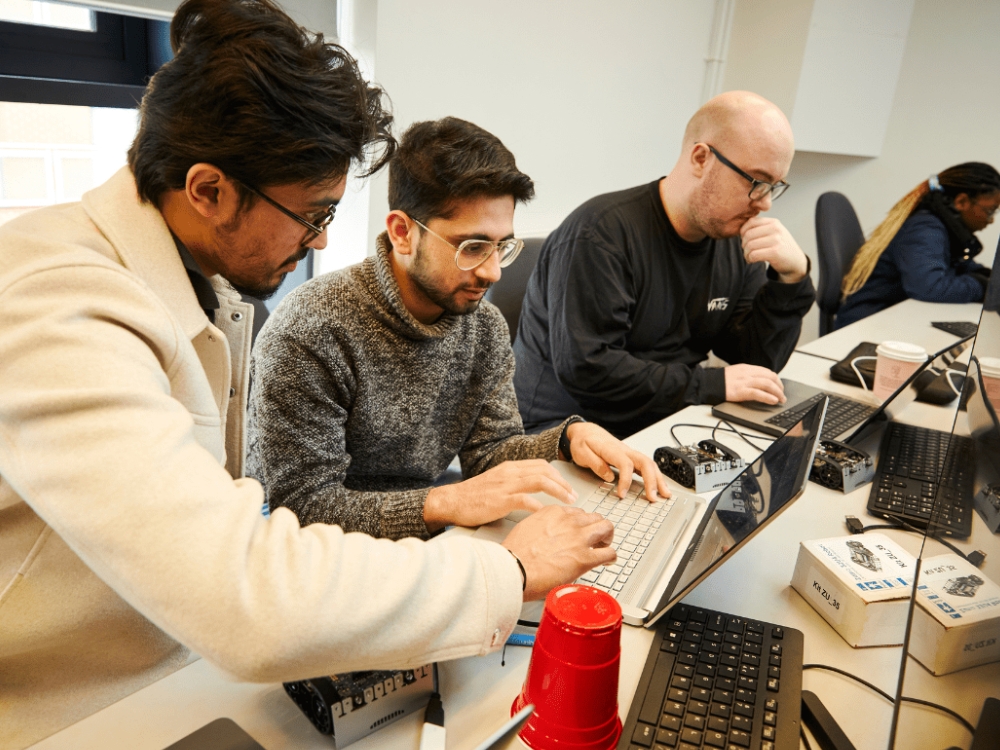
Computing Labs -

Computing Software -

Computing Equipment
Where will I study?
You study at City Campus through a structured mix of lectures, seminars and practical sessions as well as access to digital and online resources to support your learning.
City Campus
City Campus is located in the heart of Sheffield, within minutes of the train and bus stations.
City Campus map | City Campus tour

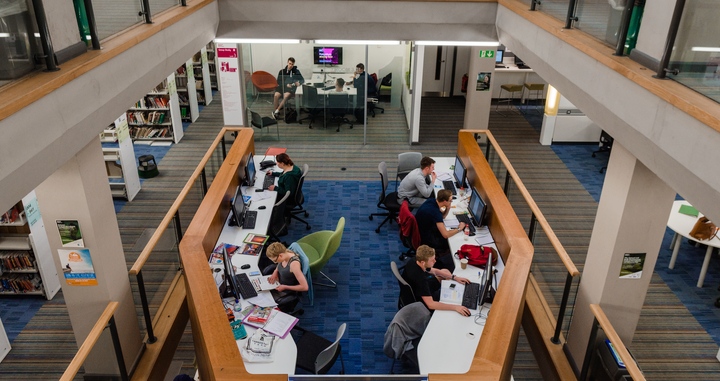
Adsetts library
Adsetts Library is located on our City Campus. It's open 24 hours a day, every day.
Explore the libraryExplore Strines
Explore Strines
Strines is where you’ll find our new Institute of Technology – a state-of-the-art learning space for manufacturing, engineering, construction, and creative and digital disciplines.
Entry requirements
All students
UCAS points
- Standard offer: 112 UCAS points
- Contextual offer: 96 UCAS points
We make contextual offers to local applicants, applicants living in low participation areas and applicants with specific personal circumstances. Check your eligibility for a contextual offer.
This must include at least 64 points from 2 A levels or equivalent BTEC National qualifications. For example:
- DMM in BTEC Extended Diploma
- Merit overall from a T level qualification
- A combination of qualifications, which may include AS Levels and EPQ
You can find information on making sense of UCAS tariff points here and use the UCAS tariff calculator to work out your points.
GCSE
- Maths at grade C or 4
GCSE equivalents
- Level 2 Numeracy or Functional Skills Level 2 Maths
• Access - an Access to HE Diploma with at least 45 credits at level 3 and 15 credits at level 2. At least 15 level 3 credits must be at merit grade or above, from a QAA-recognised Access to HE course, or an equivalent Access to HE certificate.
If English is not your first language, you will need an IELTS score of 6.0 with a minimum of 5.5 in all skills, or equivalent.
We welcome applications from people of any age. We may be flexible in our normal offer if you can show a commitment to succeed and have the relevant skills and experience. This must show that you will benefit from and finish the course successfully.
Additional information for EU/International students
If you are an International or non-UK European student, you can find out more about the country specific qualifications we accept on our international qualifications page.
For details of English language entry requirements (IELTS), please see the information for 'All students'.
Fees and funding
Home students
Our tuition fee for UK students on full-time undergraduate courses in 2027/28 is £10,050 per year (capped at a maximum of 20% of this during your placement year). These fees are regulated by the UK government and therefore subject to change in future years.
If you are studying an undergraduate course, postgraduate pre-registration course or postgraduate research course over more than one academic year then your tuition fees may increase in subsequent years in line with Government regulations or UK Research and Innovation (UKRI) published fees. More information can be found in our terms and conditions under student fees regulations.
International students
Our tuition fee for International/EU students starting full-time study in 2027/28 is £18,900 per year (capped at a maximum of 20% of this during your placement year)

Financial support for home/EU students
How tuition fees work, student loans and other financial support available.
Additional course costs
The links below allow you to view estimated general course additional costs, as well as costs associated with key activities on specific courses. These are estimates and are intended only as an indication of potential additional expenses. Actual costs can vary greatly depending on the choices you make during your course.
General course additional costs
Additional costs for School of Computing and Digital Technologies (PDF, 242.1KB)Legal information
Any offer of a place to study is subject to your acceptance of the University’s Terms and Conditions and Student Regulations.