Everything you need to know...
-
What is the fee?
Home: £10,620 for the course
International/EU: £17,725 for the course -
How long will I study?
1 Year
-
Where will I study?
-
When do I start?
January 2026
Course summary
- Study modern AI practices, theories, techniques and ethical considerations.
- Develop your problem-solving skills by applying AI methods.
- Gain in-depth understanding by exploring rigorous development processes.
- Cultivate a substantial portfolio of commercial-quality work.
On this course you’ll learn techniques relevant to the field of AI, from machine learning and to natural language processing. You’ll consider real-world challenges while developing your problem-solving and professional skills – plus a portfolio that enhances your employability in the dynamic field of AI, as well as other related industries.
Come to an open day
Find out more at our postgraduate open days. Book now for your place.
How you learn
Your lecturer’s view
This course emphasises hands-on learning in AI and machine learning, covering key areas like neural networks, robotics, natural language processing and computer vision.
You’ll prepare for real-world challenges through practical projects and collaborations with industry partners. The course also focuses on ethical considerations, security, privacy, and AI bias, encouraging a responsible approach to AI. Our expert staff help you gain both theoretical knowledge and practical skills, enhancing your employability.
You learn through:
- Lectures
- Tutorials and seminars
- Regular feedback
- Laboratory sessions
- Real-world problems
- Practical activity-based sessions
- Group and individual project work
- Supervisor support and guidance
- Acting as mentors for new students
- Self-directed study
Key themes
You’ll explore technical concepts across key areas of AI, including machine learning foundations, neural networks, cognitive systems for robotic logic and computer vision techniques. When combined, these lead into early course projects such as simulating a self-driving robot and evaluating its success.
You’ll then progress onto larger projects with industry clients that solve real-world problems. During those projects, you’ll have regular scrum meetings with academics and clients that identify narratives, learning needs and action plans to progress. You could find yourself working on a recommendation system for a retail company, or training robot football players to win the robot football world cup.
Ultimately you’ll engage in and with AI research, enhancing your learning and leading into your individual dissertation project. This is your opportunity to tailor your own piece of work in the discipline – as wide ranging as a computer-game-playing robot to screening skin conditions – with regular support from your supervisor.
Applied learning
Work placements
This course has a work experience route that offers a placement in industry of up to 12 months. For further information, please see MSc Artificial Intelligence (Work Experience).
Live projects
We maintain strong links with the AI industry, ensuring our curriculum remains relevant and aligned with industry requirements. Our industry partners and collaborations across local and national research centres include Sheffield Hallam’s Advanced Wellbeing Research Centre, Sheffield Robotics, the Advanced Manufacturing Research Centre, AstraZeneca, and the British Machine Vision Association. Collaborations with domain experts provide you with exposure to cutting-edge technologies and real-world applications.
These collaborations facilitate live projects, where you’ll work on real-world AI challenges. You’ll develop technical and professional skills – including creativity, critical thinking, collaboration, communication and leadership – all essential for industry employment. The aim is to mirror the complexity of scenarios you’ll encounter in the professional realm.
Previous students have worked on projects analysing performance with British Equestrian, and smart homecare for fall detection with Sheffield Children’s Hospital.
Networking opportunities
As part of your learning, we have regular guest lecturers who are experts in their field of AI.
Through networking events you’ll connect with industry professionals, enhancing your understanding of the AI landscape while opening doors to mentorship, internships and potential employment opportunities.
One of our most important events is our AI Festival – an enriching day filled with presentations, networking opportunities and celebrations of completed projects.
Competitions
Our events also include themed competitions, allowing you to showcase your skills and knowledge in AI, helping you to promote innovation and development.
Course leaders and tutors
Dr Maria Luisa Davila Garcia
Senior LecturerStaff profile for Dr Maria Luisa Davila Garcia, Lecturer in Artificial Intelligence at Sheffield Hallam University.
Modules
Important notice: The structure of this course is periodically reviewed and enhanced to provide the best possible learning experience for our students and ensure ongoing compliance with any professional, statutory and regulatory body standards. Module structure, content, delivery and assessment may change, but we expect the focus of the course and the learning outcomes to remain as described above. Following any changes, updated module information will be published on this page.
Final year
Compulsory modules
This module examines robotics and practical artificial intelligence, with a focus on cognitive and autonomous systems. It explores the challenges involved in designing and programming intelligent agents that interact with the physical world. It will integrate computer vision, natural language processing and deep learning into robot programming to make these agents even more intelligent
You’ll study topics such as:
- Sensory data to perceive their surroundings
- Reasoning and decision making
- Images, video and text processing
- Neural architectures
- Natural language processing
This module will solve a problem(s) by applying and developing artificial intelligence techniques and engaging with real-world situations. The module will develop an AI project that will be practical in nature, providing an opportunity to learn from work-related activities and to develop skills for collaborating in groups and with external clients.
You’ll study topics such as:
- Identify, develop, and adapt appropriate tools, techniques, and systems from the AI area
- Write project specification(s) and learn and apply project management skills as part of group work
- Identify project risks and issues that may impact the delivery of the final work
- Testing and evaluation of solutions
- Group working and interpersonal communication techniques
- Evaluation and reflection of personal performance
This module will develop skills to effectively convey intricate artificial intelligence (AI) ideas to diverse audiences. Focused on enhancing presentation skills, the module places a strong emphasis on translating complex concepts into accessible explanations while fostering critical evaluation of peer-reviewed scientific publications.
You’ll study topics such as:
- Independent thought and learner autonomy
- Seminar presentations in the format of the 3MT (three minutes thesis)
- Research-based scientific communication
- Critical evaluation of research findings
- Effective presentations
This module will apply the technical knowledge and understanding developed across the course into an original research project. This will include critical and ethical analysis of literature, synthesising the findings and tailoring them to the specific context of their research projects using a suitable research methodology.
You’ll study topics such as:
- Critical and ethical review of the literature
- Selection and application of appropriate research tools, techniques, or methods
- Design and development of the artefact/prototype
- Testing and user evaluation
- Critical reflection – evaluating the project deliverables and project success/failure
- Legal, social, and ethical considerations in the design and development of computer-based systems
- Sustainable development and deployment
This module explores the main approaches to machine learning, focusing on modern Deep Neural Networks (DNNs) in a variety of application domains. DNNs have revolutionised artificial intelligence due to their flexibility, generalisation, and scaling properties; for that reason, they have become an enabling technology for the solution of many problems in industrial and academic settings.
You’ll study topics such as:
- Deep Neural Networks
- Architectural ideas, intuitions, and training paradigms
- Evaluation and fine tuning of machine learning models
- Supervised and unsupervised and reinforcement learning
This module develops skills to design and conduct rigorous research projects in computing.
You’ll study topics such as:
- Identify research problems: Explore current challenges and opportunities in computing to uncover relevant research areas
- Formulate research questions: Craft precise questions, aims, and objectives aligned with identified problems
- Review literature and artifacts: Critically analysing existing research to synthesize knowledge and identify gaps
- Propose research methods: Evaluate and select appropriate research techniques specific to your computing area
- Communicate research proposals: Craft comprehensive proposals that meet professional, legal, and ethical standards
Future careers
This course prepares you for a career in:
- AI systems development, solving problems in a range of industries
- Data mining analysis, using AI to provide data insights
- Robotics programming, embedding AI technologies into new services
- Machine learning engineering, designing new AI systems with autonomy.
Equipment and facilities
On this course you work with:
- IT laboratories equipped with high-spec computers
- AI hardware accelerators
- GPUs for parallel processing
- Lower-power neuromorphic computing modules
- State-of-the-art-machine learning software
- Application development environments
- Specialist facilities for research
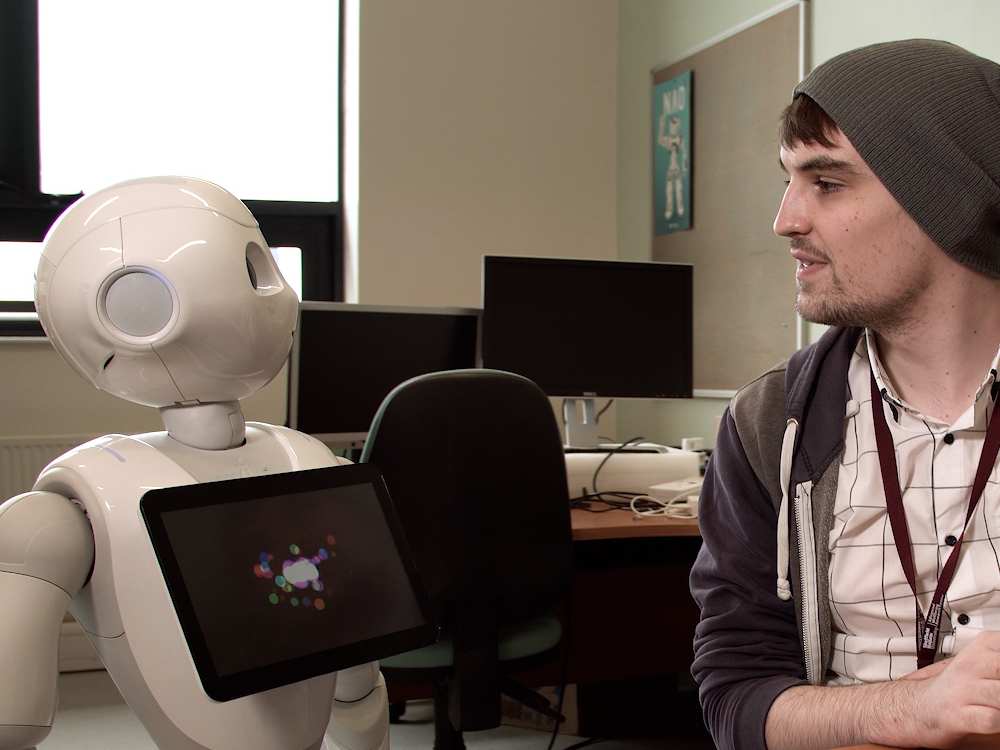
- Advanced robotics platforms, e.g. Care-O-bot Social Robot, NAO, Pepper and Turtlebot
- Cloud computing and Edge computing platforms
Where will I study?
You study at City Campus through a structured mix of lectures, seminars and practical sessions as well as access to digital and online resources to support your learning.
City Campus
City Campus is located in the heart of Sheffield, within minutes of the train and bus stations.
City Campus map | City Campus tour
Adsetts library
Adsetts Library is located on our City Campus. It's open 24 hours a day, every day.
Learn moreEntry requirements
All students
First degree in a relevant subject area, including (but not limited to) Computer Science, Software Engineering, Games Programming. Applicants with a first degree in another technical computing field will also be considered. First degree classification of 2:2 or above. We would also consider applicants with relevant and substantial industry experience in software engineering or software development in leu of a relevant first degree. If English is not your first language, you will need an IELTS score of 6.0 with a minimum of 5.5 in all skills, or equivalent.
Additional information for EU/International students
If you are an International or non-UK European student, you can find out more about the country specific qualifications we accept on our international qualifications page.
For details of English language entry requirements (IELTS), please see the information for 'All students'.
Fees and funding
Home students
Our tuition fee for UK students starting full-time study in 2025/26 is £10,620 for the course.
If you are studying an undergraduate course, postgraduate pre-registration course or postgraduate research course over more than one academic year then your tuition fees may increase in subsequent years in line with Government regulations or UK Research and Innovation (UKRI) published fees. More information can be found in our terms and conditions under student fees regulations.
International students
Our tuition fee for International/EU students starting full-time study in 2025/26 is £17,725 for the course.
Scholarships and financial support
Find information on scholarships, bursaries and postgraduate student loans.
International scholarships up to £3000 ›
Alumni scholarships up to £2000 ›
Postgraduate loans for UK students ›
Additional course costs
The links below allow you to view estimated general course additional costs, as well as costs associated with key activities on specific courses. These are estimates and are intended only as an indication of potential additional expenses. Actual costs can vary greatly depending on the choices you make during your course.
General course additional costs
Additional costs for School of Computing and Digital Technologies (PDF, 131.3KB)Legal information
Any offer of a place to study is subject to your acceptance of the University’s Terms and Conditions and Student Regulations.