
Everything you need to know...
-
Tuition fees
Home: £12,990 for the course
International/EU: £21,030 for the course -
Course duration
2 Years
-
Study location
-
Start date
September 2027
-
Placement year available?
Yes
Course summary
- Learn programming with Microsoft Azure AI and Google Cloud Vertex AI.
- Understand the ethical and data biases in AI solutions.
- Explore software development, transport solutions and health technologies.
- Gain related knowledge such as database management and web.
- Collaborate with our industry contacts on live projects.
Study an MSc Computing with Artificial Intelligence (AI) conversion course that’s designed for graduates without a computing background. You’ll build the fundamental computing skills you’ll need to work with AI technologies. While tackling real-world client projects through project-based learning, you’ll also develop professional skills in problem solving, professional communication and project management.
You’ll graduate with a foundational understanding of key computing concepts, ready to specialise in artificial intelligence – a highly sought-after competency in today’s job market.

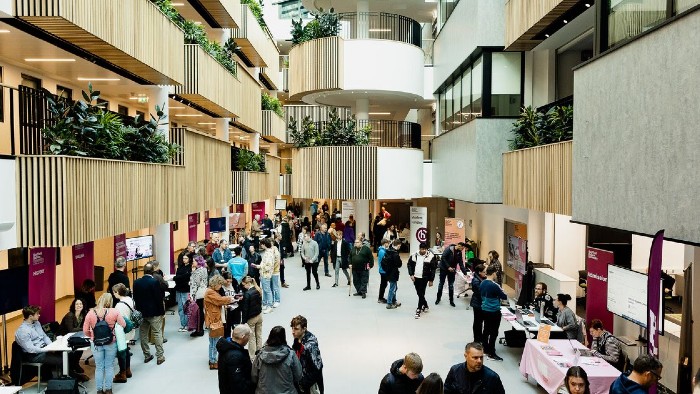
Come to an open day
Find out more at our postgraduate open days. Book now for your place.
How you learn
Our MSc Computing with AI programme is a hands-on learning experience, so you’ll develop the AI and computing skills employers are looking for. You’ll learn to design and develop scalable intelligent systems and applications that transform data into actionable knowledge and automation into innovation. By mastering the AI technologies, you’ll position yourself at the forefront of digital transformation, empowered to shape the future through intelligent, human-centred and ethical AI solutions.
The course imparts a broad range of theories, practical skills, and ethical and professional insights – cultivating successful IT professionals from diverse backgrounds. The curriculum emphasises cutting-edge IT practices and familiarises you with advanced AI skills, preparing you to meet global industry demands and take the lead in intelligent technology innovation.
You’ll also complete live projects for actual clients – such as WebMart, Made In The Cellar, and IG Tech (healthcare solution providers). These help you build a substantial portfolio of commercial-quality work, further enhancing your employment prospects when you graduate.
You learn through:
- project-based learning focused on AI applications
- hands-on lab sessions and tutorials
- AI tools and frameworks, such as PyTorch, Keras and TensorFlow
- regular feedback to support your technical and professional growth
- group activities around client projects and case studies
- presentations and discussions to support collaborative learning
- research and development projects exploring innovative AI techniques
- technical development work
- portfolio creation for employability
- self-directed learning
MSc Computing with AI key themes
The Computing with AI curriculum covers computing topics such as databases, programming, project management, web development, and AI for specialisation. The course prioritises flexibility, adapting to the latest AI technologies and catering to varying IT proficiency levels, tailoring teaching materials to individual needs.
You’ll develop fundamental programming skills in Python and C#, alongside database development and web technologies. This will serve as your essential foundation for understanding and applying AI technologies.
Building on those foundational skills, you’ll develop an appreciation of professional software development lifecycles, project management and research skills – alongside your specialisation into AI technologies.
Using platforms including Visual Studio Code and Jupyter Notebook, you will use PyTorch, Keras and TensorFlow libraries as you develop your understanding of AI technologies and solutions.
You’ll learn how to develop and deploy all sorts of techniques and technologies – from building AI models and natural language processing (NLP), to convolution neural network models and scaling agentic AI using microservices architectures:
Your masters-level computing and AI skills are developed through real-world projects set by our industry collaborators. You’ll also showcase your skills and knowledge developed throughout the course by undertaking a research-led AI project. This is a chance to further specialise in a particular area of AI, with regular support from your academic supervisor.
Course support
You will be supported in your learning journey towards highly skilled employment through a number of key areas. These include:
- access to specialist support services to help with your personal, academic and career development.
- access to our Skills Centre with one-to-ones, webinars and online resources, where you can get help with planning and structuring your assignments.
- industry-specific employability activities such as live projects and networking opportunities.
Follow our Sheffield Business School Instagram to see real student life, course experiences, events and what it is like to study here.
Applied learning
Build your computing with AI career through work experience
You’ll have the opportunity to go on a work placement for up to 12 months, where you’ll apply academic theory and your skills in a real-world setting. This hands-on experience will enhance your professional development and help you to make informed career choices after graduation.
We’ll support you to source a placement that is relevant to your course. Throughout your placement, you’ll be supported to reflect on your experience and contribution to the organisation you work for. You'll also share your progress and achievements with your Placement Academic Supervisor as part of your final assessment.
During your placement, you could explore a variety of areas – such as collaborating in teams to develop AI-driven business solutions, analysing data patterns and trends for predictive modelling and forecasting, creating intelligent chatbots to enhance user experience, or designing innovative marketing campaigns powered by AI technologies.
Your placement year also allows you to gain an Applied Professional Diploma, in addition to your degree, further enhancing your graduation profile.
Apply your skills to real business challenges
During the MSc Computing with AI programme, you’ll work in small groups on real client-based projects. You’ll analyse their requirements, before designing, developing and evaluating prototype AI solutions – which you’ll then present to the client.
During these projects, you’ll have regular meetings with the clients to identify their needs and manage progress. Examples of projects include AI-based recommendation systems for optimal space utilisation, and efficient logistic/transportation route planning and management.
Previous students on our courses have worked on live projects with industry collaborators such as AcquaSensor, Simoda, and Made In The Cellar, using AI technologies including Google Colab and Vertex.
Grow your computing with AI network
Throughout the course, you’ll have chances to attend career fairs and workshops, take part in employer presentations and visits, and seek guidance from professional advisers. We also integrate guest lecture talks and networking opportunities within the curriculum, giving you insights into the practical application of cutting-edge technologies and best practices.
One of our most important events is our AI Festival – an enriching day filled with presentations, networking opportunities and celebrations of completed projects. Find out more about our Festival of Computing.
Modules
Module and assessment information for future years is displayed as currently validated and may be liable to change. When selecting electives, your choices will be subject to the core requirements of the course. As a result, selections may be limited to a choice between one of two or more specified electives in some instances.
You will be able to complete a placement year as part of this course. See the modules table below for further information.
Year 1
Compulsory modules
Develop specialist knowledge to apply advanced topics and approaches of artificial intelligence (AI) to real-world business needs. You will learn through project-led activities to process image, video, text, and IoT streaming data, as well as to develop, test, and optimise AI applications such as prediction and classification. You will research and develop several AI applications in group-based or independent activities with a focus on deep learning and agentic artificial intelligence. The module also provides hands-on experience in industrial data management and promotes understanding of ethical considerations in AI applications development.
You will study topics such as:
Case Studies of AI adoption across industries
Understanding of AI subfields: machine learning, deep learning, and agentic AI
Supervised, unsupervised and reinforcement learning.
Developing an understanding of data processing techniques for image, video, text, and IoT data.
Applying predictive modelling and classification techniques to solve real-world problems.
Comparing AI solutions performance using relevant metrics.
Ethics of AI and responsible practices, including data and model bias.
Industry best practices for scaling and managing AI applications.
Writing project proposals and communicating the results of AI-based applications.
This module examines full-stack software development, covering technologies need for both front-end and back-end development.
You’ll study topics such as:
- Programming
- Web-based systems such as protocols used for communication in the client/server model
- Client-side technologies used to create document structure (HTML) with dynamic styles (CSS)
- Server-side technologies used for handling business logic
- Database design and development using industry standard techniques
- Foundations of object-oriented programming
- Software evaluation using appropriate testing methods
Module aim:
The aim of this module is to enhance students’ professional development through the completion of, and reflection on meaningful work experience.
A work experience will provide students with opportunities to experience the realities of professional employment and experience how their course can be applied within their chosen industry setting. The placement will:
Allow student to apply the skills, theories and behaviours relevant and in addition to their course.
Enable students to enhance their interpersonal skills in demand by graduate employers – communication, problem solving, creativity, resilience, team work etc.
Grow their student network and relationship building skills.
Provide students with insights into the industry and sector in which their placement occurs.
Help student make informed graduate careers choices.
Indicative Content:
In this module, students will undertake a work experience (minimum duration and expectations as per HESA regulations – clarified on assignment brief/Blackboard) which is integrated, assessed and aligned to their studies and appropriate for their level of study.
Their personal Placement Academic Supervisor (PAS) will be their key point of contact during their work experience and will encourage and support students to reflect on their experience, learning and contribution to the organisation they work for.
To demonstrate gains in professional development, students will be required to share their progress, learning and achievements with their Placement Academic Supervisor and reflect on these for the summative piece of work.
This module develops the programming skills needed to develop intelligent systems through machine learning and artificial intelligence algorithms. This covers relevant algorithms, tools and techniques to address current business needs for AI solutions such as Microsoft Azure machine learning studio and Google AI studio to maximise development opportunities and to support new technologies including AI prompt engineering.
You’ll study topics such as:
- Artificial Intelligence concepts and approaches
- Benefits and limitations of artificial intelligence and machine learning algorithms in a business context
- Machine learning programming libraries
- Understanding and present results and through suitable evaluation techniques
- Making recommendations based on machine learning outputs
- Consideration of security and sustainability issues, as well as social, ethical, legal, and professional dimensions of AI
This module develops skills to design and conduct rigorous research projects in computing.
You’ll study topics such as:
- Identify research problems: Explore current challenges and opportunities in computing to uncover relevant research areas
- Formulate research questions: Craft precise questions, aims, and objectives aligned with identified problems
- Review literature and artifacts: Critically analysing existing research to synthesize knowledge and identify gaps
- Propose research methods: Evaluate and select appropriate research techniques specific to your computing area
- Communicate research proposals: Craft comprehensive proposals that meet professional, legal, and ethical standards
Final year
Compulsory modules
This module will apply the technical knowledge and understanding developed across the course into an original research project. This will include critical and ethical analysis of literature, synthesising the findings and tailoring them to the specific context of their research projects using a suitable research methodology.
You’ll study topics such as:
- Critical and ethical review of the literature
- Selection and application of appropriate research tools, techniques, or methods
- Design and development of the artefact/prototype
- Testing and user evaluation
- Critical reflection – evaluating the project deliverables and project success/failure
- Legal, social, and ethical considerations in the design and development of computer-based systems
- Sustainable development and deployment
This module will explore professional practices for successful software projects. This includes key principles, methodologies, and ethical considerations that guide software development in a professional context through real-world software challenges.
You’ll study topics such as:
- The software development lifecycle
- Software development methodologies and documentation
- Management of IT projects
- The ethical landscape of technology
- Effective communication and collaboration techniques
Future careers
Our MSc Computing with AI programme prepares you for a career in:
- AI and data engineering
- machine learning engineering
- AI consultancy
- intelligent software analysis
- intelligent systems development
- web application development
- software development

All in on your career
We promise you’ll be ready to launch your career. With employer connections, hands-on learning and lifelong career support, we’ll help make your ambition a reality.
Equipment and facilities
On the Computing with AI masters, you work with industry-standard AI, programming and development tools, including:
- Microsoft Azure AI and Google Cloud Vertex AI
- IDEs like Visual Studio Code and Python
- C# programming languages
- AI libraries such as PyTorch, Keras and TensorFlow
- database technologies like MySQL and MongoDB.
- web development using Python, HTML and CSS
Where will I study?
You study at City Campus through a structured mix of lectures, seminars and practical sessions as well as access to digital and online resources to support your learning.
City Campus
City Campus is located in the heart of Sheffield, within minutes of the train and bus stations.
City Campus map | City Campus tour

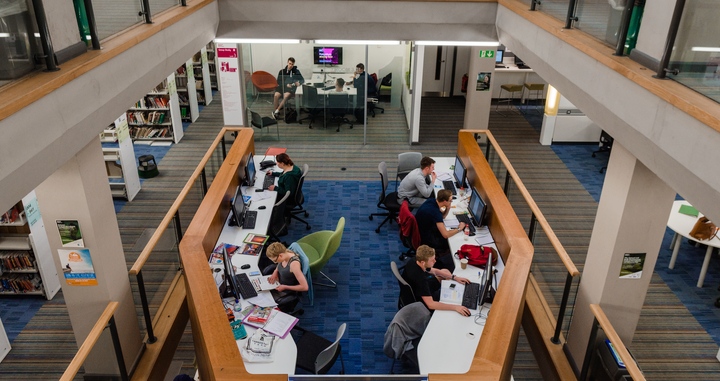
Adsetts library
Adsetts Library is located on our City Campus. It's open 24 hours a day, every day.
Explore the libraryEntry requirements
All students
Normally an undergraduate degree at 2:2 or above, in a non-computing degree; this is a conversion course for those without a background in computing or IT.
If English is not your first language, you will need an IELTS score of 6.0 with a minimum of 5.5 in all skills, or equivalent.
Additional information for EU/International students
If you are an International or non-UK European student, you can find out more about the country specific qualifications we accept on our international qualifications page.
For details of English language entry requirements (IELTS), please see the information for 'All students'.
Fees and funding
Home students
Our tuition fee for UK students starting full-time study in 2027/28 is £12,990 for the course. The tuition fee displayed above is for the full course. For this work experience route, your fees will be payable over two years, based on credits studied per year. The fee includes dedicated employability support to help you prepare for work experience. It does not guarantee you a placement and if a placement is not secured the work experience fee will still be charged. If a placement is not secured you will transfer to the standard version of the course to complete your remaining credits, where the balance of your course fees will be due in year one in line with completing the course.
If you are studying an undergraduate course, postgraduate pre-registration course or postgraduate research course over more than one academic year then your tuition fees may increase in subsequent years in line with Government regulations or UK Research and Innovation (UKRI) published fees. More information can be found in our terms and conditions under student fees regulations.
International students
Our tuition fee for International/EU students starting full-time study in 2027/28 is £21,030 for the course. The tuition fee displayed above is for the full course. For this work experience route, your fees will be payable over two years, based on credits studied per year. The fee includes dedicated employability support to help you prepare for work experience. It does not guarantee you a placement and if a placement is not secured the work experience fee will still be charged. If a placement is not secured you will transfer to the standard shorter version of the course to complete your remaining credits. We will inform the Home Office and the course end date on your visa will be adjusted accordingly. The balance of your course fees will be due in year one in line with completing the course.

Scholarships and financial support
Find information on scholarships, bursaries and postgraduate student loans.
International scholarships up to £3000 ›
Alumni scholarships up to £2000 ›
Postgraduate loans for UK students ›
Additional course costs
The links below allow you to view estimated general course additional costs, as well as costs associated with key activities on specific courses. These are estimates and are intended only as an indication of potential additional expenses. Actual costs can vary greatly depending on the choices you make during your course.
General course additional costs
Additional costs for School of Computing and Digital Technologies (PDF, 242.1KB)Legal information
Any offer of a place to study is subject to your acceptance of the University’s Terms and Conditions and Student Regulations.