Everything you need to know...
-
Tuition fees
Home: £10,050 per year
International/EU: £18,900 per year -
Course duration
4/5 Years
-
Study location
-
Entry requirements
-
Course code
AA15
-
Start date
September 2027
-
Placement year available?
Yes
Course summary
Want to design the intelligent robots and autonomous technologies of tomorrow?
Today’s world continues to seek engineering solutions to help people – across search-and-rescue, healthcare and manufacturing factories. On this course you’ll design advanced mechatronics systems that integrate mechanical, electrical and software components, contributing to the development of cutting-edge robotic systems across various industries.
- Become a professional mechatronics and robotics engineer from day one.
- Use mechatronics and robotics knowledge to solve real-world scenarios.
- Apply artificial intelligence (AI) and emerging technology to robots and mechatronics.
- Learn to solve problems experimentally, analytically, numerically and digitally.
- Explore multidisciplinary engineering perspectives to enhance your versatility.
This foundation year is designed to build your knowledge and prepare you for undergraduate study. Once you’ve successfully completed the foundation year, you’ll progress directly onto the BEng (Honours) Mechatronic and Robotic Engineering course, ready for honours degree study.
Employability
95% of UK graduates are in work or further study 15 months after graduating (2023/24 Graduate Outcomes Survey).
How you learn
This course is ideal if it’s been a while since you last studied, you’d like extra preparation before starting degree level study, or you don’t meet the entry requirements for our BEng (Honours) Mechatronic and Robotic Engineering course.
Our Mechatronic and Robotic Engineering course gives you experience as a professional engineer from day one. You’ll learn through lectures, tutorials and preparation for assessments. Through lab work, simulation and team projects, you’ll put theory into practice, graduating with the skills to progress towards accreditation as an engineer.
Develop practical engineering skills
On this practical course you can build real technology from year one. You could:
- develop a two-wheel mobile robot for safely delivering trays in factories
- design and build Arduino-based data loggers using sensors and microcontrollers
- design globally responsible solutions through Engineers Without Borders’ design challenges, tackling real social and environmental issues
- programme Mitsubishi programmable logic controllers (PLCs)
- integrate AI, machine vision and sensor technologies into intelligent robots using industry software such as Python
- design autonomous robots that can deliver medication in healthcare settings
Key topics
During your foundation year, you’ll build essential academic skills, report writing, experimentation and teamwork, preparing you for undergraduate study.
As you progress through the course,you’ll learn engineering and maths fundamentals. Then design and analyse robotics and mechatronic systems while exploring analogue and digital electronics, mechanical concepts engineering and the applications of mechatronics systems. You’ll then advance to machine vision, sensor fusion, AI, the Internet of Things (IoT), control and automation.
Learn from the latest research
We bring our experts’ research into your learning so you can explore new ideas and engineering challenges. For example, in our Advanced Food Innovation Centre (AFIC), you could develop a human-trailing robot to follow line staff to collect scrap, wastes, or used packaging materials and take them to waste-management or recycling stations. This reduces heavy lifting, pushing, and repetitive strain injuries for floor workers moving heavy loads across wet or slippery plant floors in food manufacturing environments.
Assessments that boost your CV
You’ll be assessed in ways that prepare you for your future career, with evidence you can take to interviews. Throughout the course you’ll prove you can:
- apply the PRINCE2 project management framework to real-world projects
- demonstrate mechatronic systems prototypes
- work in a team to use embedded systems in mechatronic applications
- create reports that explain how engineering principles have solved problems
- integrate advanced technologies into intelligent robots
Supporting your career
We’ll support you with personal, academic and career development services, such as:
- Skills Centre one-to-ones and online resources, where you can get help with planning and structuring your assignments
- digital skills, career readiness and graduate attributes
- finding, applying and interviewing for work experience opportunities
- the Engineering Café, a weekly drop-in for questions and expert advice
- a twice-weekly maths and stats drop-in for engineering students
Applied learning
Industry projects
Working on live projects gives you great experience of the tools and skills used in the industry today. You’ll be treated as a professional from the moment you join us, refining the skills you learn with us in the real world.
You’ll begin by applying the principles that govern mechatronics to real-world challenges, developing essential skills through projects such as the Engineers Without Borders design challenge, where you create a solution to a social or environmental challenge.
In collaboration with an industry partner, you’ll integrate knowledge from across engineering subjects to design and develop autonomous and robotic systems that meet a combination of societal, user, business and customer needs. For example, you’ll design, build and validate a two-wheel drive mobile robot for obstacle detection and avoidance, including sensor integration, data acquisition and control systems. Your design will consider material properties, degradation mechanisms, mechanical behaviour, failure modes and manufacturing considerations.
In your final undergraduate year, you’ll gain proficiency in the use of real-time input from sensors and vision to control and produce desirable behaviours in mechatronic systems. You’ll then apply AI to optimise the behaviour of the systems in different situations. These skills equip you to take on multidisciplinary challenges involving automation, AI and autonomous systems.
Placements and work experience
You’ll have the opportunity to arrange a year-long work placement before the final year of your Mechatronic and Robotic Engineering degree. It's your chance to work as an engineer, applying what you've learned in a commercial environment. You’ll learn how the industry works and make valuable connections for your future career. You’ll also have the opportunity to graduate with an Applied Professional Diploma to add to your CV.
To support you, we offer various activities, resources, employer events and opportunities through our Careers & Employability Team – helping you make the most of your work experience opportunities during your degree.
Competitions
You’ll get the opportunity to take part in national and international engineering competitions. These include Formula Student – where you design and build a race car and race it at Silverstone, home of the British Grand Prix. There’s also the Unmanned Aerial System (UAS) Challenge – where you get hands-on experience in designing, building and operating unmanned aerial vehicles (UAVs or drones).
You’ll have the opportunity to put your engineering skills into practice through student competitions. You can get involved with SHU Racing, a team led by over 70 undergraduate Sheffield Hallam students, predominantly from the engineering disciplines. Each year the team strives to optimise and develop a Formula Student competition car – through smart innovation, professionally engineered development and lean manufacturing strategies.
You could also join Hallam Rocketry to develop a liquid rocket engine for the Race2Space National Propulsion Competition and take part in national and international competitions to design, build and launch rockets.
Employer and industry connections
You’ll be able to attend a presentation from The Institution of Engineering and Technology (IET) about the routes to becoming a professional engineer. There’s also the opportunity to join IET as a student member.
Throughout the course, you can attend scheduled events and meet industry partners, employers, researchers and alumni. Past events have included alumni careers panels, careers fairs, winter research poster events, the SHU Racing launch and EngFest, the school’s end of year celebration.
You’ll also have the opportunity to become a member of the Siemens Connected Curriculum, which organises visiting lecturers to Sheffield Hallam, competitions among universities and offers free access to industrial automation software.
Your course leader

Modules
Important notice: The structure of this course is periodically reviewed and enhanced to provide the best possible learning experience for our students and ensure ongoing compliance with any professional, statutory and regulatory body standards. Module structure, content, delivery and assessment may change, but we expect the focus of the course and the learning outcomes to remain as described above. Following any changes, updated module information will be published on this page.
You will be able to complete a placement year as part of this course. See the modules table below for further information.
Year 1
Compulsory modules
This module supports and broadens your learning through practical experiments and application of mathematical knowledge. As an engineer or mathematician you’ll need to develop a variety of experimental and transferable skills as part of your education and ongoing professional development.
You’ll study topics such as:
-
Mechanical laboratory experiments
-
Electrical and electronic practical work and skills
-
Mathematical case studies with real-world problems
-
Town planning and traffic management
-
Monitoring natural phenomena
-
How to design experiments
-
How to deal with experimental errors
-
Scientific writing
This module introduces you to core topics in science, physics and mathematics. You’ll develop an awareness of mathematics contexts and your ability to apply mathematics appropriately.
You’ll study topics such as:
-
Numbers and order of operations
-
Algebra, mathematical functions and solving simple equations
-
Geometry including trigonometry of right-angled triangles
-
Vector addition and resolution
-
Technology for calculations and plot graphs
-
Ohm's Law and capacitance
-
LR, CR and LCR circuits
-
AC theory
-
SI units and motion in a straight line (rectilinear)
-
Forces, friction and equilibrium
This module consolidates your previous learning, developing further essential skills in science, physics and mathematics. You’ll study mathematical, electrical and mechanical areas of the subject with a structured approach to problem solving.
You’ll study topics such as:
-
Functions and product, quotient, chain rules, gradients, min/max problems
-
Integration by function, parts, substitution and integrals
-
Velocity and acceleration problems
-
Trigonometric graphs, equations and sine/cosine rules
-
Logarithmic and exponential functions and graphs
-
Inverse and simultaneous equations using matrices
-
Electronics for measurement, diodes, power supplies and sensors
-
Op amps, analogue to digital converters and microcontrollers
-
Circular motion, work, energy, power and simple harmonic motion
-
Specific and latent heat, changes of state, expansion/contraction
This module studies the physical and chemical principles underpinning materials science, introducing the structure, processing and characteristics of engineering materials. You’ll explore different manufacturing techniques, associated equipment and tooling, while developing your presentation and information skills.
You’ll study topics such as:
-
Atomic and electronic structure of atoms
-
Chemical reactivity and electronic structure
-
Ionic bonding, crystals, compounds and covalent bonding
-
Characteristics and examples of organic compounds
-
Metallic bonding and conservation of mass in chemical reactions
-
Metals, organic polymers, ceramics and composites
-
Health, safety and solidification processes
-
Hot and cold metal working processes
-
Ceramic and polymer processing
-
Machining processes
Year 2
Compulsory modules
Module Aim:
The aim of the module is to develop fundamental knowledge of engineering, understanding of how the fundamentals govern performance of systems as well as experimental investigation techniques in mechanical and electronic engineering.
Module Delivery:
This module will be delivered via a mixture of lectures, seminars / tutorials, and laboratory sessions.
Indicative Content:
- Statics: Forces, moments/couples, effects of friction, free body diagrams, equations of equilibrium, reaction forces/moments in simple statically determinate assemblies of rigid bodies
- Strength of Materials: Direct and shear stress/strain, Hooke’s law and elastic moduli, Poisson’s ratio, stress-strain relationships in 2D
- Dynamics: Kinematics: Position, velocity and time calculations for systems with constant acceleration
- Kinetics: Newton’s Laws of motion applied to linear motion problems and rotation about a fixed axis. Work, energy and power. Momentum and impulse
- Fluid Mechanics: Flow regimes (laminar and turbulent), internal and external flow, hydrostatic pressure, buoyancy
- Thermodynamics: States of matter. Temperature scales. Intensive and extensive properties. Specific variables. Heat, work, and power. Control volumes. Conservation of mass and energy. Sensible heat and internal energy. Efficiency and coefficient of performance. Gas laws. Polytropic processes.
- Heat Transfer: Conduction, convection and radiation mechanisms
- Electrical/Electronic Engineering
- Basic DC theory: Ohm's and Kirchhoff's laws, resistors in series and parallel combinations, single source circuits, Thévenin's theorem
- Basic AC theory: Resistance/capacitance/inductance circuits, series and parallel, phase shift and impedance triangle, power and power factor
Module Aim:
To develop a foundation for the understanding and familiarisation of basic analogue and digital electronic components, systems and their applications and to introduce their applications.
You will study topics such as:
- Digital electronics
- Mathematics for digital electronics
- Digital electronic circuit components
- Circuit design methods
- Digital components and circuits
- Software packages for digital circuit design
- Analogue electronics
- Analogue electronics key basic components
- Analogue circuit concepts and signals
- Measurement and testing techniques
- Non-linear electronic devices principles and applications
Module Aim:
This module is intended to teach mathematical methods and the basics of computer programming, using a structured approach to mathematical techniques, programming and appropriate software tools, thus enabling students to produce mathematical and programming solutions for a range of simple engineering problems.
Module Delivery:
This module will be delivered via a mixture of lectures, seminars / tutorials, and laboratory sessions.
Indicative Content:
- Software development processes and tools. number systems and character coding
- Primitive data types and data structures, variable declaration and initialisation
- Basic arithmetic and logical expressions
- Basic programming constructs, such as; selection and iteration
- Creation of functions, arrays, pass by value and reference arguments.
- Relevant language specific features and applications,
- Solving/manipulating equations involving elementary functions (polynomials, trigonometric, exponential, logarithmic).
- Differentiation, integration, and applications.
- Complex numbers and applications.
- Matrices and solving systems of linear equations.
- Analytical solutions of 1st and 2nd order ODEs.
- Software-based solution verification e.g. MATLAB
This module will be delivered through design challenges such as IET Global Challenge, Engineers without Borders, etc as an applied project using blended approaches. This gives the students an opportunity to recognise and engage with professional behaviours and roles that consider inclusivity and industry sector values and give them a chance to express their own values. Students will work collaboratively in teams to explore real-world challenges and professional roles. The Engineers Without Borders’ “Engineering for People” design project for example will give students the opportunity to apply their knowledge of electronics, develop team working and leadership skills and apply their knowledge of CAD software and lab equipment. Students will reflect on their own strengths, recognise their professional behaviours, limitations, and experiences from Engineers Without Borders’ “Engineering for People” design project to support their future preparation for a recruitment and placement.
Indicative Content:
- Safe working practices, relevant codes of practice (including risk and environmental issues) and safety standards.
- Engineering processes (e.g. using hand and tools, test equipment, soldering, fabrication, and measurements).
- Design and development tools, with appreciation of their limitations and applicability.
- Computer based design tools (e.g. Solidworks, Eagle CAD, simulation tools, etc).
- Sketching and interpretation of engineering drawings and electrical/electronic circuit diagrams.
- Design, building, testing and modification of appropriate artefacts to meet the requirement of an external body or competition, such as IET Global Challenge, Engineers without Borders, etc.
- Report writing, team working, oral presentations.
- Professional and personal development planning.
Year 3
Compulsory modules
Module Aim:
This module will develop knowledge and understanding in both the art and science of electronic circuit engineering and develop confidence and competence in the application of design skills to unfamiliar problems incorporating technical uncertainty.
Module Delivery:
This module will be delivered via a mixture of lectures, seminars / tutorials, and laboratory sessions.
Indicative Content:
- Fitness for purpose and awareness of professional codes of practice, health and safety constraints, cost, environmental and sustainability considerations in the design and selection of electronic circuits and systems.
- Digital component technology. Logic system design. Top-down design methodology, state machine approach to the design of sequential circuits. Synthesis of digital circuits using FPGAs. Introduction to high level synthesis, simulation & implementation techniques using integrated design environments, incorporating a variety of design entry approaches. The analogue/digital interface.
- Schematic capture and simulation/verification of appropriate circuits. Circuit design techniques. Device and circuit modelling. Power supplies: linear and switching. Amplification and other circuit design techniques, linear and non-linear applications. Waveform generators and signal conditioning circuits. Discrete circuits. Bipolar and field effect transistor equivalent circuits. Constant current circuits. Discrete differential amplifiers. Feedback. Filter types and properties and design of filters according to specifications.
This module develops the electronics technology thread that runs through the course.
Module Aim:
The module aims to provide a general introduction to the control of engineering processes, including sequential and feedback control. The integration of modelling and simulation together with the use of instrumentation in an automated system to perform real world tasks will be explored.
Module Delivery:
This module will be delivered via a mixture of lectures, seminars / tutorials, and laboratory sessions.
Indicative content:
- System dynamics; dynamic modelling for electro-mechanical systems, transfer functions and block diagrams
- 1st order and 2nd order system step response performance characteristics, closed loop stability
- PID controllers & PLC applications
- Instrumentation systems, sensors, actuators, robots
- Machine vision systems
Module Aim:
This module, through an applied project, will provide students with the knowledge and skills necessary to design and develop engineering solutions that meet a combination of societal, user, business and customer needs.
Students learn to apply an integrated or systems approach to complex problems, evaluate environmental and societal impacts, identify and analyse ethical concerns, and adopt an inclusive approach to engineering practice.
Indicative content:
- Identifying, understanding and defining the problem
- Identifying system goals and constraints
- Evaluate and select appropriate Processor system(s) and peripherals.
- Understanding of hardware and software I/O and relevant interfacing technologies
- Developing a solution that meets the system's goals and constraints
- Evaluating the solution
- Evaluate the environmental and societal impact of solutions to complex problems and minimise adverse impacts, while reflecting upon their career aspirations.
This module builds upon concepts and practical approaches introduced at level 4 and will prepare you for sandwich placement and for level 6 project.
Module Aim:
This module provides a background in mechanical engineering concepts and covers the principles and design of mechatronic systems.
The module addresses several core themes including Materials Engineering and Computer Aided Design (Mechanical engineering concepts) and the control and integration of electro-mechanical systems. (Mechatronics)
The topics are interlinked through a project-based design and prototyping task which requires all core themes to be considered and addressed demonstrating the interdisciplinary requirements of typical engineering projects.
Module Delivery:
This module will be delivered via a mixture of lectures, seminars / tutorials, and laboratory sessions.
Indicative Content:
-
Computer Aided Design CAD – Construction and verification of assembly models
-
Evaluation of and management of CAD in the design process and within the working environment
-
Material structures - Introduction to the three main engineering materials, ceramics, polymers and metals
-
Material properties – mechanical/electrical/Thermal
-
Material classification and applications
-
Measurement systems; automated data acquisition, processing and display.
-
Programmable automation/control systems
-
Sensors and Actuators
-
Electronical/electronics for sensing and measurement
-
Electronical/electronics for action and control
This module builds on both electrical and mechanical threads running through the course and demonstrates the interdisciplinary nature of the course and overall engineering discipline.
Year 4
Compulsory modules
Module aim:
The aim of this module is to enhance students’ professional development through the completion of and reflection on meaningful work placement(s).
A work placement will provide students with opportunities to experience the realities of professional employment and experience how their course can be applied within their chosen industry setting.
The placement will:
- Allow student to apply the skills, theories and behaviours relevant and in addition to their course
- Enable students to enhance their interpersonal skills in demand by graduate employers – communication, problem-solving, creativity, resilience, team work etc
- Grow their student network and relationship building skills
- Provide student with insights into the industry and sector in which their placement occurs
- Help student make informed graduate careers choices
Indicative Content:
In this module students undertake a sandwich placement (min 24 weeks / min 21 hours per week) which is integrated, assessed and aligned to their studies.
Their personal Placement Academic Supervisor (PAS) will be their key point of contact during their placement and will encourage and support students to reflect on their experience, learning and contribution to the organisation they work for.
To demonstrate gains in professional development, students will be required to share their progress, learning and achievements with their Placement Academic Supervisor and reflect on these for the summative piece of work.
Final year
Compulsory modules
Module Aim:
This module will develop the skills and knowledge needed that will allow students to identify and analyse tasks that can be automated using real-time input devices (sensors and vision) to control and produce desirable behaviours in robotic devices. This module fuses together software techniques with hardware.
Module Delivery:
This module will be delivered via a mixture of lectures and practical laboratory sessions.
Indicative Content:
-
Machine vision, including colour, object and feature detection and identification
-
Sensor and actuator applications
-
Simulation and modelling techniques
-
Embedded robotic devices
-
Control algorithms
-
Handling real-time data
-
Human-machine interactions and interfaces
-
Safety and ethics of automated advanced robotics
Module Aim:
This module will develop theoretical and practical expertise in Artificial Intelligence (AI) and the Internet-of-Things (IoT) allowing the student to acquire a range of data using embedded IoT technologies and analyse them using AI.
Module Delivery:
This module will be delivered via a mixture of lectures, seminars / tutorials, computer-based IT and practical laboratory sessions.
Indicative Content:
AI contents:
- Overview of AI and its role in solving engineering and scientific challenges.
- Machine learning fundamentals.
- Neural networks, deep learning, fuzzy systems, and evolutionary algorithms.
IoT contents:
- In system embedded communication protocols (such as serial buses).
- Embedded TCP-IP.
- IoT protocols.
This module builds on the embedded systems, and digital and communications technologies threads running through the course.
Your individual final year project is the apex of your academic journey, offering a platform to apply the wealth of knowledge and skills gathered throughout your degree to real-world linked problems. This module requires your creativity, problem-solving capabilities, and the ability to navigate new material independently in whichever field you choose to specialise in.
This module allows you to:
- Undertake in-depth research in a topic of your choosing
- The opportunity to work alongside cutting-edge researchers
- Create a body of work that can support you into further study, or work in a field that interests you
Develop solid foundations for undertaking a self-managed academic research project. On this module you will develop the skills and understanding you will need to complete your dissertation project to the highest level. Through lectures, guided reading and one-to-one discussions with your project supervisor you will design a path through to successful completion of an extensive research project including developing the project management skills you will need to achieve this.
You’ll study topics such as
- The life cycle of a project
- Reviewing academic literature
- Quality management
- Project management techniques and tools
- Research ethics
- Intellectual property rights
Future careers
This course prepares you for various opportunities in mechatronics, robotics and wider engineering industries, including:
- mechatronic engineering
- robotics
- automation and control
- process
- project engineering
- manufacturing
- energy
- automotive
- aerospace
Guaranteed graduate internships
You are guaranteed a paid internship if you aren’t in work or further study 12 months after successfully completing your course. Beyond that, you’ll have access to lifelong career support. Our employability team offers guidance on applications, interviews and career planning for as long as you need it. Find out more about our career promise.

All in on your career
We promise you’ll be ready to launch your career. With employer connections, hands-on learning and lifelong career support, we’ll help make your ambition a reality.
Equipment and facilities
You’ll learn in excellent teaching facilities, including an impressive range of professionally-equipped laboratories for teaching, projects and research.
We have cutting-edge teaching space, labs and workshops for:
- embedded systems – hardware and software facilities for advanced Field Programmable Gate Array (FPGA), and microcontroller development (ARM and Arduino)
- electronics and communications – modern digital oscilloscopes, function generators, power supplies and spectrum analysers
- control systems– Programmable Logic Controllers (PLCs), pneumatic and hydraulic kits with software for monitoring and control (supervisory control and data acquisition)
- computer-aided design (CAD) and simulation software such as SolidWorks and SPICE
- analysis software such as Fluent, Abaqus, Ansys and MATLAB
- automation, industry 4.0 facilities and a wide range of fixed and mobile robots and cobots
- rapid prototyping equipment with laser cutters and 3D printers
- materials testing and manufacturing
360 tour - engineering facilities
Media Gallery


Where will I study?
You study at City Campus through a structured mix of lectures, seminars and practical sessions as well as access to digital and online resources to support your learning.
City Campus
City Campus is located in the heart of Sheffield, within minutes of the train and bus stations.
City Campus map | City Campus tour

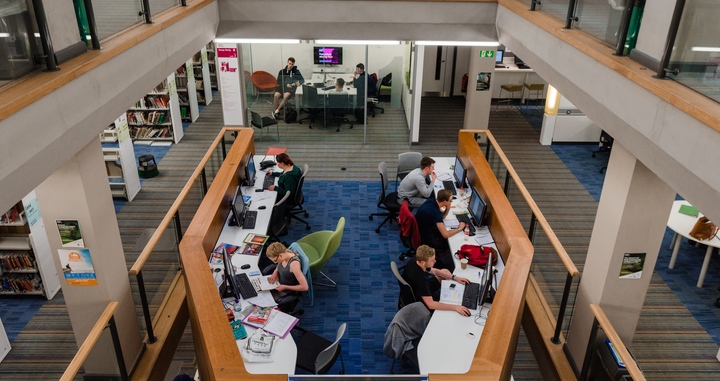
Adsetts library
Adsetts Library is located on our City Campus. It's open 24 hours a day, every day.
Explore the libraryExplore Strines
Explore Strines
Strines is where you’ll find our new Institute of Technology – a state-of-the-art learning space for manufacturing, engineering, construction, and creative and digital disciplines.
Entry requirements
All students
UCAS points
- Standard offer: 72 UCAS points
This must include at least 32 points from one A level or equivalent BTEC qualifications. For example:
- CDE at A Level.
- MMP in BTEC Extended Diploma.
- Pass overall from a T level qualification with D or E from core
- A combination of qualifications, which may include a maximum of one AS level, EPQ and general studies.
You can find information on making sense of UCAS tariff points here and use the UCAS tariff calculator to work out your points.
GCSE
- English Language at grade C or 4
- Maths at grade C or 4
*GCSE Equivalents
- Level 2 Literacy or Functional Skills Level 2 English
- Level 2 Numeracy or Functional Skills Level 2 Maths
• Access - an Access to HE Diploma with at least 45 credits at level 3 and 15 credits at level 2. At least 15 level 3 credits must be at merit grade or above from a QAA-recognised Access to HE course, or an equivalent Access to HE certificate.
We may also accept you, if you have no formal qualifications but can show evidence of ability and a genuine commitment to studying the subject.
Some applicants may be invited to attend an informal interview with the course leader to ensure that the programme is suitable for themselves and their aspirations.
UK students may be able to claim financial support for the course.
If English is not your first language, you will need an IELTS score of 6.0 with a minimum of 5.5 in all skills, or equivalent.
Additional information for EU/International students
If you are an International or non-UK European student, you can find out more about the country specific qualifications we accept on our international qualifications page.
For details of English language entry requirements (IELTS), please see the information for 'All students'.
Fees and funding
Home students
Our tuition fee for UK students on full-time undergraduate degree courses in 2027/28 is £10,050 per year (capped at a maximum of 20% of this during your placement year). These fees are regulated by the UK government and therefore subject to change in future years.
If you are studying an undergraduate course, postgraduate pre-registration course or postgraduate research course over more than one academic year then your tuition fees may increase in subsequent years in line with Government regulations or UK Research and Innovation (UKRI) published fees. More information can be found in our terms and conditions under student fees regulations.
International students
Our tuition fee for International/EU students starting full-time study in 2027/28 is £18,900 per year (capped at a maximum of 20% of this during your placement year)

Financing your studies
Explore tuition fees, student loans, scholarships and financial support available, including up to £2,100 a year towards living costs for eligible students.
Explore fees and funding ›
Discover cost-of-living support ›
Find scholarships and bursaries ›
Additional course costs
The links below allow you to view estimated general course additional costs, as well as costs associated with key activities on specific courses. These are estimates and are intended only as an indication of potential additional expenses. Actual costs can vary greatly depending on the choices you make during your course.
General course additional costs
Additional costs for School of Engineering and Built Environment (PDF, 253.6KB)Legal information
Any offer of a place to study is subject to your acceptance of the University’s Terms and Conditions and Student Regulations.

Come to an open day
Discover our TEF Gold rated teaching and see why students voted Sheffield Hallam a top five university in England at the prestigious Whatuni Student Choice Awards.