Everything you need to know...
-
Tuition fees
Home: £10,940 for the course
International/EU: £18,600 for the course -
Course duration
1 Year
-
Study location
-
Start date
September 2026
January 2027
Work Placement Route
For international students wishing to undertake a placement as part of this course, you must apply to MSc Advanced Mechanical Engineering (Work Experience) route. Transferring to the work experience route later will not be possible due to visa restrictions.
Course summary
- Explore mechanical engineering design from a manufacturing perspective.
- Apply modern computational methods to resolve engineering challenges.
- Experience real-world projects, applying theoretical knowledge and practical skills.
- Study best practices in cutting-edge technologies, processes and systems.
- Enhance your decision-making by solving increasingly open-ended problems.
On this course you’ll benefit from extensive resources, from computational and metrology labs to wind tunnels and rapid prototyping equipment. You’ll have the flexibility to tailor your course to your goals – choosing from a selection of modules to match your interests. Previous graduates have gone on to excel in a variety of engineering fields.

Come to an open day
Find out more at our postgraduate open days. Book now for your place.
How you learn
You’ll benefit from our expert team’s wealth of experience – studying a combination of technical modules and advanced aspects of mechanical engineering.
You’ll apply your knowledge and skills to real-world contexts – actively engaging in work placements, live projects, field trips, networking events and competitions. These experiences will enhance your employability, deepen your understanding of the engineering and management fields, and prepare you to thrive in a dynamic and competitive professional landscape.
You learn through:
- Lab sessions
- Lectures
- Problem solving
- Critical reflection
- Group project work
- Independent study
- Assessments
- Coursework
- Seminars
- Tutorials
Key Themes
You’ll apply theories to real-life situations, whether within your organisation or through case studies. Practical work varies across formal lab sessions that explore relevant systems, processes or materials – which you’ll critically reflect on, and report your findings.
You’ll learn to apply modern computational methods – including finite elements modelling and analysis (FEM/FEA) and computational fluid dynamics (CFD).
We’ll support and challenge you to grow as an independent learner who confidently uses contemporary materials. You’ll address increasingly open-ended problems, using your evolving knowledge, experience and decision-making skills. The MSc project is the ultimate stage, where you're expected to work reasonably independently under your supervisor's guidance.
Course Support
You’ll be supported in your learning journey towards highly skilled, graduate-level employment, including:
- Academic support to help you thrive, integrating theory and practical modelling.
- Access to specialist support services to help with your personal, academic and career development.
- Access to our Skills Centre with one-on-ones, webinars, and online resources, where you can get help with planning and structuring your assignments.
Applied learning
Live Projects
You’ll be able to engage in exciting live projects throughout the course. These projects allow you to apply your knowledge and skills to real-world scenarios, working on design challenges and problem-solving tasks.
Collaborating with industry partners, you’ll gain practical experience in managing projects, working in interdisciplinary teams and delivering innovative solutions. These are great opportunities to develop your creativity alongside a holistic understanding of the engineering and management field.
Networking Opportunities
You’ll have various opportunities to connect with professionals and experts in the mechanical engineering field.
You’ll have access to guest lectures, industry conferences, workshops and alumni events – chances to interact with leading practitioners, researchers and thought leaders. Here you can expand your professional network, gain industry insights and explore potential career paths.
Field Trips
We offer field trips to engineering facilities in and around Sheffield. These enhance your appreciation of mechanical engineering used in organisations and manufacturing settings, as well as introducing you to real-world working environments.
Competitions
Competitions are excellent ways to apply your skills, demonstrate your capabilities and gain recognition. You may be able to enter engineering and management competitions at regional, national and even international levels, such as SHU Racing.
These competitions challenge you to solve complex problems, showcase your innovative thinking and collaborate effectively within a team. You’ll also gain confidence and engage with industry professionals and potential employers.
Your course leader

Thanuja Goonetilleke
Senior LecturerThanuja is a Senior Lecturer in Engineering & Mathematics with research expertise in inclusive design, ergonomics, and Mechanical design systems.
Modules studied may differ depending on when you start your course.
Modules
Important notice: The structure of this course is periodically reviewed and enhanced to provide the best possible learning experience for our students and ensure ongoing compliance with any professional, statutory and regulatory body standards. Module structure, content, delivery and assessment may change, but we expect the focus of the course and the learning outcomes to remain as described above. Following any changes, updated module information will be published on this page.
Modules studied may differ depending on when you start your course.
Final year
Compulsory modules
This module introduces how engineering designs can be optimised to reduce manufacturing and assembly costs. You will learn how to make more informed selection of parts for your mechanical engineering designs to enhance reliability.
You will study topics such as:
- Design for manufacturing (process and material selection)
- Design for assembly, part reduction, fool proofing
- Value engineering
- Plastic part and/or sheet metal design
- Tolerance stacks
- Part selection process for reliability and system reliability
- Overhead costing and break even costing
This module will develop your understanding of reverse engineering hardware and software tools, and through practical examples, their use within the wider Computer-Aided Design (CAD) workflow.
You’ll study topics such as:
- CAD
- Introduction to contact and non-contact metrology
- Assessing errors in scan data
- The hierarchy of importance for areas of scanned geometry
- Assessing scan to CAD inaccuracies
- Integration of processed scan data into the CAD workflow
- Optimisation of resultant geometry
- Use of rapid prototyping technologies including 3D printers
This module enables you to conduct practical engineering analysis using modern engineering simulation software in areas such as solids/structures (Finite Element Analysis (FEA)) and fluid dynamics (Computational Fluid Dynamics (CFD)). You will learn how to apply key simulation concepts to specific cases; and to define models, run analyses and communicate results effectively.
You’ll study topics such as:
CFD content
- Governing equations
- Mesh generation and techniques
- Solution analysis
- Case studies
- Emerging developments and applications
FEA content:
- Use of commercial software
- Selection of appropriate loads and boundary conditions
- Element types and mesh quality
- Results interpretation; validation and verification
The Project and Dissertation module represents the capstone in your learning journey. It is your chance to push the boundaries of knowledge, showcasing originality through major research.
You will complete an intellectually rich masters-level research project with the support of an academic supervisor.
This module allows you to:
- Develop your own original ideas on a topic of your choosing
- Work alongside active researchers and receive one-to-one guidance
- Contribute to the field of your choosing and advance it in a meaningful way
- Gain insight into the day-to-day activities of a research scientist
In this module you will develop the skills needed for high-quality research and scientific excellence. You will cultivate the essential skills required to prepare for dissertation work. You will develop a comprehensive plan for an original piece of research, supported though taught sessions that allow you to understand research project frameworks, as well as one-to-one support from a dedicated academic supervisor.
This module allows you to:
- Understand the importance and process of planning research to ensure high-quality work
- Learn how to search for research literature and evaluation
- Develop a critical faculty to examine and evaluate the quality of academic research
- Improve your academic writing abilities, with the potential of developing publishable research
Elective modules
This module will develop your theoretical understanding and ability to utilise advanced engineering analysis tools. You will use specialist simulation software and define modelling strategies to solve complex problems related to Finite Element Analysis (FEA) for solid and structural mechanics, and Computational Fluid Dynamics (CFD) for fluid mechanics and heat transfer.
You will study topics including:
- Finite Element Analysis
- Geometric nonlinearity, bifurcations and limit states
- Material nonlinearity, computational plasticity
- Basic contact mechanics
- Dynamics – modal analysis, transient analysis
- Solution methods
- Computational Fluid Dynamics
- Navier-Stokes equations
- Linear and non-linear ordinary differential equations
- Finite volume and finite difference
- Scientific uncertainty and benchmark
This module will develop your theoretical and practical expertise in artificial intelligence (AI) allowing you to develop analytical skills in data science technologies and solve problems using AI.
You will study topics such as:
- Overview of AI and its role in solving engineering and scientific challenges
- Machine learning fundamentals
- Neural networks, deep learning, fuzzy systems, and evolutionary algorithms
- Design and critical evaluation of AI-based systems for solving complex engineering and scientific problems
This module provides a comprehensive overview of process improvement tools including discrete-event simulation (DES), lean and six sigma. You will understand how these tools are used to improve the quality, efficiency, and profitability of a system by critically applying them in a variety of industrial sectors.
You will study topics such as:
- Philosophy: Lean thinking, characteristics of lean, agile operations, sustainable lean enterprises
- Analysis & Mapping: takt time, system thinking, value stream mapping, and DES
- Improvement: Continuous improvements, 5S, Kaizen, Six Sigma
- Management and control: Kanban, Just-in-time, Visual based management, demand smoothing
This module introduces you to the growing field of robotics and autonomous systems. You will gain understanding of fundamental and emerging concepts required to theoretically and practically design and programme these systems, including sensors, actuators, grippers, manipulators, their mechanics and control, robotic hardware and software and their interfacing, robot locomotion and perception, and robotic applications.
You will study topics such as:
- Devices and systems for robotics and autonomous systems
- Smart systems with autonomous capability, such as driverless cars, unmanned boats, and autonomous mobile robots used in warehouses
- Collaborative robots, robots that can work alongside humans
- Autonomous robots in manufacturing
- Advantages and disadvantages of autonomous systems
- Autonomous robot navigation, control and sensing data analysis
- Methods from mathematics and physics; kinematics and dynamics, graph theory, search algorithms), machine vision and artificial intelligence (AI)
Future careers
A primary motivation for Master’s level study is enhancing your employability by achieving higher-level technical knowledge and personal skills. These employability-related skills and competencies are explicitly referred to in the Engineering Council UK spec – and they’re embedded in all our modules.
You’ll have access to employability services during the year – from focused career advice to interview preparation.
This course prepares you for a career in:
- Mechanical design
- Mechanical system/structural analysis
- Energy/power
- Renewable energy systems
- Manufacturing/production
- Research and development
- Postgraduate study
Equipment and facilities
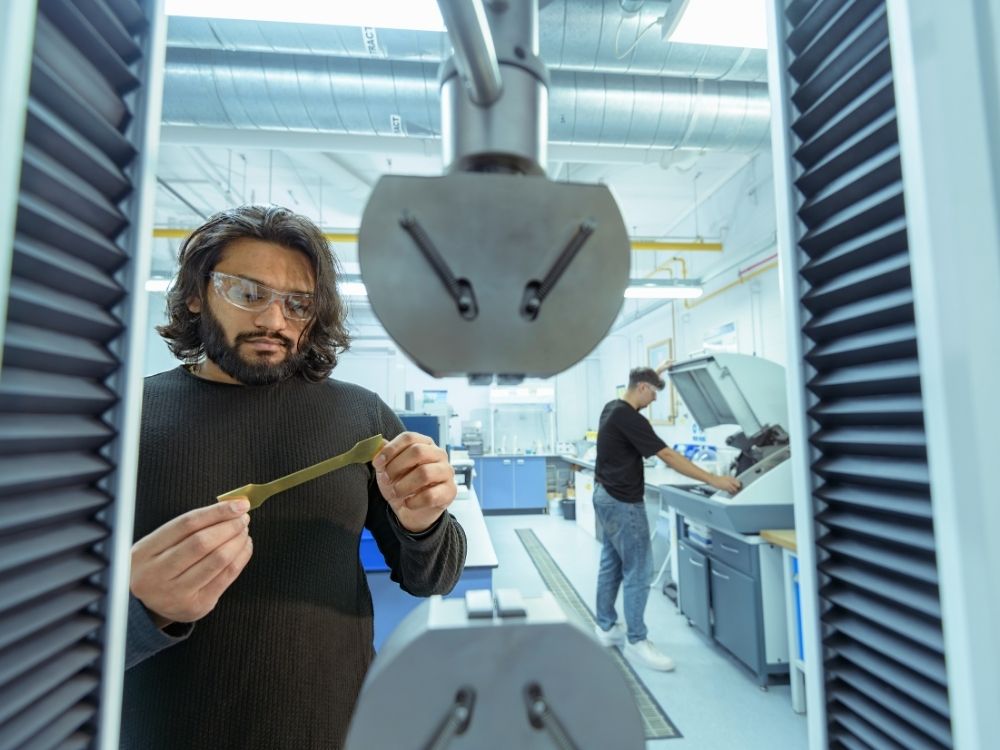
On this course you’ll have access to the following facilities, resources and state-of-the-art laboratories:
- A computer numerical control (CNC) manufacturing workshop
- Additive manufacturing
- Automation and robotics
- A design studio
- A modelling and simulation workshop
You’ll also study in our Adsetts Learning Centre, gaining teaching, academic skills and library research support, plus library resources and systems. You’ll have access to the Microsoft Office suite for free via a cloud provider – on devices we provide or on your personal ones.
360 tour - engineering facilities
Where will I study?
You study at City Campus through a structured mix of lectures, seminars and practical sessions as well as access to digital and online resources to support your learning.
City Campus
City Campus is located in the heart of Sheffield, within minutes of the train and bus stations.
City Campus map | City Campus tour

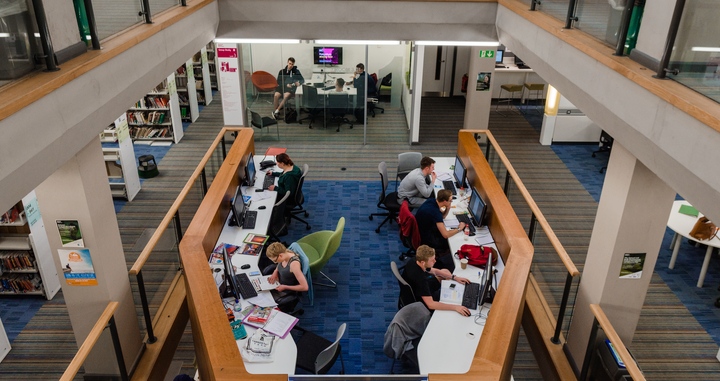
Adsetts library
Adsetts Library is located on our City Campus. It's open 24 hours a day, every day.
Explore the libraryExplore Strines
Explore Strines
Strines is where you’ll find our new Institute of Technology – a state-of-the-art learning space for manufacturing, engineering, construction, and creative and digital disciplines.
Entry requirements
All students
UK students
Normally one from
• an honours degree (2.2 or above) in a science or engineering subject
• suitable professional qualifications in an engineering field
• a degree in any discipline plus at least one year of relevant experience
• a diploma in a technological area plus at least three years of relevant experience
You may also be able to claim credit points which can reduce the amount of time it takes to complete your qualification at Sheffield Hallam. Find out more
Overseas students
Overseas applicants from countries whose first language is not English must normally produce evidence of competence in English. An IELTS score of 6.0 with 5.5 in all skills (or equivalent) is the standard for non-native speakers of English.
India
• a first class BE in an relevant discipline, or a good second class BE with a strong performance in mechanical and manufacturing subjects
China
• a four year Bachelors degree in an relevant discipline, with an overall average of at least 80 per cent or equivalent
Other countries
• a good honours degree or equivalent in an relevant subject
Additional information for EU/International students
If you are an International or non-UK European student, you can find out more about the country specific qualifications we accept on our international qualifications page.
For details of English language entry requirements (IELTS), please see the information for 'All students'.
Fees and funding
Home students
Our tuition fee for UK students starting full-time study in 2026/27 is £10,940 for the course.
If you are studying an undergraduate course, postgraduate pre-registration course or postgraduate research course over more than one academic year then your tuition fees may increase in subsequent years in line with Government regulations or UK Research and Innovation (UKRI) published fees. More information can be found in our terms and conditions under student fees regulations.
International students
Our tuition fee for International/EU students starting full-time study in 2026/27 is £18,600 for the course.

Scholarships and financial support
Find information on scholarships, bursaries and postgraduate student loans.
International scholarships up to £3000 ›
Alumni scholarships up to £2000 ›
Postgraduate loans for UK students ›
Additional course costs
The links below allow you to view estimated general course additional costs, as well as costs associated with key activities on specific courses. These are estimates and are intended only as an indication of potential additional expenses. Actual costs can vary greatly depending on the choices you make during your course.
General course additional costs
Additional costs for School of Engineering and Built Environment (PDF, 266.7KB)Legal information
Any offer of a place to study is subject to your acceptance of the University’s Terms and Conditions and Student Regulations.