Everything you need to know...
-
Tuition fees
Home: £11,490 for the course
International/EU: £19,530 for the course -
Course duration
1 Year
-
Study location
-
Start date
September 2027
Work Placement Route
For international students wishing to undertake a placement as part of this course, you must apply to MSc Geospatial Data Science with Artificial Intelligence (Work Experience) route. Transferring to the work experience route later will not be possible due to visa restrictions.
Course summary
- Explore geospatial data science, AI and Geographic Information Systems (GIS).
- Apply geospatial technologies to understand and solve real-world spatial problems.
- Develop your ability to communicate complex concepts to different audiences.
- Gain advanced skills through industry projects and professional networking.
- Consider the optional glaciology specialism, with opportunities for Arctic fieldwork.
Geospatial data science and AI skills are increasingly important for understanding our rapidly changing world. Building on GIS foundations, you’ll combine geospatial technologies, data science and AI to analyse and model complex spatial patterns and processes. You’ll apply your skills to environmental, societal and commercial challenges, gaining experience that prepares you for a career in the geospatial sector.

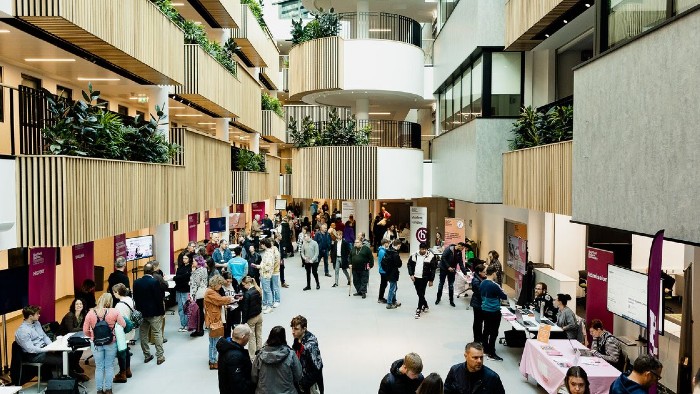
Come to an open day
Find out more at our postgraduate open days. Book now for your place.
How you learn
The Geospatial Data Science with Artificial Intelligence course balances academic and practical learning, enabling you to use GIS in real-world, applied scenarios. Most sessions involve interactive practical exercises supported by a tutor, alongside short lectures and opportunities for group discussion and collaboration. You’ll develop your knowledge, practical expertise and confidence across a range of industry contexts.
You learn through:
- interactive practical exercises
- tutorials
- work-based placements
- live projects
- lectures
- guest lectures
- field trips
- a virtual learning platform
- self-directed study
Key themes
You’ll explore how geospatial data science, GIS and AI can be used to understand complex spatial patterns and processes.
Throughout the course, you’ll build your technical and analytical skills while exploring how geospatial technologies are used in professional and research settings. You’ll also develop your ability to communicate complex spatial information clearly to different audiences.
If you choose the specialist glaciology pathway, you’ll explore how geospatial technologies can help us understand environmental change, with the opportunity to study a module at the University Centre in Svalbard and develop Arctic field skills.
Course support
You’ll be supported in your learning journey towards highly skilled employment through a number of key areas. These include:
- specialist support services to help with your personal, academic and career development
- Skills Centre one-to-ones and online resources to help you prepare for assessments
- industry-specific employability activities such as live projects and networking opportunities
Applied learning
Live projects
On the GIS professional module, you’ll work on a project commissioned by a client organisation. You’ll engage directly with the client, applying your knowledge to a real-world challenge while developing valuable problem-solving and professional skills.
Networking opportunities
You’ll be taught by experts with extensive professional experience and contacts across the GIS sector. Their industry insight informs your learning, and in tutorials they’ll help you explore employability and career development. You’ll also be encouraged and supported to attend a geospatial industry conference, giving you opportunities to develop your professional knowledge and networks.
Glaciology specialist pathway
If you choose the specialist MSc Geospatial Data Science with Artificial Intelligence (Glaciology) pathway, you can apply to spend seven weeks studying in the Arctic at the University Centre in Svalbard.
You’ll develop Arctic field skills and specialist knowledge of glaciology, gaining first-hand experience of Arctic environments. You’ll explore how geospatial technologies are used to monitor and understand cryospheric change, while working alongside an international community of students and researchers.
The pathway combines advanced geospatial analysis with Arctic environmental science, supporting careers and further study in areas such as environmental monitoring, climate change research and polar science.
Your course leader

Niall Gandy
Lecturer in GISNiall is a palaeo-glaciologist and GIS specialist, primarily lecturing in GIS at Sheffield Hallam University.
Modules
Module and assessment information for future years is displayed as currently validated and may be liable to change. When selecting electives, your choices will be subject to the core requirements of the course. As a result, selections may be limited to a choice between one of two or more specified electives in some instances.
Final year
Compulsory modules
In this module you will expand your knowledge and application of cutting-edge GIS techniques. You will focus on new emerging technologies in GIS, including AI and cloud computing, and plan for your continued professional development to keep pace with the advancing field.
You’ll study topics such as:
- Spatial statistics
- AI and machine learning
- Python and SQL
- Network analysis
- Spatial autocorrelation and hotspot analysis
In this module you will advance our understanding of the world though the application of your professional skills. You will plan and execute an independent project, with a freedom to explore the range of topics that your developed skillset allows.
You’ll study topics such as:
- Working as part of a research group
- Identifying research gaps in the literature
- Writing a research proposal
- Executing independent research
In this module you will use data collection and GIS analysis techniques to monitor change, and then communicate your findings effectively online.
You’ll study topics such as:
- Remote Sensing and Drone monitoring
- Error classification
- GIS and the Internet of Things
- Statistical Downscaling
- Online data presentation
This module develops your toolkit of skills to understand society and the natural environment. In this module, you will integrate core GIS skills with the broader fieldwork, literacy, numeracy, and presentation skills that a modern GIS professional requires.
You’ll study topics such as:
- Geographical Information Systems
- Desk-based Site Survey
- Collecting field data
- Statistical analysis
- Python for Environmental Science
- Cartography
- Data plotting
Elective modules
In this module you will apply your expertise to a professional context. You will experience the use of GIS in a range of professional contexts, and apply your skills to a real-life project in partnership with colleagues in the industry.
You’ll study topics such as:
- Contacting clients
- Site visits
- Effective GIS consultancy
- Professionalism and CV skills
- Making the most of conference attendance
Module Aim:
To develop specialist knowledge and practical skills in glaciology through the study of glacier systems and Arctic fieldwork
Indicative content:
Arctic fieldtrip, research seminar series, crevasse rescue training, planning and executing fieldwork
Formative assessment statement:
An initial draft submission mid-semester will receive individual oral feedback in class.
Future careers
This course prepares you for careers such as:
- GIS technology
- strategic analysis
- environmental modelling
- spatial analysis
- research
- data science
- statistics
- planning
Previous graduates of this course have gone on to work for:
- Amazon Web Services
- Environment Agency
- Esri
- Moors for the Future
- Scottish Forestry
- Sheffield and Rotherham Wildlife Trust
- Yorkshire Water
Equipment and facilities
You’ll have access to specific GIS computer suites, field equipment, outdoor gear store, and remote-access software.
Where will I study?
You study at City Campus through a structured mix of lectures, seminars and practical sessions as well as access to digital and online resources to support your learning.
City Campus
City Campus is located in the heart of Sheffield, within minutes of the train and bus stations.
City Campus map | City Campus tour

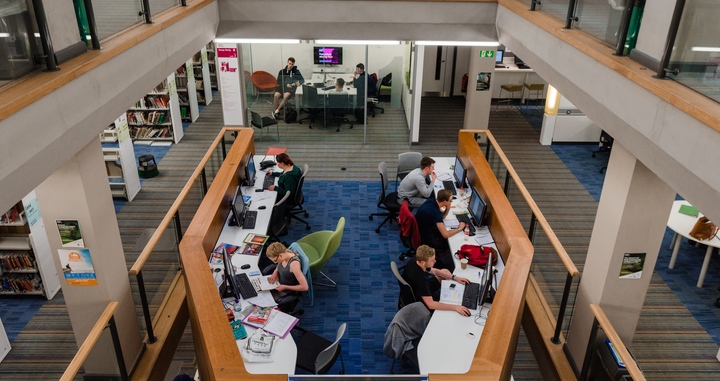
Adsetts library
Adsetts Library is located on our City Campus. It's open 24 hours a day, every day.
Explore the libraryEntry requirements
All students
A lower second class degree or above in a relevant subject ensures consideration for entry on to the course. You may also be able to claim credit points which can reduce the amount of time it takes to complete your qualification at Sheffield Hallam. Find out more
Individuals without a suitable degree will be considered where they can demonstrate they meet the applicant entry profile and have worked for two years at a management level using GIS in the workplace, or, have a sufficiently high level of technical ability and responsibility within their role to meet the satisfaction of the admissions tutor.
If English is not your first language you typically need an IELTS 6.0 score with a minimum of 5.5 in all skills or equivalent.
Additional information for EU/International students
If you are an International or non-UK European student, you can find out more about the country specific qualifications we accept on our international qualifications page.
For details of English language entry requirements (IELTS), please see the information for 'All students'.
Fees and funding
Home students
Our tuition fee for UK students starting full-time study in 2027/28 is £11,490 for the course.
If you are studying an undergraduate course, postgraduate pre-registration course or postgraduate research course over more than one academic year then your tuition fees may increase in subsequent years in line with Government regulations or UK Research and Innovation (UKRI) published fees. More information can be found in our terms and conditions under student fees regulations.
International students
Our tuition fee for International/EU students starting full-time study in 2027/28 is £19,530 for the course.

Scholarships and financial support
Find information on scholarships, bursaries and postgraduate student loans.
International scholarships up to £3000 ›
Alumni scholarships up to £2000 ›
Postgraduate loans for UK students ›
Additional course costs
The links below allow you to view estimated general course additional costs, as well as costs associated with key activities on specific courses. These are estimates and are intended only as an indication of potential additional expenses. Actual costs can vary greatly depending on the choices you make during your course.
General course additional costs
Additional costs for Sheffield Institute of Social Sciences (PDF, 251.6KB)Legal information
Any offer of a place to study is subject to your acceptance of the University’s Terms and Conditions and Student Regulations.