
Everything you need to know...
-
Tuition fees
Home: £10,050 per year
International/EU: £18,900 per year -
Course duration
3 / 4 Years
-
Study location
-
Entry requirements
-
Course code
G100
-
Start date
September 2027
-
Placement year available?
Yes
Course summary
- Apply mathematical and statistical expertise to modern life and real-world contexts
- Model complex problems to create insights and solutions
- Develop advanced logical reason skills through the study of pure maths
- Use SAS and Python to enhance your mathematical and statistical understanding
- Collaborate on real-world projects using live datasets and business briefs
Whether you’re modelling customer behaviours, the spread of infectious diseases, managing the sustainable use of renewable resources, designing for energy efficiency, simulating sustainable transport, or pricing financial derivatives – maths is at the heart of some of the biggest global issues we face. This is just a taste of the topics you could be exploring on the course.
If you don't meet the entry requirements for this course, or you’d like extra preparation before starting degree-level study, we recommend you join the foundation course.
Employability
95% of UK graduates are in work or further study 15 months after graduating (2023/24 Graduate Outcomes Survey).

Come to an open day
Discover our TEF Gold rated teaching and see why students voted Sheffield Hallam a top five university in England at the prestigious Whatuni Student Choice Awards.
Accredited by

Institute of Mathematics and its Applications (IMA)
This course is accredited by the Institute of Mathematics and its Applications to meet the educational requirements of the Chartered Mathematician designation when followed by subsequent training and experience in employment to obtain equivalent competences to those specified by the Quality Assurance Agency (QAA) for taught masters degrees.
How you learn
You are at the centre of teaching on the course, supporting you to develop your understanding of mathematical concepts and your ability to apply them in various contexts. At the heart of this is your dedicated learning space that fosters a community environment across staff and students alike, emphasising small group, supportive collaboration.
You’ll learn from lecturers who are active in the continued development of knowledge through research and publications.
You learn through:
- lectures and workshops
- practical sessions and tutorials
- hands-on lab experience in computational modelling and simulation
- regular feedback
- teamwork and group learning
- applied learning and live client projects
- independent and guided research
- industry talks and events such as the Festival of Computing
Key Themes
You’ll begin by deepening your mathematical knowledge and skills, from refreshing your A-Level knowledge through to core principles of proof and reasoning. You’ll develop core mathematical techniques including algebra, calculus and data analysis. Using these skills, you will analyse business data to present findings to industry partners, such as YES Energy Solutions, further building your professional communication skills.
The second year will build your knowledge in topics such as advanced calculus and complex analysis, while continuing to develop a deeper understanding of statistical and mathematical modelling alongside problem-solving techniques. This includes continuous modelling with differential equations, discrete and statistical modelling.
During your final year, alongside developing your deeper understanding of mathematical concepts and their practical applications, you will work on a dissertation topic of your choice. You will be guided by a dedicated supervisor and supported throughout the life cycle of the project from planning and scoping, through to completion. Many of our students work with industry partners on their final year projects.
Couse Support
You’ll be supported in your learning journey towards highly skilled, graduate-level employment. This includes:
- access to specialist services to help with your personal, academic and career development
- access to our Skills Centre with one to ones, webinars and online resources, where you can get help with planning and structuring your assignments
- industry-specific employability activities such as live projects, learning in simulated environments and networking opportunities
Student's success story

After studying BSc Mathematics at Sheffield Hallam, Alice Switonski now works as a statistician at Reckitt, supporting clinical trials and helping bring new medicines and medical devices to market. Read more.
Applied learning
Work Placement
You’ll have the opportunity to complete a year-long work placement between your second and final year. We have connections with a range of employers including HSBC, Volkswagen, and Paraxel, and we’ll support you to set up work experience that’s right for you.
Many students go on to secure a graduate role with their host employer after completing their placement year.
Students from this course have worked with companies such as:
- Government Operational Research Service
- Lloyds Banking Group
- PepsiCo
- Experian
- Covance
- Disney
- WSP
Your placement year will allow you to gain an Applied Professional Diploma in addition to your degree which will enhance your graduate profile and give you the edge with future employers.
Live Projects
We embed real-life case studies and work experience into the course to support your development into a professional mathematician. You’ll explore case studies from areas such as mathematical modelling, machine learning, AI, data analysis and climate science. Some of these are presented by guest lecturers from our industry partners in the local region, giving you direct links to future employers and the opportunity for professional networking.
Live projects form an essential part of our teaching. You’ll work on live data sets from local businesses, government, health trusts or charities – developing essential skills such as project management, teamwork and reporting, and presenting results to both technical and non-technical audiences. By undertaking this work, you’re also gaining real work experience as a consultant, preparing you for your future career.
Our students have previously undertaken projects with Sheffield United FC, Paraxel, 4Most, and YES Energy Solutions. This has seen them undertake projects including replication of medical data analysis in SAS and Python, analysing company Equality, Diversity, and Inclusion (EDI) data, and analysing data for energy improvements for homes.
Networking Opportunities
You’ll have the opportunity to attend scheduled events across the academic year, including careers fairs, and meet industry partners, employers and researchers. You'll also have the chance to attend alumni presentations where you can gain insights from previous students before you graduate.
Our annual Festival of Computing gives you the opportunity to showcase your work to peers, academics and representatives from industry.
Your course leader

Angharad Ugonna
Senior LecturerAngharad Ugonna, Senior Lecturer, School Of Computing and Digital Technologies
Lylah Haynes
Senior Lecturer in Mathematics and Placement Tutor for Mathematics, Visiting TutorI teach on the Mathematics BSc of which I am module leader for Mathematical Finance, lead Employability tutor, Mathematical Analysis tutor, and final year project su … Read more
Modules
Important notice: The structure of this course is periodically reviewed and enhanced to provide the best possible learning experience for our students and ensure ongoing compliance with any professional, statutory and regulatory body standards. Module structure, content, delivery and assessment may change, but we expect the focus of the course and the learning outcomes to remain as described above. Following any changes, updated module information will be published on this page.
You will be able to complete a placement year as part of this course. See the modules table below for further information.
Year 1
Compulsory modules
This module develops your knowledge and understanding of key statistical techniques, statistical software and project-based skills, working
collaboratively with local partners on an applied project. You’ll learn through a mix of lectures, workshops and laboratory sessions.
You’ll study topics such as:
-
Project-based statistics, from data collection to conclusions
-
Statistical programming
-
Data manipulation, summary and visualisation
-
Commonly used statistical techniques and statistical modelling
-
Working with employers as a data analyst
-
Consultancy and project management skills
This module develops the skills required of a professional mathematician, including reading, thinking and working with mathematical and statistical ideas, and programming. In lectures, workshops and group tutorials, you’ll develop confidence and accuracy with foundational concepts and techniques, extending these to new topics which are essential for successful further study.
You’ll study topics such as:
-
Functions, solving equations and complex numbers
-
Calculus, analytical and numerical techniques for basic differential equations
-
Matrices and linear algebra
-
Core concepts of statistics
-
Probability and inferential statistics
-
Programming
This module develops skills in applying both familiar and new mathematical techniques to solve everyday problems, including critical thinking, team work and understanding the roles of different team members. Through lectures, workshops and group tutorials, you’ll appreciate the role of mathematics and statistics in research and wider society, including the impact of Artificial Intelligence (AI) and machine learning algorithms.
You’ll study topics such as:
- Modelling principles and techniques
- Matrix algebra
- Linear simultaneous equations and vectors
- Linear programming
- Queuing systems
- Probability
- Ordinary differential and difference equations
- Mathematics and statistics in real-world contexts
- The role of ethics
This module explores problem solving and mathematical thinking skills by introducing mathematical theory and abstraction. Through interactive workshops you’ll develop an appreciation of rigour and methods of mathematical proof.
You’ll study topics such as:
-
Problem-solving strategies
-
Communicating solution methods with clear definitions and justifications
-
Connecting and applying prior learning and skills to new problems
-
Proof methods
-
Set theory and logic
-
Number bases
-
Modular arithmetic
-
Functions
-
Group and graph theories
-
Combinatorics
Year 2
Compulsory modules
Module Aim:
To develop knowledge and understanding of different modelling techniques in a variety of contexts to enable the production and interpretation of model output in real world scenarios.
Indicative content:
-
Continuous modelling with differential equations
-
Discrete modelling
-
Statistical modelling
At least one of these will include an enhanced applied project.
The module will be delivered through workshop style teaching sessions and independent study.
This module contributes to course cohesion by developing the core skills of mathematical modelling central to applied mathematics and integral to the core Level 6 modules.
This module broadens your experience of techniques and applications of calculus and linear algebra. You’ll learn through lectures, tutorials and workshops. You’ll study topics such as: · Multiple integrals, double integration in Cartesian and polar co-ordinates · Change of order of integration and triple integration · Vector calculus gradient, divergence, curl, identities and directional derivative · Fourier analysis · Spaces isomorphic to Rn · Linear independence, bases, subspaces, rank and transformations · Eigenvectors, eigenvalues and abstract vector spaces
This module develops mathematical rigour and knowledge in an area of pure mathematics, enabling you to prove and apply theorems and discover properties of mathematical objects. You’ll explore both real and complex analysis through a mix of lectures and tutorials.
You’ll study topics such as:
-
Upper and lower bounds
-
Inequalities
-
Convergence and divergence of sequences and series
-
Power series
-
Complex-valued functions
-
Cauchy-Riemann equations
-
Contour integration
-
Laurent series
-
Residues
-
Applications of contour integration
This module develops your theoretical understanding and practical application of more advanced statistical techniques that are used widely in industry. You’ll also expand on techniques covered at level 4.
You’ll study topics such as:
-
Statistical modelling and application
-
Model formulation and selection
-
Identification of issues
-
Non-linear models
-
Understanding the relevant theory
-
Probability and theory of statistical inference
-
Bayesian statistics
Year 3
Compulsory modules
Module aim:
The aim of this module is to enhance students’ professional development through the completion of and reflection on meaningful work placement(s).
A work placement will provide students with opportunities to experience the realities of professional employment and experience how their course can be applied within their chosen industry setting. The placement will:
- Allow student to apply the skills, theories and behaviours relevant and in addition to their course
- Enable students to enhance their interpersonal skills in demand by graduate employers – communication, problem-solving, creativity, resilience, team work etc.
- Grow their student network and relationship building skills.
- Provide student with insights into the industry and sector in which their placement occurs
- Help student make informed graduate careers choices.
Indicative Content:
In this module students undertake a sandwich placement (min 24 weeks / min 21 hours per week) which is integrated, assessed and aligned to their studies.
Their personal Placement Academic Supervisor (PAS) will be their key point of contact during their placement and will encourage and support students to reflect on their experience, learning and contribution to the organisation they work for.
To demonstrate gains in professional development, students will be required to share their progress, learning and achievements with their Placement Academic Supervisor and reflect on these for the summative piece of work.
Final year
Compulsory modules
This module applies tools developed throughout the degree to build mathematical models that tackle issues of sustainability. Through lectures, seminars, tutorials, workshops and lab sessions, you’ll specialise in your own area of interest to further your knowledge and enhance your mathematical and statistical skills. You’ll study topics such as: · Modelling with partial differential equations · Mathematical biology · Data science and Statistics · Fluid dynamics · Discrete mathematics · Programming with Mathematical applications.
Your individual final year project is the apex of your academic journey, offering a platform to apply the wealth of knowledge and skills gathered throughout your degree to authentic, discipline-specific problems. This module requires your creativity, problem-solving capabilities, and the ability to navigate new material independently in whichever field you choose to specialise in. This module allows you to: · Undertake in-depth research in a topic of your choosing · The opportunity to work alongside researchers · Create a body of work that can support you into further study, or work in a field that interests you
Develop solid foundations for undertaking a self-managed academic research project. On this module you will develop the skills and understanding you will need to complete your dissertation project to the highest level, and undertake some initial work. Through guided reading and one-to-one discussions with your project supervisor you will design a path through to successful completion of an extensive research project including developing the project management skills you will need to achieve this. You’ll study topics such as · The life cycle of a project · Reviewing academic literature · Quality management · Project management techniques and tools · Research ethics
· Intellectual property rights
This module develops your theoretical and practical expertise in a range of mathematical and statistical applications. Through lectures, seminars, tutorials, workshops and lab sessions, you’ll specialise in areas of interest, further developing your theoretical and practical expertise in a range of mathematical and statistical applications. You’ll study topics such as: · Fluid dynamics · Data science and Statistics · Codes, cryptography, and abstract algebra · Combinatorics and game theory · Mathematical physics · Mathematical finance
Future careers
Maths leads to a broad range of careers because the skills you develop are widely applicable. Whether you have an idea of where you’re heading or not, we’ll help you find and achieve your goals.
This course prepares graduates who are highly employable in many general and specialist graduate roles, including:
- Scientific or medical research
- Medicine and health logistics
- Engineering
- Business logistics, market research and data analysis
- Local and national government
- Finance and banking, wealth management, counter fraud
- IT/technology
- Teaching
- Credit Risk Analyst
Previous graduates of this course have gone on to work for:
- HSBC
- Lloyds Banking Group
- Direct Line
- Experian
- WSP
- BAE Systems
- Volkswagen
- International Airlines Group
- Reckitt
- AstraZeneca
- Covance
- Parexel
- NHS England
- Disney
- UK Government Civil Service
- Amazon Logistics
- Nectar360 at Sainsbury’s
- GCHQ
- PepsiCo
Further study is also a popular option – including postgraduate study in mathematics, cybersecurity, neuroscience, quantity surveying and teaching.

All in on your career
We promise you’ll be ready to launch your career. With employer connections, hands-on learning and lifelong career support, we’ll help make your ambition a reality.
Where will I study?
You study at City Campus through a structured mix of lectures, seminars and practical sessions as well as access to digital and online resources to support your learning.
City Campus
City Campus is located in the heart of Sheffield, within minutes of the train and bus stations.
City Campus map | City Campus tour

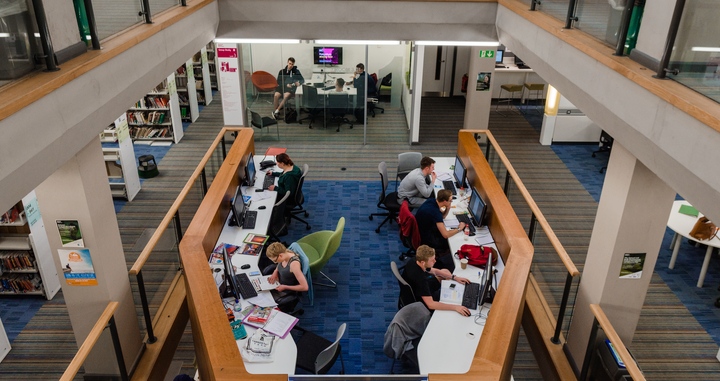
Adsetts library
Adsetts Library is located on our City Campus. It's open 24 hours a day, every day.
Explore the libraryEquipment and facilities
Maths students and staff from every year of the course have a shared work and study space - the Maths and Physics floor. It’s intended to build a strong community and designed for collaborative use across a range of facilities:
- Group working areas.
- Large screens and whiteboards for discussions.
- Spaces for individual study, with PCs and laptop loans.
- Meeting rooms.
- A large multi-purpose teaching room.
- Industry-leading statistics software, including SAS.
Entry requirements
All students
UCAS points
- Standard offer: 112 UCAS points
- Contextual offer: 96 UCAS points
We make contextual offers to local applicants, applicants living in low participation areas and applicants with specific personal circumstances. Check your eligibility for a contextual offer.
This must include at least 64 points from two A levels or equivalent BTEC National qualifications, including at least 32 points from A level mathematics. For example:
- BBC at A Level with grade C in mathematics.
- DMM in BTEC Extended Diploma.
- Merit overall from a T level qualification.
- A combination of qualifications, which must include a C in A level mathematics, may include AS Levels, EPQ and general studies.
You can find information on making sense of UCAS tariff points here and use the UCAS tariff calculator to work out your points.
GCSE
- Maths at grade C or 4
GCSE equivalents
- Level 2 Numeracy or Functional Skills Level 2 Maths
• Foundation - successful completion of Engineering and Mathematics foundation year or equivalent
• Access - an Access to HE Diploma with at least 45 credits at level 3 and 15 credits at level 2. At least 15 level 3 credits must be at merit grade or above, from a QAA-recognised Access to HE course, or an equivalent Access to HE certificate.
If English is not your first language, you will need an IELTS score of 6.0 with a minimum of 5.5 in all skills, or equivalent.
We welcome applications from people of any age. We may be flexible in our normal offer if you can show a commitment to succeed and have the relevant skills and experience. This must show that you will benefit from and finish the course successfully.
Additional information for EU/International students
If you are an International or non-UK European student, you can find out more about the country specific qualifications we accept on our international qualifications page.
For details of English language entry requirements (IELTS), please see the information for 'All students'.
Fees and funding
Home students
Our tuition fee for UK students on full-time undergraduate courses in 2027/28 is £10,050 per year (capped at a maximum of 20% of this during your placement year). These fees are regulated by the UK government and therefore subject to change in future years.
If you are studying an undergraduate course, postgraduate pre-registration course or postgraduate research course over more than one academic year then your tuition fees may increase in subsequent years in line with Government regulations or UK Research and Innovation (UKRI) published fees. More information can be found in our terms and conditions under student fees regulations.
International students
Our tuition fee for International/EU students starting full-time study in 2027/28 is £18,900 per year (capped at a maximum of 20% of this during your placement year)

Financial support for home/EU students
How tuition fees work, student loans and other financial support available.
Additional course costs
The links below allow you to view estimated general course additional costs, as well as costs associated with key activities on specific courses. These are estimates and are intended only as an indication of potential additional expenses. Actual costs can vary greatly depending on the choices you make during your course.
General course additional costs
Additional costs for School of Computing and Digital Technologies (PDF, 242.1KB)Legal information
Any offer of a place to study is subject to your acceptance of the University’s Terms and Conditions and Student Regulations.