

Everything you need to know...
-
Tuition fees
Home: £10,050 per year
International/EU: £18,900 per year -
Course duration
2 Years
-
Study location
-
Entry requirements
-
Course code
BB34
-
Start date
September 2027
Course summary
- Gain valuable insights from our experienced experts and international networks
- Apply your practical skills and knowledge in real-life situations with work placements
- Use our strong ties with professional teams and organisations to forge industry connections
- Cultivate leadership and strategic skills to assess and thrive in the sport business arena
- Gain local and global experience, including with the University of Madrid
You’ll study key business concepts and theories and examine best practices in management to navigate the dynamic sport business landscape.
You’ll study in an environment that encourages the exploration of new ventures and the development of a strong business mindset. You’ll graduate as a motivated and innovative business leader.
This is a foundation degree with a top up opportunity for a full BSc qualification. Click here for our full time on Campus BSc Sport Business Management course.
World top 150 for sport
We’re ranked in the world top 150 universities for sport in the QS World University Rankings 2026. This reflects our strength in sport teaching, research, industry reputation and international outlook.

Come to an open day
Discover our TEF Gold rated teaching and see why students voted Sheffield Hallam a top five university in England at the prestigious Whatuni Student Choice Awards.
How you learn
Blended learning in Sport Business Management
Explore how our FdSc Sport Business Management course combines in person and online teaching alongside real world industry experience, offering a flexible and accessible route into higher education.
Our sports management courses are taught by Sheffield Hallam staff, who are highly experienced in the sporting world and facilitated by our partner sports organisations. You’ll develop your skills and knowledge through teaching, working and doing – exploring the business of sport from a global perspective, while also delving into the intricacies of the UK sport industry.
You’ll also enhance your digital capability, critical thinking and inclusive approaches that value equality and diversity.
Our hands-on approach to sports management learning includes:
- Lectures, seminars and workshops
- A virtual learning environment (VLE)
- Work-based learning experiences
- Placements
- Field trips
- Practical activities in both simulated and in-situ environments
- Independent study
- Research opportunities
What is blended learning?
Blended learning captures the balance between in-person and virtual teaching. Students will be ‘based’ at a regional, partner organisation. In smaller groups and a more personalised environment, students will have in-person teaching five times per academic year, with the rest of their learning via pre-recorded videos that will be delivered by Sheffield Hallam staff, facilitated by an educationalist that is based at the partner organisation.
The content and staff remain the same as the full-time on campus module, the difference is the format of delivery.
Who are the partner organisations and what do they do?
For this course, you will need to be affiliated to one of our partners, where your learning will be facilitated. The purpose of this format of learning is for students to work with partner organisations by:
- Gaining experience working for / volunteering for the partner organisation
- Support them on matchdays (where appropriate)
- Support them with running events (where appropriate)
Our partner organisations can be found below, along with their own website for this opportunity or a link to their contact details to find out more about their personal offers.
What does this sports business management degree cover?
You’ll gain the hard and soft skills you will need to succeed in the competitive industry of sports business. You’ll see the importance of effective communication, ethical practices, deep consumer understanding, and a willingness to embrace calculated risks.
While you study you will also enhance your proficiency in technical, supervisory, and managerial aspects of sports business, equipping you for a range of career paths.
You’ll explore theoretical, philosophical, and practical foundations for sports business management – across marketing, finance, leadership, sports event management and enterprise. You’ll graduate with a deep understanding of the sport and physical activity sector and the broader business world.
Career-focused assessment and support for sports management students
This sports business management degree is designed to help you demonstrate your learning outcomes – with authentic assessment activities relating to real-world scenarios, your specific goals and your skills development. Throughout your studies, various individuals will support your learning and target setting – guiding you towards resources for academic, professional and personal development.
These support roles include:
- Course and Module Leaders
- Your Academic Adviser
- Your Student Support Adviser
- Your Employability Adviser
- Central services like counselling, Library and IT
98% of students on this course were satisfied with how well teaching staff supported their learning in the 2025 National Student Survey.
Studying at a university in the top 150 globally for sport looks like…
Take a glimpse into your life as a sport student at Sheffield Hallam and all it has to offer.
Applied learning
Build your sports management career with practical work placements
There’s a mandatory short placement at the end of your second year. Completing up to 200 hours, you will be learning while you work and preparing to progress into employment after you graduate.
You’ll also have the opportunity to undertake a year-long work placement (24 weeks minimum) or multiple placements between your second and final years. This gives you further valuable work experience to prepare you for your future career and allows you to graduate with an Applied Professional Diploma to add to your CV.
Past placements have involved working with local councils, national governing bodies such as the English Football Association (the FA), and professional clubs. We also maintain strong connections with local kit equipment manufacturers.
Additionally, there are often chances for you to volunteer in media sports events such as the Olympics, Wimbledon, the Commonwealth Games and the Paralympics.
Explore sports management first-hand on field trips
On field trips you will discover how your learning is applied first-hand to real-world situations, gaining valuable insight into working practice.
In previous years, students have visited prestigious venues such as Headingley Cricket Ground, Emirates Stadium and Aintree Racecourse.
Sheffield Hallam has developed a strong and collaborative partnership with the University of Madrid, enabling students to benefit from an enriching international experience. Through this close tie-up, there is an opportunity to take a field trip to Madrid.
Learn from experienced professionals in guest lectures
You’ll hear from specialist sports industry experts who share context-specific examples of the knowledge, skills and behaviours you will need for your career ahead.
Previous students have heard from influential guest speakers at UEFA, Arsenal FC, England Hockey and England Cricket.
Networking opportunities
Your employability is enhanced by the involvement of employers and industry partners – from the real-world projects you complete to the opportunities to build networks at careers fairs and workshops.
Our global networks really set us apart and give you the upper hand in a career field that truly is international. From our University of Madrid link-up to the chance to volunteer at global sporting events, you will create invaluable connections with individuals and organisations around the world.
On top of this, students have the opportunity to participate in numerous events, such as SportsPro Media Hackathon, a weekend-long event where groups of students come together to create and pitch new solutions, products or businesses that have a positive impact on the world.
Your course leader

Modules
Module and assessment information for future years is displayed as currently validated and may be liable to change. When selecting electives, your choices will be subject to the core requirements of the course. As a result, selections may be limited to a choice between one of two or more specified electives in some instances.
Year 1
Compulsory modules
Module Aim
This module develops your knowledge and understanding of contemporary issues relevant to managing sport, introducing you to current issues and emerging topics and debates in the global sport industry. You will learn how to find and investigate current academic sources including how these topics are reflected in real life examples and case studies.
You’ll study topics such as:
-
Corruption in sport
-
Ethical behaviours and values
-
Gambling and the sports betting industry
-
Equality, Diversity and Inclusion (EDI)
-
Social Return on Investment (SROI)
Module Aim
This module will develop your knowledge and understanding of the key functional areas within a sport business, and how they can be managed effectively and efficiently to meet organisational objectives.
You’ll study topics such as:
- Marketing as an exchange process
-
Segmentations, targeting, positioning
-
Marketing tactics to engage target audiences
-
Sources of revenue and costs
-
Return on investment
-
Corporate social responsibility
-
Workforce development
-
Governance
-
Interdisciplinary business functions
Module Aim
This module will introduce you to theories and ideas around leadership and management. You will explore the importance of these theories within sport organisations, applying them practically to brands you are familiar with, to understand how effective leadership and management drives success.
You’ll study topics such as:
- Traditional and contemporary approaches to management and leadership
-
Theoretical approach to managing teams, groups and individuals
-
Planning and organisation
-
Communication
-
Motivation
-
Professional development, presence and promotion
Module Aim
This module will explore the sporting landscape in the UK, introducing you to key organisations and the role of government, examining their roles and relationships in the management and delivery of sport and physical activity in the UK.
You’ll study topics such as:
-
Evolution of sport industry
-
Government involvement in sport and physical activity
-
The sport system (National, regional, local)
-
Public, commercial and voluntary sport sectors
Final year
Compulsory modules
Module Aim
This module develops your knowledge and understanding of the organisation and management of sporting events. It will develop your leadership, time management and communication skills, and explore important concepts and processes required to stage successful and safe sport and physical activity events.
You’ll study topics such as:
- The event planning process
-
Event logistic and risk management
-
Sponsorship, fundraising and financial planning
-
Staff and volunteer management
-
Innovative event PR and marketing
-
Self-reflection and evaluation
Module Aim
This module will develop your understanding of finance in the sport industry and how management decisions have financial implications. You will analyse financial data and explore effective ways to communicate crucial information and ideas based on your findings.
You’ll study topics such as:
- Financial statements (income statement and balance sheet)
- Financial decision-making in the private, public and not-for-profit sector
- Revenue streams and costs
- Budgeting and pricing
- Capital Investment Appraisals
- Ratio analysis
Module Aim
This module will explore innovation and entrepreneurship as a means of solving current issues that arise within industry. Through real-world examples, you will develop an understanding of the unique challenges and opportunities that exist in the sports industry.
You’ll study topics such as:
-
Sport innovation
-
Business model canvas and value proposition
-
Triple bottom line framework
-
Business intelligence
-
Project and event management
-
Technology trends
-
Data visualisation
-
Idea generation
Module Aim
This module will equip you with the knowledge and skills necessary to manage and develop sports brands. In it you will explore the marketing environment and the factors that impact marketing and promotion within sport and physical activity contexts.
You’ll study topics such as:
- The marketing environment and media landscape
-
Marketing research
-
Marketing management
-
The Marketing Mix
-
Segmentation, targeting and positioning
-
Campaign management
-
Consumer behaviour
Future careers
With a sports business management degree, you can enter a career in:
- International, regional and national sporting bodies
- Professional sports clubs and leagues
- Major venue and facility management
- Major events and event management
- Sport consultancy
- Social media, sponsorship and marketing
Previous sports management graduates have gone on to work for:
- Professional sports club (Sheffield United, Sheffield Wednesday, Arsenal FC, Nottingham Forest FC, Everton FC)
- National sport governing bodies (England Cricket, The FA, Netball England)
- Sport brands (Adidas, Kitlocker, Sportfive, Raab, DAZN)
- Sport media (Sky Sports, SportsPro Media, EA Games)
- Business graduate roles (M&S, Enterprise, Aldi)
- Major sport events (Commonwealth Games, Tottenham Hotspur Stadium, England Golf)
Employability
95% of UK graduates are in work or further study 15 months after graduating (2023/24 Graduate Outcomes Survey).

All in on your career
We promise you’ll be ready to launch your career. With employer connections, hands-on learning and lifelong career support, we’ll help make your ambition a reality.
Equipment and facilities
On this course, you will work with world-class digital resources and databases to support your learning, including access to sport-specific cases developed by academic colleagues around the world.
You will be part of more than 1,500 students at our nationally renowned School of Sport and Physical Activity and get to learn in cutting-edge facilities, including our £6m sports park and a satellite campus at the English Institute of Sport.
Sports facilities tour
Take a look around Sheffield Hallam University's sports facilities with Wellbeing, Sport and Physical Activity Officer Ellie.
Media Gallery






Where will I study?
You study at Collegiate Campus through a structured mix of lectures, seminars and practical sessions as well as access to digital and online resources to support your learning.
Collegiate campus
Collegiate Campus can be found just off Ecclesall Road, a bustling student district.
Collegiate Campus map | Campus facilities

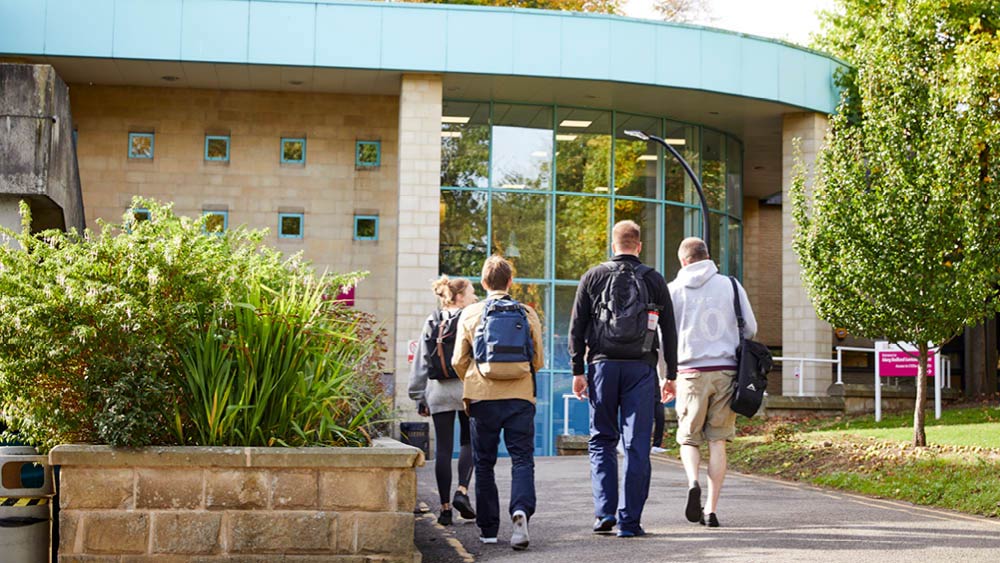
Collegiate library
Collegiate Library can be found just off Ecclesall Road. It's open 24 hours a day, every day.
Learn moreEntry requirements
All students
UCAS points
- 96
This must include at least two A levels or equivalent BTEC National qualifications. We do not accept General Studies. For example:
- CCC at A Level.
- MMM in BTEC Extended Diploma.
- Pass with C from a T Level qualification with extra from core.
- A combination of qualifications, which may include AS Levels or EPQ.
If you meet our contextual offer criteria we will make you a reduced offer up to 16 points below the standard entry requirement for this course. Find out more.
You can find information on making sense of UCAS tariff points here and use the UCAS tariff calculator to work out your points.
And GCSEs in
- English Language or Literature at grade C or 4, or equivalent*
- Mathematics at grade C or 4, or equivalent*
Or
- Access to HE Diploma from a QAA recognised Access to HE course. Normally we require 15 credits at level 2 and 45 at level 3.
Other equivalent qualifications are considered individually.
You also need to demonstrate an ability to;
- study academic subjects at degree level,
- debate topics and issues,
- draw on conclusions from written material,
- study independently as well as a member of a group,
- use computers and technology associated with contemporary teaching, learning and assessment methods,
- successfully complete a range of assignments including researched essays and practical examinations.
This is normally achieved by completing academic study at level three or above in the last four years.
* GCSE English and mathematics equivalent
- equivalency test from www.equivalencytesting.co.uk
IELTS
If English is not your first language, you will need an IELTS score of 6.5 with a minimum of 5.5 in all skills, or equivalent.
We strongly recommend that you tell us about any long term health conditions or disabilities you may have. This is so we can assess whether we can deliver the course in such a way that you can meet the course requirements and take part without disadvantage. You can contact our University student support staff and explore any issues you may have.
Additional information for EU/International students
If you are an International or non-UK European student, you can find out more about the country specific qualifications we accept on our international qualifications page.
For details of English language entry requirements (IELTS), please see the information for 'All students'.
Fees and funding
Home students
Our tuition fee for UK students on full-time undergraduate courses in 2027/28 is £10,050 per year. These fees are regulated by the UK government and therefore subject to change in future years. If a placement is undertaken this will cost an additional £250.
If you are studying an undergraduate course, postgraduate pre-registration course or postgraduate research course over more than one academic year then your tuition fees may increase in subsequent years in line with Government regulations or UK Research and Innovation (UKRI) published fees. More information can be found in our terms and conditions under student fees regulations.
International students
Our tuition fee for International/EU students starting full-time study in 2027/28 is £18,900 per year.

Financial support for home/EU students
How tuition fees work, student loans and other financial support available.
Additional course costs
The links below allow you to view estimated general course additional costs, as well as costs associated with key activities on specific courses. These are estimates and are intended only as an indication of potential additional expenses. Actual costs can vary greatly depending on the choices you make during your course.
General course additional costs
Additional costs for Sport and Physical Activity (PDF, 246.6KB)Legal information
Any offer of a place to study is subject to your acceptance of the University’s Terms and Conditions and Student Regulations.