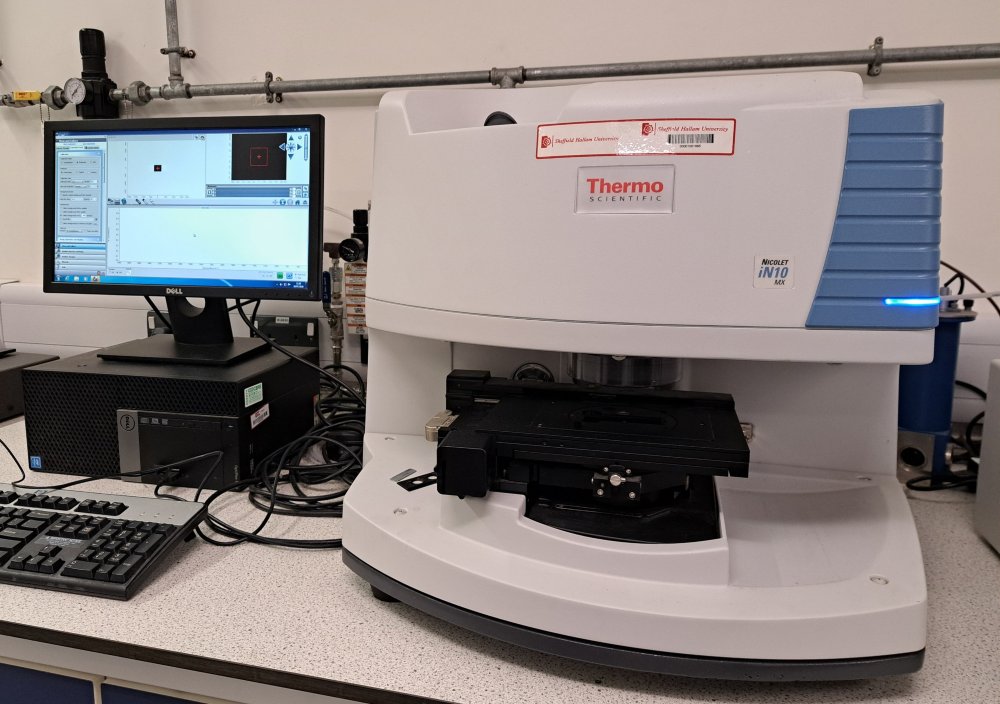
The Thermo Scientific™ Nicolet™ iN10 MX Infrared Imaging Microscope provides advanced chemical characterisation at the microscale, enabling researchers and industrial partners to investigate the composition, distribution and interactions of materials with exceptional detail. The technique combines infrared spectroscopy with microscopy, allowing individual particles, fibres, inclusions, defects and microscopic features to be analysed directly.
A key strength of the Nicolet iN10 MX is its ability to produce spatially resolved infrared chemical images. Rather than examining only a single point, the system can map the distribution of different compounds across a sample. This allows researchers to visualise chemical variation, locate contamination, assess coating uniformity and investigate complex, multi-component materials in greater detail.
With high spatial resolution and rapid imaging capabilities, the instrument provides valuable insight into materials where chemical composition varies across microscopic dimensions. By linking chemical information directly to observed microstructural features, the system helps uncover the root causes of material behaviour, processing issues and product failures.
Typical applications include:
- Material identification and verification
- Polymer, plastic and elastomer characterisation
- Coating and thin-film evaluation
- Packaging and multilayer material analysis
- Contamination and foreign particle identification
- Pharmaceutical formulation studies
- Microplastics and environmental investigations
- Failure analysis and root-cause determination
- Quality control and manufacturing support
The Nicolet iN10 MX is particularly valuable when understanding the location and distribution of materials is critical to solving a research or engineering problem. Whether examining a coating defect, identifying an unknown contaminant, assessing product consistency or investigating the composition of a complex material system, infrared imaging provides detailed chemical information that is often inaccessible through visual inspection alone.