Everything you need to know...
-
Tuition fees
Home: £10,050 per year
International/EU: £18,900 per year -
Course duration
3 / 4 Years
-
Study location
-
Entry requirements
-
Course code
NL31
-
Start date
September 2027
-
Placement year available?
Yes
Course summary
Want to solve real-world financial challenges with economics?
Given the rapidly changing financial sector, economics and financial expertise, economics and financial expertise are sought after all over the world. On this course you’ll develop the curiosity and analytical confidence to understand human behaviour and how economic systems operate, preparing for various roles where you can inform decisions in business, policy and society.
- Gain experience as a finance professional from day one, study micro and macroeconomics, investment management, analysis, policy and risk.
- Solve economics problems with statistical software, research and data analysis.
- Learn from experts, live projects, placements and global opportunities.
- Study the theory required for globally recognised qualifications such as CISI.
- Graduate with the knowledge and professional skills for diverse finance careers.
More ways to study this course
If you haven’t yet met the entry requirements for the course – or you’d like extra preparation before starting degree-level study – you’re welcome to join our integrated foundation year, which has been designed to encourage exploration and experimentation.
Get future, business and life ready.
Make Sheffield Business School your home. Learn in our brand new building with state of the art facilities, gold rated teaching, hands on industry partnerships and an experience ranked 5* by QS Top Universities. Build your skills, confidence and connections for the future. Make your move.
Employability
95% of UK graduates are in work or further study 15 months after graduating (2023/24 Graduate Outcomes Survey).

Come to an open day
Discover our TEF Gold rated teaching and see why students voted Sheffield Hallam a top five university in England at the prestigious Whatuni Student Choice Awards.
Accredited by

Association to Advance Collegiate Schools of Business (AACSB)

CISI Educational Partner
Sheffield Business School is accredited by the Association to Advance Collegiate Schools of Business (AACSB). This internationally recognised accreditation places us among the top business schools globally.
This course is accredited by the Chartered Institute for Securities & Investment (CISI). The university works closely with CISI to ensure that every module reflects real industry expectations and professional standards.
Top performing students may also receive University funded sponsorship to sit CISI professional examinations, subject to meeting the University’s eligibility criteria, giving them the opportunity to gain an industry recognised qualification alongside their degree – a valuable advantage in the competitive financial sector.
How you learn
This Economics and Finance degree is taught in lectures, tutorials, IT sessions and our state-of-the-art financial trading floor. Through team projects, research briefs, consultancy and placements, you’ll gain experience in economics analysis and research from day one. In our AACSB-accredited Sheffield Business School, you’ll join a global community where business leaders, researchers and 6,500 business students come together to solve problems and make things better.
Follow our Sheffield Business School Instagram to see real student life, course experiences, events and what it is like to study here.
Develop practical skills for diverse financial roles
On this course you can build professional skills in economics, accounting, business and finance from year one. You could:
- assess economic policy impact on households, businesses and the wider economy
- solve challenges for project and placements partners like M&S, HSBC and PwC
- apply trading and investment knowledge in the University Global Trading Challenge
- research inflation, interest rates, unemployment and market competition
- enhance your employability with additional Bloomberg and Microsoft certifications
Find out more in the practical learning section below.
Key themes
You’ll start by building a strong foundation in finance and economics, exploring economic theories, financial markets, investment management and policy. As you progress, you’ll apply your knowledge to real economic challenges, analysing data, evaluating policy decisions and exploring how human behaviour influences financial choices. In your final year, you’ll bring your learning together through a consultancy project for a real organisation, producing evidence based insights and recommendations to prepare you for careers in finance, economics, business and public policy.
Learn from the latest research
You’ll learn from experienced academics who bring their industry expertise and research insights into the classroom. Explore real economic challenges, from inflation and interest rates to unemployment and market competition, using economic data to analyse trends and evaluate policy decisions.
You’ll also investigate how human behaviour influences financial and economic choices, conducting your own research and surveys to understand what drives decision making. Through these activities, you’ll develop the analytical and research skills to make informed recommendations in business, finance and public policy.
Assessments that boost your CV
You’ll be assessed in ways that prepare you for your future career, with evidence you can take into interviews. Throughout the course you’ll prove you can:
- create reports, presentations and recommendations inspired by industry challenges
- connect economic concepts to the evidence you gather in your research projects
- use Excel to analyse real-world data, identify trends and evaluate performance
- turn real data into meaningful business insights, analysis and posters
- design research, develop surveys and apply economic theory to practical problems
Supporting your career
We’ll support you with personal, academic and career development services, such as:
- Skills Centre one-to-ones and online resources to help you plan and prepare for assessments
- digital skills, career readiness and graduate attributes
- finding, applying and interviewing for work experience opportunities
- live projects, learning in simulated environments and networking opportunities
Applied learning
Industry projects
In your first and second years, you’ll work on live client projects, researching business challenges and presenting recommendations to real organisations. Previous projects have included product development for Marks & Spencer, with some students securing placements through these opportunities.
You’ll also develop practical skills in communication, teamwork and problem solving through industry case studies, simulations and guest speakers, preparing you for careers in finance, consultancy and public policy.
Placements and work experience
After your second year, you’ll have the opportunity to undertake a sandwich placement, gaining valuable industry experience and practical skills in areas such as financial reporting, pricing strategies, sales targets and business operations. This hands-on experience will equip you with valuable workplace insights to enhance your readiness for your future career – as well as an Applied Professional Diploma for your CV.
Our dedicated placement team will support you throughout the process. Previous students have secured placements with organisations including Investec, Lloyds Bank, PwC, HSBC and Santander.
Competitions
As well as in-class tests and quizzes to help build your learning, we also run investment competitions and take part in the annual Bloomberg University Trading Challenge. Here you can apply trading strategies and investment knowledge in a competitive, real-world marketing environment. In 2024 two of our teams were in the top 50 of 570 teams, from nearly 2,300 students across 180 universities in 24 countries.
Employer and industry connections
You’ll build industry connections through career fairs, employer presentations, workshops, field visits and networking opportunities. You can also work towards Microsoft and four Bloomberg for Education certifications, covering finance fundamentals, market concepts, environmental social governance (ESG), and spreadsheet analysis.
You’ll develop knowledge for globally recognised professional qualifications such as those from the Chartered Institute for Securities & Investment (CISI), with opportunities to attend CISI and Chartered Financial Analyst institute (CFA) webinars and workshops to stay up to date with industry trends, build your network and explore careers in investment, banking and finance.
Your course leader

Cynthia Chakahwata
Senior LecturerDr. Cynthia Chakahwata is an accomplished academic and finance expert with over 15 years of experience teaching in Finance, Investment and Banking
Modules
Important notice: The structure of this economics and finance degree is periodically reviewed and enhanced to provide the best possible learning experience for our students and ensure ongoing compliance with any professional, statutory and regulatory body standards. Module structure, content, delivery and assessment may change, but we expect the focus of the course and the learning outcomes to remain as described above. Following any changes, updated module information will be published on this page.
You’ll be able to complete a placement year as part of this course. See the modules table below for further information.
You will be able to complete a placement year as part of this course. See the modules table below for further information.
Year 1
Compulsory modules
This module develops your understanding of various quantitative processes for collecting, analysing, managing, interpreting and utilising data within the context of business and economics. You’ll gain the knowledge and analytical and mathematical skills to tackle advanced material in later years, along with transferable insights for other disciplines and applications.
You’ll study topics such as:
-
Summarising data by tabulation, graphs and summary measures
-
Analysis through measures of change and index numbers
-
Examine the relationships between variables using scatter diagrams and correlation coefficients
-
Time series analysis using graphs, moving averages and linear regression
-
Forecasting using additive and multiplicative models
-
Creating future cash flows based on forecast figures and estimation
-
Calculate present, future and outstanding values and the internal rate of return of a project
-
Descriptive statistics, measures of central tendency, variability and graphical representation
-
Trend analysis, seasonal factor and time series model forecasting
This module provides a broad understanding of the main financial asset classes and investment products that a sophisticated investor may use. You’ll explore how investment strategies are developed as part of the portfolio construction and review process with a client, and the effect of taxation and macro-economic trends on portfolio performance.
You’ll study topics such as:
-
Analysis of the main asset classes
-
The macro-economic environment in relation to investing
-
Principles of investment risk and return
-
Taxation of investors and investments, including personal and trust taxation
-
Investment products
-
Portfolio construction and planning
-
The process of giving investment advice
-
Portfolio performance and review
Module Aim:
The main aim of this module is to examine the key mathematical concepts widely applied in modern business and economics. These include algebraic manipulation, functions, and elementary differential calculus, with particular application to optimisation in economics. It is designed to enable all students, regardless of their mathematical background, to apply mathematical concepts to business and economic problems.
Indicative content:
Some of the indicative content that this module will be covering include topics such as:
-
Linear equations
-
Non-linear equations
-
Financial Mathematics
-
Differentiation
-
Partial differentiation
-
Optimisation
-
Integration
This module provides a solid foundation in the fundamental concepts and theories of economics, introducing principles of micro and macroeconomics, market structures and economic systems. We’ll equip you with the analytical tools you need to understand and evaluate economic issues and policies in a wide range of contexts – as well as the opportunity to work collaboratively with a client to explore real-world challenges.
You’ll apply learning and skills such as:
-
Market forces and welfare, market efficiency and inefficient market allocations
-
Consumer choice
-
Firm behaviour, factor markets and market structures
-
Public goods and trades
-
Work experience through a client-led experiential project
-
Reflection on your strengths
-
Professional behaviours
Year 2
Compulsory modules
This module focuses on advanced microeconomic theories and analysis, appreciating how introductory micro economic theories can analyse the choices and constraints facing consumers and producers, while introducing alternatives to the neo-classical economic model. You’ll then shift to more advanced macroeconomic theories – areas such as the GDP, inflation, unemployment, the AS-AD model, economic growth models and business cycle fluctuations – and you’ll gain experience through immersive work experience, in partnership with external organisations.
You’ll study topics such as:
-
Demand: income and substitution effects of a price change
-
Supply: isocost and isoquant analysis
-
Transaction cost theory and their influence on the vertical boundaries of the firm
-
Ethical externalities and porter's concept of creating shared value
-
Game theory and the Cournot model
-
Bertrand and Stackelberg models
-
Short-run macroeconomic equilibrium and analysis of economic intervention
-
Combining the money and goods markets
-
ISLMBP model (Mundell-Fleming): open economy macroeconomics
-
Long-run growth, Solow growth and endogenous growth models
This module enhances your understanding of financial markets to help you evaluate choices in funding and financing investment decisions. You’ll explore the role of cash in firm, managing working capital and the management and measurement of risk for decision-making – applying core concepts of finance to reduce risk or engage in risk-taking activities, explaining these decisions to all stakeholders of a firm.
You’ll study topics such as:
- Risk, return and the time value of money
- Business risk and financial risk
- Sources of finance, including equity finance, debt finance and leasing decisions
- Working capital management and the management of cash, inventory, receivables and payables
- Investment appraisal techniques with risk and capital rationing
- Foreign exchange rate risk management using both internal and external techniques
- Interest rate risk management using both internal and external techniques
- The management of liquidity, commodity and operational risk
- Credit ratings (such as key factors determining ratings, covenant tests, and ratings methodology)
- The adoption and implementation of enterprise-wide risk management
This module introduces the econometric methods generally used to analyse economic data. We’ll equip you with the knowledge to understand recent developments in econometrics, helping you to carry out future applied econometrics analysis.
You’ll study topics such as:
-
Econometrics and statistical concepts
-
Simple linear regression modelling
-
Multiple regression analysis
-
Dummy variable regression models
-
Functional forms of regression model
-
Multicollinearity
-
Heteroskedasticity
-
Autocorrelation
Elective modules
This module presents various heterodox views in economics as alternative approaches to the mainstream economics – a blend between conventional economist wisdom and the opposing heterodox perspectives which treat the social reality as open, processual and implicitly related. You’ll be able to link economics to other social disciples, such as philosophy, sociology, psychology and politics.
You’ll study topics such as:
-
Economic thinking in the ancient era
-
Mercantilism
-
The classical economists
-
Radical economics and Marxism
-
The neoclassical approach
-
Keynesian economics
-
Chicago school of thought and the monetarists
-
Austrian school of economic thinking
-
Further heterodox approaches in economic thinking
This module explores the latest technological trends and innovations in the financial industry, from the impact of fintech on traditional banking services to the emergence of new business models – such as peer-to-peer lending, crowdfunding and digital currencies. You’ll learn about the opportunities and challenges posed by fintech – regulatory compliance, cybersecurity risks and ethical considerations – while examining the role of big data, artificial intelligence and blockchain in transforming financial services and enhancing customer experience.
You’ll study topics such as:
-
Banking and fintech history, evolution and key concepts
-
Fintech players, trends and challenges
-
Fintech and traditional banking: competition, collaboration or coexistence?
-
Mobile payments, e-wallets and contactless
-
Peer-to-peer lending, crowdfunding, and online marketplaces
-
Cryptocurrencies and other digital assets
-
Fintech legal frameworks, compliance and governance
-
Insurtech, Realtech and emerging markets
-
Transforming customer insights, risk management and fraud detection
-
Chatbots, robo-advisers and predictive analytics
-
Blockchain: distributed ledger technology, smart contracts and usage in finance
This module explores the principles and practices of managing corporate cash and liquidity, from cash forecasting and working capital management, to foreign exchange risk management and financial instruments used for cash management. You’ll learn how to develop cash management strategies, optimise cash flows and manage short-term investments, as well as understanding the role of treasurers in managing financial risks, and the importance of effective communication with other departments, such as accounting and finance.
You’ll study topics such as:
-
Cash management and treasury
-
Cash forecasting techniques and models
-
Working capital management and cash conversion cycle
-
Cash concentration and pooling techniques
-
Short-term investments and money market instruments
-
Foreign exchange risk management
-
Hedging techniques and strategies
-
Treasury operations and systems
This module is for undergraduate students to study abroad in their second year, Semester 2 (only for courses that offer this option). With this module, you can spend a semester at one of the University’s approved partner institutions worldwide – from Europe to the Americas, Asia Australia or Canada. Study Abroad plays an important role in the University's commitment to an engaging, challenging, and thriving learning culture. It offers opportunities to experience other academic cultures and foster intellectual maturity while enhancing co-curricular skills and students' long-term employability. Study abroad for credit is permitted on existing university-approved courses only. Students are awarded credits and grades at the partner institution, which are converted into Sheffield Hallam credits and grades on return and included in the Sheffield Hallam degree classification. Please check and refer to the webpage “How study abroad works”. You must submit a Learning Agreement outlining the modules you will be taking at the partner institution. The Learning Agreement will be signed off by your academic tutor to ensure that the Learning broadly covers the Learning Outcomes set out in your course curriculum during your study abroad.
Year 3
Compulsory modules
Module aim:
The aim of this module is to enhance students’ professional development through the completion of and reflection on meaningful work placement(s).
A work placement will provide students with opportunities to experience the realities of professional employment and experience how their course can be applied within their chosen industry setting.
The placement will:
- Allow student to apply the skills, theories and behaviours relevant and in addition to their course
- Enable students to enhance their interpersonal skills in demand by graduate employers – communication, problem-solving, creativity, resilience, team work etc
- Grow their student network and relationship building skills
- Provide student with insights into the industry and sector in which their placement occurs
- Help student make informed graduate careers choices
Indicative Content:
In this module students undertake a sandwich placement (min 24 weeks / min 21 hours per week) which is integrated, assessed and aligned to their studies.
Their personal Placement Academic Supervisor (PAS) will be their key point of contact during their placement and will encourage and support students to reflect on their experience, learning and contribution to the organisation they work for.
To demonstrate gains in professional development, students will be required to share their progress, learning and achievements with their Placement Academic Supervisor and reflect on these for the summative piece of work.
Final year
Compulsory modules
This module evaluates behavioural theories to help us better understand the world we live in, examining the strengths and weaknesses of the standard model to aid decision-making with a more accurate account of real-life phenomena. We’ll discuss behavioural foundations of decision-making, decision making under certainty, risk and uncertainty to intertemporal choice and strategic interactions between agents.
You’ll study topics such as:
- Basic consumer theory
- Expected utility theory
- Choice and risk
- Prospect theory, reference-dependence and loss aversion models
- Standard intertemporal choice models and their anomalies
- Hyperbolic discounting, choice and time
- Social preferences
- Social influence and the Herding/bandwagon effect
- Cognitive dissonance in economics
- Mere exposure effect, validation bias and other cognitive/perceptive biases
Students will take an applied ‘consultancy’ approach, developing and presenting solutions to real-world industry challenges on behalf of a real client. This can alternatively be undertaken as part of an enterprise residency where students develop their own venture.
Indicative content:
Students will be given distinct opportunities to develop a suite of essential skills which could include those listed below but may change depending on the client brief:
communication skills (such as pitching ideas, working collaboratively, the ability to respond to client feedback)
project management skills (such as time and team management, leadership, consideration of professional and ethical responsibilities, commercial viability, interprofessional working)
evaluation tools and techniques (such as needs assessment, benchmarking, commercial and financial awareness, formal evaluation)
technical skills as required by PSRB competencies
personal and professional reflective skills
confidence, creativity, adaptability and resilience to be career ready
report writing and presentation skills
This module explores the economic climate and financial market trends, including the global financial crisis of 2008, and the resulting regulatory measures aimed at improving the stability and resilience of the financial system. You’ll consider the impact of blockchain and cryptocurrencies on traditional financial institutions and markets – plus sustainability, climate change and the social responsibility of financial institutions.
You’ll study topics such as:
-
The rise of fintech and its impact on traditional financial institutions
-
The adoption of blockchain technology and its potential impact
-
The growth of cryptocurrencies and the challenges they present
-
Sustainable finance and environmental, social, and governance (ESG)
-
Central banks stabilising financial systems and promoting growth
-
The impact of demographic shifts on financial systems
-
Financial literacy and education for individuals and society
-
The role of financial markets in emerging economies
-
The ethical and social responsibility of financial institutions
-
The impact of geopolitical events on global financial markets
This module explores the advanced theory and practice of managing investments and using derivatives in financial markets, from portfolio theory and asset allocation to risk management and valuation techniques for stocks, bonds and other securities. We’ll also introduce the use of derivatives – such as options, futures and swaps – in managing financial risk and enhancing investment returns, giving you the skills you’ll need to evaluate investment strategies and construct portfolios that meet investment objectives.
You’ll study topics such as:
-
Asset allocation and portfolio rebalancing strategies
-
Alternative investments and portfolio diversification
-
Equity and fixed income securities analysis and valuation
-
Advanced derivatives: pricing, trading and risk management
-
Hedging and speculative trading strategies using derivatives
-
Volatility trading strategies and market microstructure
-
Credit risk and counterparty risk in derivative markets
-
Financial engineering and structured products
-
Advanced performance evaluation and attribution analysis
-
Ethical and regulatory issues in investment management and derivatives
Future careers
This contemporary and highly relevant economics and finance degree offers a comprehensive understanding of economic and financial theories, building skills for careers in economic analysis, finance, business and public policy.
Where our graduates have worked
- Oxford Economics
- Morrisons Plc
- Lloyds Banking Group
- Anheuser-Busch InBev
- The Department for Transport
Sheffield Business School’s Economics and Finance degree prepares you for various opportunities – from economist and statistician to analyst roles across investment, finance, data and risk. Plus roles from wealth, asset and risk management to banking, economic policy advice and consultancy in economics and financial planning.
Guaranteed graduate internships
You are guaranteed a paid internship if you aren’t in work or further study 12 months after successfully completing your course. Beyond that, you’ll have access to lifelong career support. Our employability team offers guidance on applications, interviews and career planning for as long as you need it. Find out more about our career promise.

All in on your career
We promise you’ll be ready to launch your career. With employer connections, hands-on learning and lifelong career support, we’ll help make your ambition a reality.
Equipment and facilities
Our new state-of-the-art Sheffield Business School will be your home, offering dedicated spaces to collaborate with peers, staff, industry partners, and the wider business community through our Business Hub. You’ll have access to an industry-standard financial trading floor – where you can analyse markets, trade and manage risk in an environment that simulates a professional investment bank.
You’ll also industry-standard tools such as:
- our virtual learning environment – Blackboard
- Stata econometrics software
- Bloomberg Terminals – real time access to global market and financial data
- Bloomberg for Education finance courses and certification opportunities
- An industry standard Financial Trading Floor, where you can analyse markets, trade and manage risk in an environment that simulates a professional investment bank
- physical and online library resources
- databases and digital books
- journals, newspapers and magazines
Media Gallery







Where will I study?
You study at City Campus through a structured mix of lectures, seminars and practical sessions as well as access to digital and online resources to support your learning.
City Campus
City Campus is located in the heart of Sheffield, within minutes of the train and bus stations.
City Campus map | City Campus tour

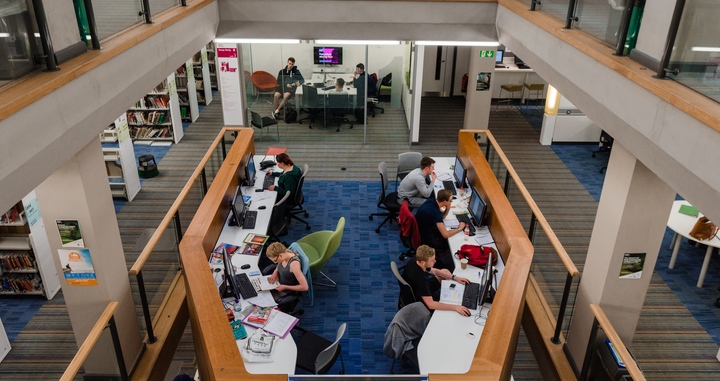
Adsetts library
Adsetts Library is located on our City Campus. It's open 24 hours a day, every day.
Explore the libraryExplore Langsett
Explore Langsett
Make your move in our brand-new building at Sheffield Business School. Find a welcoming community where you can experience state-of-the-art facilities and gold-rated teaching.
Entry requirements
All students
UCAS points
- Standard offer: 112 UCAS points
- Contextual offer: 96 UCAS ponts
We make contextual offers to local applicants, applicants living in low participation areas and applicants with specific personal circumstances. Check your eligibility for a contextual offer.
This must include at least 64 points from 2 A Levels or equivalent BTEC qualifications. For example:
- BBC at A Level
- DMM in BTEC Extended Diploma
- Merit overall from a T level qualification
- A combination of qualifications, which may include AS levels, EPQ and general studies
You can find information on making sense of UCAS tariff points here and use the UCAS tariff calculator to work out your points.
GCSE
- Maths at grade D or 3
GCSE equivalents
- Level 2 Numeracy or Functional Skills Level 2 Maths
Other
• Access - an Access to HE Diploma with at least 45 credits at level 3 and 15 credits at level 2. At least 15 level 3 credits must be at merit grade or above, from a QAA-recognised Access to HE course, or an equivalent Access to HE certificate.
• Entry with prior credit - we consider applications for direct entry to the final year from those holding Higher National Diplomas or equivalent qualifications
If English is not your first language, you will need an IELTS score of 6.0 with a minimum of 5.5 in all skills, or equivalent.
We welcome applications from people of any age. We may be flexible in our normal offer if you can show a commitment to succeed and have the relevant skills and experience. This must show that you will benefit from and finish the course successfully.
Additional information for EU/International students
If you are an International or non-UK European student, you can find out more about the country specific qualifications we accept on our international qualifications page.
For details of English language entry requirements (IELTS), please see the information for 'All students'.
Fees and funding
Home students
Our tuition fee for UK students on full-time undergraduate courses in 2027/28 is £10,050 per year (capped at a maximum of 20% of this during your placement year). These fees are regulated by the UK government and therefore subject to change in future years.
If you are studying an undergraduate course, postgraduate pre-registration course or postgraduate research course over more than one academic year then your tuition fees may increase in subsequent years in line with Government regulations or UK Research and Innovation (UKRI) published fees. More information can be found in our terms and conditions under student fees regulations.
International students
Our tuition fee for International/EU students starting full-time study in 2027/28 is £18,900 per year (capped at a maximum of 20% of this during your placement year)

Financing your studies
Explore tuition fees, student loans, scholarships and financial support available, including up to £2,100 a year towards living costs for eligible students.
Explore fees and funding ›
Discover cost-of-living support ›
Find scholarships and bursaries ›
Additional course costs
The links below allow you to view estimated general course additional costs, as well as costs associated with key activities on specific courses. These are estimates and are intended only as an indication of potential additional expenses. Actual costs can vary greatly depending on the choices you make during your course.
General course additional costs
Additional costs for Sheffield Business School (PDF, 255.8KB)Legal information
Any offer of a place to study is subject to your acceptance of the University’s Terms and Conditions and Student Regulations.