
Everything you need to know...
-
Tuition fees
Home: £10,050 per year
International/EU: £18,900 per year -
Course duration
4/5 Years
-
Study location
-
Entry requirements
-
Course code
CC12
-
Start date
September 2027
-
Placement year available?
Yes
Course summary
- Position yourself at the forefront of environmental building design and creative thinking
- Hone your design, drawing and modelling skills in state-of-the-art design studios
- Work on real-world projects across diverse landscapes and architectural challenges
- Take on placement opportunities to gain real-world experience with UK-leading architectural practices
- Join a forward-thinking community of architects who are socially aware, environmentally focused and digitally prepared
By studying this course with a foundation year, you’ll begin by developing the creative, practical and academic skills needed for degree level study within the Creative Industries. You’ll learn alongside other foundation year students from across the Creative Industries Institute, becoming part of a vibrant creative community with access to specialist facilities, technical expertise and industry focused teaching. The foundation year prepares you to progress directly onto the Animation degree, amongst a range of other courses within the Creative Industries without needing to reapply.
With an emphasis on applied learning, this BArch Architecture course will help you develop your potential and achieve your goals, so you can shape the future of architecture.

Come to an open day
Discover our TEF Gold rated teaching and see why students voted Sheffield Hallam a top five university in England at the prestigious Whatuni Student Choice Awards.
Employability
95% of UK graduates are in work or further study 15 months after graduating (2023/24 Graduate Outcomes Survey).
How you learn
You’ll start this course with the foundation year, joining students from across our Creative Industries courses as part of one creative community. You’ll learn together in an immersive studio environment with access to specialist facilities, exploring a range of materials, methods and processes through practical workshops that encourage experimentation and creative thinking.
Working collaboratively across different creative disciplines will help you discover your interests, develop new approaches and build confidence in your skills. With regular support and feedback from expert tutors, you’ll also be encouraged to develop your independent practice and extend your learning beyond the studio.
You learn through
- Practical workshops
- Technical inductions
- Creative projects
- Lectures and seminars
- Self-directed study and practice
- Presentations
- Field trips
- Regular formative feedback
- Group and individual tutorials
- Guided critical reflection
- Live projects
What you’ll study on the foundation year
On the foundation year, you’ll gain a strong introduction to the creative industries. You’ll develop creative thinking, practical making skills and the confidence to explore ideas, experiment and take creative risks in a supportive studio environment. You are encouraged to work with autonomy and explore your own interests.
Your learning is built around two core modules. The first introduces a broad range of creative skills, materials and processes through hands-on experimentation. The second gives you a unique the opportunity to apply what you’ve learned through longer, project-based work, with a choice of briefs endorsed by each linked to different degree routes.
Assessment is 100% coursework. You’ll build a portfolio that showcases your creative development, including project work, sketchbooks and digital documentation.
Architecture key themes
Our Architecture degree provides a collaborative, practical and applied learning experience at all levels, bridging the gap between your studies and real-world situations. Sustainable design practices are embedded across all years of study, exposing you to current global issues and fostering innovative and experimental approaches to building design.
You’ll develop practical and technical skills – including proficiency in a range of modelling software, from Computer Aided Design (CAD) to Building Information Modelling (BIM). These tools enable you to explore designs and create data-rich environments, enhancing your capabilities as an architect.
You’ll engage in team-based projects within the design studio environment, with an opportunity to work across disciplines in an innovative collaborative project module. You’ll also work with real clients on design projects, allowing you to hone your practical skills and make tangible contributions to the world.
Course support
At every level of study, students are given the opportunity to thrive, culturally, personally and professionally. Throughout your learning journey, you’ll experience a range of dedicated support, such as:
- Access to specialist support services to help with your personal, academic and career development
- Access to our Skills Centre with one-to-ones, webinars and online resources, where you can get help with planning and structuring your assignments
- Free access to office and studio space, expert workshops, freelance opportunities and a vast business network ready for you to tap into
Applied learning
The foundation year has strong links across all Creative Industries degrees, offering opportunities to engage with live projects, competitions and work related learning. You’ll graduate from the year as an adaptable, collaborative and creatively confident learner, ready to apply your cross disciplinary experience to your future degree and career.
The BArch Architecture course has been designed to embrace real-world challenges and provide you with the practical skills and knowledge you need to succeed.
Work placements
You’ll have the opportunity to arrange a year-long work placement in between your third and final years. This gives you valuable work experience to prepare you for your future career and allows you to graduate with an Applied Professional Diploma to add to your CV.
You’ll apply a wide range of practical abilities and knowledge to real-world situations, developing independent and creative decision-making skills.
Live projects
You’ll apply your knowledge, skills and research in studio design projects, with increasing challenges from year to year.
You’ll creatively engage with diverse scenarios, contexts, clients and live project briefs. Communication and collaboration are fundamental to both studio learning and architectural practice. You’ll cultivate ethical approaches to architectural practice through research, history and theory modules – exploring social and political issues across a range of design projects.
You’ll gain a strong repertoire of skills using industry-standard digital software – from CAD to digital modelling, environmental simulation and graphic presentation.
Field trips
Connect theory to experiential learning with opportunities for European and UK trips, site and building visits, and studying abroad.
Previous destinations have included renowned architectural cities such as Rotterdam, Rome, Venice, Barcelona and Berlin. UK visits have included London, Liverpool, Glasgow, Newcastle, Manchester and Bristol.
Networking opportunities
You’ll gain professional engagement and real-world learning from guest speakers, practising tutors, and a short work placement in your final year.
We’ll encourage you to take on extra-curricular activities to raise your profile and gain confidence, including design competitions, exhibitions and networking events.
There’s also a chance to attend and exhibit at Future Now. This is Sheffield’s festival of creativity – where we ask emerging creatives to show us the future through exhibitions, events, performances and screenings.
Modules
Module and assessment information for future years is displayed as currently validated and may be liable to change. When selecting electives, your choices will be subject to the core requirements of the course. As a result, selections may be limited to a choice between one of two or more specified electives in some instances.
You will be able to complete a placement year as part of this course. See the modules table below for further information.
Year 1
Compulsory modules
Module Aim:
This module provides the opportunity to apply and extend what you have learned in the first module. With a structured approach to project work you will be supported through a creative process to create an individual outcome to a brief. Workshops, seminars and studio practice help you to investigate, interrogate, research, test, trial and refine a project outcome. You extend this learning by developing strategies for organising independent study and time management.
You will be encouraged to consider the wider influences of history, environment, society and culture on Creative Industries disciplines as well as your own practice.
Indicative Content:
Theme based creative research
Choice of project briefs written in collaboration with Creative Industries degree route staff
Synthesising and communicating research
Core discipline specific vocabulary, terminology and some core discipline knowledge
Example independent study tasks to develop discipline specific knowledge
Technical inductions and other activities to support your project work
Creative process
Project proposal, management and planning strategies
Communication of work for different audiences and in different formats
Knowledge of other degree routes and broader creative and contextual awareness of the Creative Industries
This module introduces, and builds upon, core skills and techniques needed to develop creative work. Studio based activities promote an experimental approach to making which embrace risk-taking as part of the process. Curiosity, experimentation and exploration are core components of this module, developed through a wide range of workshops and practical activities.
Structured critical reflection alongside formative assessment throughout the module encourage independence and autonomy.
Applied learning strategies enable you to work alongside other students in an immersive studio environment. You learn from, and with, each other, while developing your own creative confidence.
INDICATIVE CONTENT
Creative thinking core skills: curiosity, enquiry, exploration and reflection
Drawing confidence: observational, effective sketching, technical/perspective drawing, life drawing, drawing from imagination
Workshops in: print, photography, laser cutting, sewing, woodwork and more
Group projects and tasks
Fundamental principles for all disciplines with freedom for interpretation, e.g. colour theory, form, structure and image making
Field trips and local visits
A range of additional support through the Learning Centre including, planning and managing your time, academic writing skills and digital literacy skills
Using SHU email account and the virtual learning environment (Blackboard) to help manage your time, work independently and communicate with your tutors
Use of, and exposure to, facilities across the city campus alongside meeting staff from across the Creative Industries Institute
How to access student support services offered by the university and connect with others
Year 2
Compulsory modules
Module Aim:
Building on the core characteristics introduced in the preceding module - ‘Introduction to Architecture’ - this module focusses on people and place and introduces a design approach centred on contextual design and the spatial and qualitative/quantitative requirements of users. Students will develop the architectural design skills to explore, produce and represent an imaginative design proposal for a small scale, naturally daylit building with an emphasis on spatial design and visual comfort.
Indicative content:
-
Graphic representation skills to support effective communication of architectural design thinking.
-
Hand drawn 2D and 3D presentation techniques including orthographic drawing and physical modelmaking.
-
Research, analysis and precedent study of related architecture and building types.
-
Research and study of visual and graphical representation techniques.
-
Sensory and experiential approaches to environmental architecture.
-
Introduction to context and site analysis as key design considerations.
-
Creative spatial design informed by functional process, people and user requirements.
-
Daylight analysis and designing for daylight as passive environmental design.
-
Domestic scale construction considering building performance, materials, structural principles, and technology.
-
Potential to work on a live project related to real clients and scenarios.
-
Group working.
Module Aim:
This module will continue developing architectural design skills to produce and represent a competent, integrated design proposal for a small-scale project applying the fundamental principles of environmental design with an emphasis on domestic environments.
Collaboration provides the foundation of the module through the opportunity to engage with real life clients and project briefs.
Indicative content:
-
Creative design for domestic environmental architecture.
-
Alternative social and inclusive concepts for domestic architecture to challenge design and creativity.
-
Strategic design through collaborative group work.
-
Research, analysis and precedent study of related architecture and building types.
-
Potential to work on a live project related to real clients and scenarios.
-
Introduction to 2D and 3D digital skills, software and representation techniques.
-
Graphic representation skills to support effective communication of architectural design thinking
-
Hand drawn 2D and 3D presentation techniques and physical modelmaking.
-
Domestic scale construction considering building performance, materials, passivhaus standards, structural principles, and technology.
-
Introduction to statutory legislation (building regulations).
-
Evaluation of passive environmental strategies and thermal comfort through manual calculations, modelling and testing.
Module Aim:
The module aims to provide an introduction to histories and theories of architecture to understand the influence of cultural, social, artistic, political and environmental contexts on architectural design. The module also develops methods of researching and analysing built works using written, drawn and digital skills.
Indicative content:
-
Cultural, environmental, political, social, aesthetic, stylistic and environmental aspects of architecture examined through global, and diverse historical case studies.
-
How the history and theory of architecture has changed over time.
-
Influence of related artistic and design disciplines on architecture.
-
Decolonising architecture, politics and power relations shaping architectural histories.
-
Digital skills in drawing, representing and understanding architecture through historic precedent.
-
Drawing skills in architectural analysis through historic precedent.
-
Discussion, reflection and understanding the built environment through students own prior learning and diverse lived experience.
-
Academic writing, research and referencing.
Module Aim
The module aims to introduce key skills, core characteristics and attributes of the course and the practice of environmental and sustainable architecture. People, place, environment and ethics are explored through a creative, applied real-world design project. Supporting the transition to University and Higher Education, the module extends induction to introduce ways of learning, feedback, processes and skills.
Indicative content:
-
What is Architecture?
-
Principles of environmental design
-
Environmental and social ethics of architectural practice
-
Climate emergency data
-
Cultural awareness and social diversity
-
Global and diverse architectural precedents
-
Collaboration and group working through an applied real-world project
-
Creative architectural design
-
Experimental model making both full size and to scale
-
Ways of seeing and analysing; sensing the environment
-
Communicating ideas through hand drawing, physical modelling and verbal presentation
-
Orthographic and technical drawing skills
-
Physical Model making skills
-
Graphic and verbal presentation skills
-
Writing and critical reflection
-
Receiving, understanding and acting on feedback
Year 3
Compulsory modules
Module Aim
This project-based module will enable you to collaborate with other students across a number of disciplines within the Department of Natural and Built Environment. It will promote the development of employability skills through interaction with a variety of students, academic staff, external clients, and external professionals.
The collaborative project will be strategic in nature will address critical issues related to climate change and relate to the UN Sustainability Goals. It will be based on a brief identified by an external client and will be delivered as an applied project using professional modes of working.
The collaborative project will be devised to explore topical and challenging issues related to social justice and inclusion and based in diverse local and national communities.
In addition to contributing to the collaborative aspect of the project, you will have the opportunity to explore and extend the strategic design proposal into more detailed technical design proposals. This second stage of the project will be undertaken as an individual, building on the work produced by the group.
Indicative content:
-
Working with others, in building relationships, including with external stakeholders
-
Equality, diversity and inclusion
-
Critical thinking and reflection
-
Exploration and utilisation of collaborative skills
-
Developing collaborative and strategic design proposals
-
Project management
-
Communication and presentation skills
-
Reflection on collaborative learning and inclusive practice
-
Study and consideration of UN Sustainable Development Goals (SDGs
-
Collaborative working using Building Information Management software (BIM)
-
Developing and presenting environmental and construction design solutions
Module Aim:
The module provides a creative and stimulating opportunity to engage in environmental architectural design for people, communities and organisations through projects situated in urban real-world situations. The module builds on and progresses from level 4 modules to consider more complex briefs, urban context and placemaking. Developing technical knowledge, in sustainability and construction from the analysis of related non-domestic buildings of a similar scale, complexity and typology is then applied and explored through the design projects
Indicative content:
-
Social mapping and analysis
-
Collaborative urban analysis and researching with others
-
Design process and experimentation
-
Creative architectural design
-
Design for users, groups, society and wellbeing
-
Equality, diversity and inclusion
-
Urban design, landscaping and placemaking
-
Architectural drawing, modelling and presentation techniques
-
Architectural production and professional procedures
-
Digital practice and modelling in architecture
-
UN Sustainable Development goals
-
Environmental sustainability and net zero architecture
-
Human comfort and climate and building science
-
Energy efficiency and passive and active design principles and strategies
-
Structural systems, frames, foundations and stability
-
Basic structural calculations
-
Sustainable structural systems and materials
-
Academic research and case study analysis
Module Aim:
The module provides a creative and stimulating opportunity to engage in environmental architectural design for people, communities and organisations through projects situated in urban real-world situations. The module builds on preceding level 5 modules to consider a more complex brief for a small community building and urban public space to produce a coherent and resolved proposal integrating aspect of environmental design and construction. This is a key stage of technical integration.
The project will be based in a European city with an increased emphasis on international and globally diverse cultures, architecture and urbanism.
The module will also deliver a programme of activities linked to career readiness, including CV writing, making applications for work, building an online profile and expanding digital capabilities in preparation for Level 6 short placement.
Indicative content:
-
Social mapping and analysis
-
Collaborative urban analysis and researching with others
-
Design process and experimentation
-
Global and culturally diverse precedents in architecture and environmental design
-
Design for users, groups, society and wellbeing
-
Equality, diversity and inclusion
-
Urban design, landscaping and placemaking
-
Architectural drawing, modelling and presentation techniques
-
Architectural production and professional procedures
-
Fire safety and life safety legislation and design considerations
-
Digital practice and modelling in architecture
-
Environmental ethics and professional responsibilities
-
UN Sustainable Development Goals and environmental legislation
-
Environmental sustainability and net zero architecture
-
Energy efficiency and passive and active design principles and strategies
-
Science and design for human comfort
-
Building services and low energy mechanical and renewable energy systems
-
Digital environmental design software and applied simulation and analysis
-
Structural systems, frames, foundations and stability
-
Applied structural design
-
Applied constructional design and specification for sustainable external envelopes
-
Employability and career readiness
Module Aim:
The aim of this module is to develop a critical appreciation of contemporary practice of architecture and urbanism. It further aims to promote an awareness of the significant contextual influences inherent in architecture and urbanism with an emphasis on globally diverse cultures, social inclusion and diversity, and environmental conditions. It will consolidate the study of architecture and cities through visits to urban spaces and offer an opportunity for critical analysis through research and personal experience.
The module will be delivered through a series of lectures, seminars and tutorials. Additionally, a field trip to a European city (or alternative UK city) will enhance learning in the module and integrate with design projects in the semester 2 Environmental Architecture 4 module.
Indicative content:
-
Theories of urban design, landscape and planning
-
Influence of the design and development of cities on the contemporary built environment
-
Planning policy and development control legislation, including social, environmental and economic aspects
-
Relationship between social justice and environmental sustainability
-
Equality, diversity and inclusion
-
UN Sustainable Development Goals
-
Environmental Urban Design
-
Alternative Urban Practice
-
Urban analysis theories and methods
-
Social mapping and analysis
-
Academic research and case study analysis
Elective modules
This module is for undergraduate students to study abroad in their second year, Semester 2 (only for courses that offer this option). With this module, you can spend a semester at one of the University’s approved partner institutions worldwide – from Europe to the Americas, Asia Australia or Canada.
Study Abroad plays an important role in the University's commitment to an engaging, challenging, and thriving learning culture. It offers opportunities to experience other academic cultures and foster intellectual maturity while enhancing co-curricular skills and students' long-term employability.
Study abroad for credit is permitted on existing university-approved courses only. Students are awarded credits and grades at the partner institution, which are converted into Sheffield Hallam credits and grades on return and included in the Sheffield Hallam degree classification.
Please check and refer to the webpage How study abroad works. You must submit a Learning Agreement outlining the modules you will be taking at the partner institution. The Learning Agreement will be signed off by your academic tutor to ensure that the Learning broadly covers the Learning Outcomes set out in your course curriculum during your study abroad.
Year 4
Compulsory modules
Module aim:
The aim of this module is to enhance students’ professional development through the completion of and reflection on meaningful work placement(s).
A work placement will provide students with opportunities to experience the realities of professional employment and experience how their course can be applied within their chosen industry setting. The placement will:
- Allow student to apply the skills, theories and behaviours relevant and in addition to their course
- Enable students to enhance their interpersonal skills in demand by graduate employers – communication, problem-solving, creativity, resilience, team work etc.
- Grow their student network and relationship building skills.
- Provide student with insights into the industry and sector in which their placement occurs
- Help student make informed graduate careers choices.
Indicative Content:
In this module students undertake a sandwich placement (min 24 weeks / min 21 hours per week) which is integrated, assessed and aligned to their studies.
Their personal Placement Academic Supervisor (PAS) will be their key point of contact during their placement and will encourage and support students to reflect on their experience, learning and contribution to the organisation they work for.
To demonstrate gains in professional development, students will be required to share their progress, learning and achievements with their Placement Academic Supervisor and reflect on these for the summative piece of work.
Final year
Compulsory modules
Module Aim:
The module enables the creative development and review of synthesised, coherent and imaginative architectural design proposals for a reasonably complex public building (c. 750 sq. m floor area) and immediate surroundings within a landscape setting. The module develops learning from level 5 and requires the integration of innovative environmental design strategies, materials and technologies.
Indicative content:
- Exploration and analysis of physical and social aspects of a real-world landscape/urban periphery context.
- Exploration and analysis of micro-climate and local ecology
- Research and analysis of related global and culturally diverse building typologies and strategies
- Developing innovative sustainable architectural design proposals which synthesise spatial, environmental, contextual, functional, structural and construction strategies
- Analysis and development of key environmental design and sustainable construction strategies
- Advanced theory and strategies in effective, holistic environmental design
- Passive and active environmental strategies.
- Advanced level of environmental and technical knowledge.
- UN Sustainable Development Goals and environmental legislation
- Environmental sustainability and net zero architecture
- Analysis and testing of fire safety and means of escape for life safety
- Presenting resolved architectural design proposals verbally, graphically and through drawings and models.
- Digital Software relevant to Professional Practice
Module Aim:
The module enables the development and review of synthesised urban, landscape and architectural design proposals for complex civic buildings (c. 1,200 sq. m) and surrounding civic public spaces set within a UK city. The module is the culmination of learning from levels 4, 5 and preceding level 6 modules and expands integration of innovative environmental design strategies, materials and technologies.
Indicative content:
- Exploration, analysis and integration of physical and social aspects of a real-world urban contexts.
- Principles of urban design and landscape design
- Exploration and analysis of micro-climate
- Research and analysis of related global and culturally diverse building typologies and strategies
- Developing innovative architectural design proposals which synthesise spatial, environmental, contextual, functional, structural and construction strategies
- Developing urban design and landscape proposals
- Analysis and development of key environmental design and sustainable construction strategies
- Evidence informed design: simulating and testing environmental design within your projects through digital and physical modelling
- Advanced theory and strategies in effective, macro to micro holistic environmental design
- Advanced level of environmental and technical knowledge.
- UN Sustainable Development Goals and environmental legislation
- Environmental sustainability and net zero architecture
- Presenting resolved architectural design proposals verbally, graphically and through drawings and models.
- Digital Software relevant to Professional Practice
Module Aim:
To build rigorous disciplinary knowledge in the architectural humanities, and fluency in key concepts and methodologies, through the exploration of contemporary and recent global architectural histories and theories, and related disciplines, in relation to a personal area of interest.
Indicative content:
- Cultural, artistic, social, political, economic and environmental situations in which movements and approaches to architecture emerge.
- Movements in architecture (e.g. Modernism, post-modernism, deconstructivism)
- Indigenous and vernacular architecture
- Ecological and environmental architecture
- Participation and Activism
- Feminism and Gender
- Intersectionality and critical theories
- Architecture post conflict/disaster
- Contemporary art
- Academic skills: research and analysis, constructing critical questions; communication in written & graphic form
Themes (Global 20th/21st century histories and discourse):
- How have architects responded to, and been informed by environmental movements and ecological thinking?
- What tools, approaches and roles have architects’ developed to engage in social and political issues and struggles?
- How have architects’ been influenced by contemporary arts, and/or technological changes in developing architectural languages, processes and ideas?
Module Aim:
The module aims to introduce management principles, professional procedures and statutory codes relevant to architectural practice and enhance employability through a direct engagement and experience with architectural practice and related professions. The module includes short work placements within architectural or related industry practices, or through industry related entrepreneurial initiatives and real projects.
Indicative content:
- RIBA Plan of Work and project management
- Professions, professionalism and ethical practice
- Alternative ways of practising, diversity and current issues in practice.
- Design team, client relationships, collaboration and team working
- Practice management, office organisation and fee calculation
- Quality management and systems in practice and on-site
- Principles of law relating to construction, contracts and dispute resolution;
- Economics of the construction industry and procurement routes
- Legislation and Regulatory Frameworks including Planning Law; Building Regulations; CDM regulations and Health and Safety issues in the construction industry
- CV and professional portfolio development
- Critical thinking and reflection
- Professional communication and networks
Future careers
The BArch Architecture course prepares you for careers and future study in:
- Architecture
- Other design-focused professions
- Construction
- Digital design and management
- Environmental consultancy
- Project or design management
- Property development
- Teaching in colleges or universities
- Third-sector and charitable organisations
Previous graduates of this course have gone on to work for:
- Foster + Partners
- Glen Howells Architects
- Hawkins\Brown
- Mae Architects
- Fielden Clegg Bradley
- Simpson Haugh
- Cullinan Studio
- BDP
- Purcell Architects

All in on your career
We promise you’ll be ready to launch your career. With employer connections, hands-on learning and lifelong career support, we’ll help make your ambition a reality.
Equipment and facilities
You'll have access to a wide variety of facilities across the university campuses – including a 24-hour learning centre, Students’ Union, cafes and eateries, lecture theatres, exhibition spaces and more. On the Foundation Year, you have a dedicated studio space on City Campus, with access to all the facilities below.
On this BArch Architecure course you will have access to:
- Dedicated design studio spaces, open seven days a week
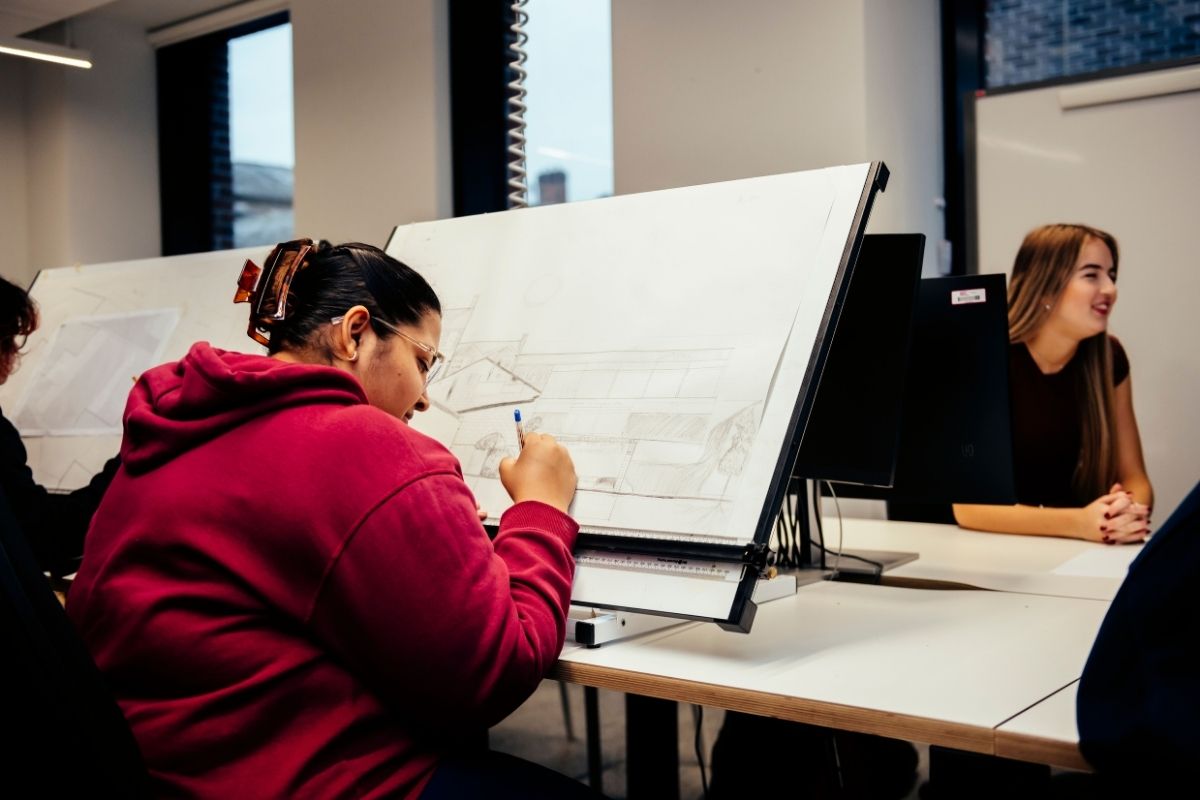
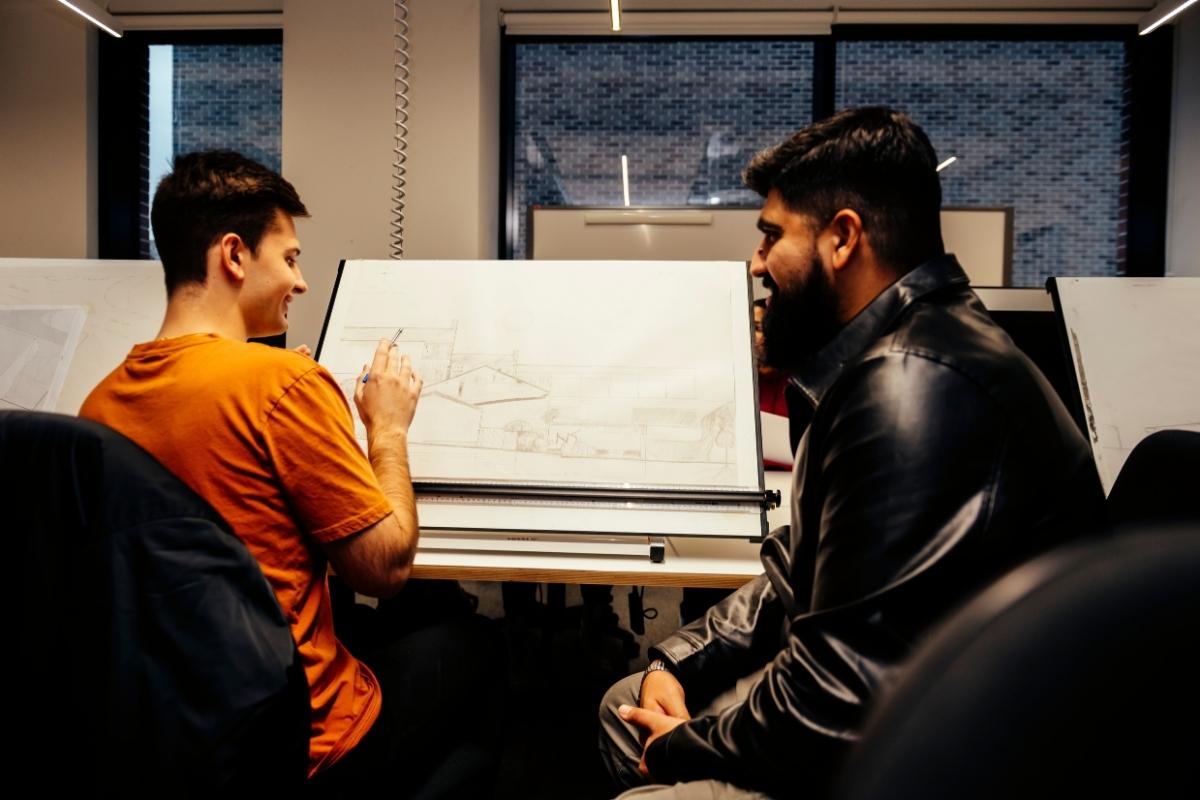
- State-of-the-art design spaces with drawing boards, model storage and desktop computers
- Architecture labs which include digital fabrication tools, 3D printer laser cutters, analogue tools, environmental simulation software, BIM and CAD software
- The Adsetts Learning Centre, a 24/7 library with additional resources for academic support
- IT support and access to all necessary software
- Technical equipment loans, analogue and digital workshop facilities and specialist advice from technicians
Media Gallery
-
-
-

-

-

Media Gallery Image Item -
Media Gallery Image Item -
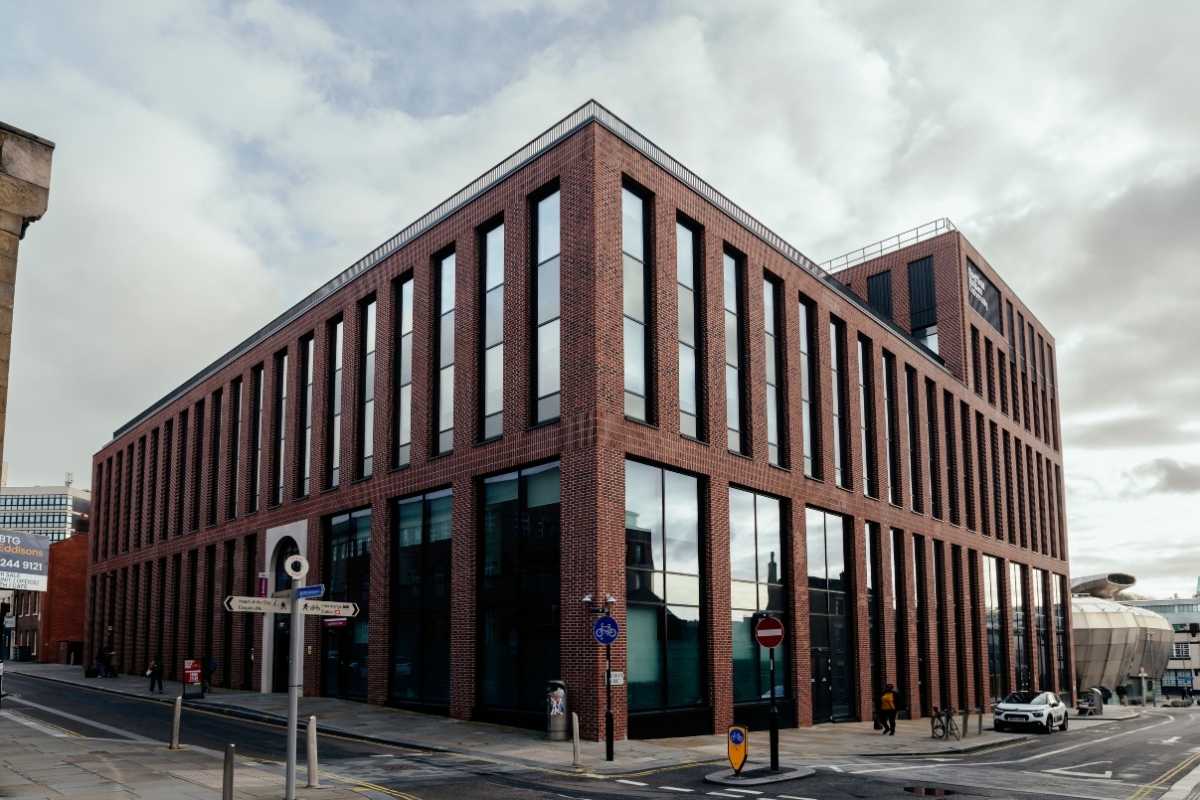
Media Gallery Image Item
Where will I study?
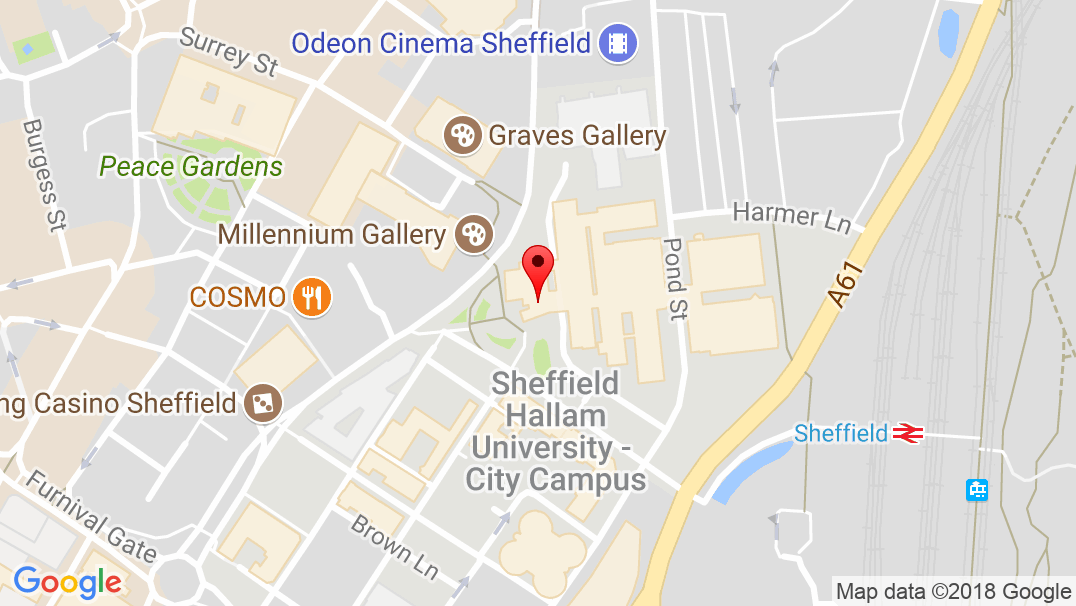
You study at City Campus through a structured mix of lectures, seminars and practical sessions as well as access to digital and online resources to support your learning.
City Campus
City Campus is located in the heart of Sheffield, within minutes of the train and bus stations.
City Campus map | City Campus tour
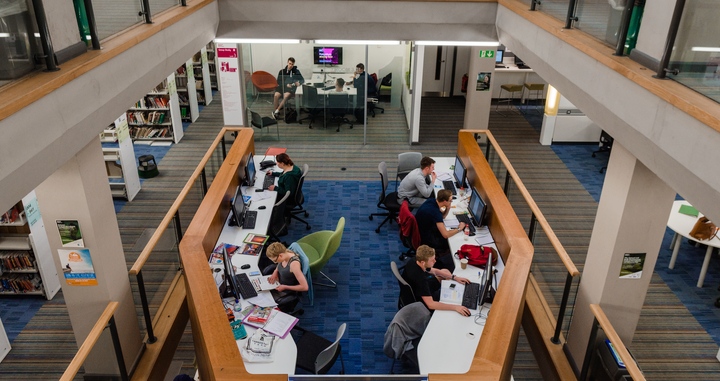
Adsetts library
Adsetts Library is located on our City Campus. It's open 24 hours a day, every day.
Explore the libraryEntry requirements
All students
UCAS points
- Standard offer: 88 UCAS points
This must include at least 32 points from at least one A level or equivalent BTEC National qualifications. For example:
- CCD at A Level.
- MMM in BTEC Extended Diploma.
- Merit overall from a T level qualification with C from core.
- A combination of qualifications which must include an A level grade C or BTEC grade M in a relevant subject and may include AS levels, EPQ and general studies.
You can find information on making sense of UCAS tariff points here and use the UCAS tariff calculator to work out your points.
GCSE
- English Language or literature at grade C or 4 or equivalent
- Mathematics at grade C or 4 or equivalent
• Or, an Access to HE Diploma from a QAA recognised Access to HE course. Normally we require 15 credits at level 2 and 45 at level 3. At least 15 level 3 credits must be at merit grade or above from a QAA-recognised Access to HE course, or an equivalent Access to HE certificate.
All applications are welcome. We follow a flexible and inclusive process when making offers.
All applicants who are made a conditional offer at the application stage will be invited to a course discussion with a member of our architecture staff. You will have the option of an online discussion or on campus discussion. There are a range of dates to choose from.
You will be sent a selection of up to date course information with the invite to attend a course discussion. If you received a conditional offer, you should prepare a portfolio of work for the discussion. Your portfolio should demonstrate your creative potential. It should demonstrate your imagination, originality and enthusiasm and show you to be someone with a good range of skills in graphic communication and may contain sketching, drawing, painting, photography, 3d work.
The discussion is an opportunity for you to find out more about the course and for us to get to know you as an individual.
We also consider other qualifications from the UCAS tariff. Applicants with alternative qualifications or a combination of qualifications and work experience will also be considered
If English is not your first language, you will need an IELTS score of 6.0 with a minimum of 5.5 in all skills, or equivalent.
Guidelines on personal statements and references can be found on the UCAS website.
We welcome applications from people of any age. Please note the University will only admit students who are aged 18 at the point of enrolment.
All of our decisions will be communicated via UCAS Track, so please check your account regularly.
Portfolios for international applicants
International applicants will be invited to submit a digital portfolio after we receive your application. It must contain no more than 10 pages and must not exceed 3MB in overall size. You must rely on your creativity and graphic judgement. You can present more than one piece on each portfolio page.
Some international applicants will also be invited for an online interview.
Additional information for EU/International students
If you are an International or non-UK European student, you can find out more about the country specific qualifications we accept on our international qualifications page.
For details of English language entry requirements (IELTS), please see the information for 'All students'.
Fees and funding
Home students
Our tuition fee for UK students on full-time undergraduate degree courses in 2027/28 is £10,050 per year (capped at a maximum of 20% of this during your placement year). These fees are regulated by the UK government and therefore subject to change in future years.
If you are studying an undergraduate course, postgraduate pre-registration course or postgraduate research course over more than one academic year then your tuition fees may increase in subsequent years in line with Government regulations or UK Research and Innovation (UKRI) published fees. More information can be found in our terms and conditions under student fees regulations.
International students
Our tuition fee for International/EU students starting full-time study in 2027/28 is £18,900 per year (capped at a maximum of 20% of this during your placement year)

Financial support for home/EU students
How tuition fees work, student loans and other financial support available.
Additional course costs
The links below allow you to view estimated general course additional costs, as well as costs associated with key activities on specific courses. These are estimates and are intended only as an indication of potential additional expenses. Actual costs can vary greatly depending on the choices you make during your course.
General course additional costs
Additional costs for Sheffield Creative Industries Institute (PDF, 277.5KB)Legal information
Any offer of a place to study is subject to your acceptance of the University’s Terms and Conditions and Student Regulations.