Everything you need to know...
-
Tuition fees
Home: £10,050 per year
International/EU: £18,900 per year -
Course duration
4/5 Years
-
Study location
-
Entry requirements
-
Course code
A038
-
Start date
September 2027
-
Placement year available?
Yes
Course summary
- Engage with a medium that allows you to see, think and communicate differently.
- Thrive in an environment which cultivates your skills, confidence and risk taking.
- Shape your innovative, flexible practice while challenging photography conventions.
- Experiment with image making, its presentation and global dissemination.
- Collaborate to shape an ethical, responsible and sustainable future.
By studying this course with a foundation year, you’ll begin by developing the creative, practical and academic skills needed for degree level study within the Creative Industries. You’ll learn alongside other foundation year students from across the Creative Industries Institute, becoming part of a vibrant creative community with access to specialist facilities, technical expertise and industry focused teaching. The foundation year prepares you to progress directly onto the Animation degree, amongst a range of other courses within the Creative Industries without needing to reapply.
Creative UK membership
We are members of Creative UK, which means our art and design students are also members until they graduate. With 10,000 members in its network, Creative UK represents, champions and supports the UK’s creative industries, advocating on the issues that matter the most to creative communities.
Employability
95% of UK graduates are in work or further study 15 months after graduating (2023/24 Graduate Outcomes Survey).

Come to an open day
Discover our TEF Gold rated teaching and see why students voted Sheffield Hallam a top five university in England at the prestigious Whatuni Student Choice Awards.
How you learn
You’ll start this course with the foundation year, joining students from across our Creative Industries courses as part of one creative community. You’ll learn together in an immersive studio environment with access to specialist facilities, exploring a range of materials, methods and processes through practical workshops that encourage experimentation and creative thinking.
Working collaboratively across different creative disciplines will help you discover your interests, develop new approaches and build confidence in your skills. With regular support and feedback from expert tutors, you’ll also be encouraged to develop your independent practice and extend your learning beyond the studio.
- You learn through
- Practical workshops
- Technical inductions
- Creative projects
- Lectures and seminars
- Self-directed study and practice
- Presentations
- Field trips
- Regular formative feedback
- Group and individual tutorials
- Guided critical reflection
- Live projects
What you’ll study on the foundation year
On the foundation year, you’ll gain a strong introduction to the creative industries. You’ll develop creative thinking, practical making skills and the confidence to explore ideas, experiment and take creative risks in a supportive studio environment.
Your learning is built around two core modules. The first introduces a broad range of creative skills, materials and processes through hands-on experimentation. The second gives you the opportunity to apply what you’ve learned through longer, project-based work, with a choice of briefs linked to different degree routes.
Assessment is 100% coursework. You’ll build a portfolio that showcases your creative development, including project work, sketchbooks and digital documentation.
Photography key themes
On the Photography degree, you’ll start by experimenting creatively and applying photographic skills. In workshops, we’ll introduce photographic making and thinking, exploring approaches to image production and presentation across both analogue and digital technologies. You’ll then learn about key professional contexts and pathways, considering client and audience requirements while exploring diverse cultural, social and critical perspectives in relation to real-world opportunities and challenges.
You’ll explore further multidisciplinary skills and concepts relevant to the expansive field of photographic practice and image culture. You’ll undertake a collaborative sustainability project while developing your knowledge of the various sites, spaces, platforms and communities in which photographic work is made and shown.
You’ll define a self-initiated practice-based research project. You’ll deepen your exploration of the connections between intention, process, outcome and context. You’ll consolidate knowledge, technical skills, creative and intellectual abilities to produce a significant body of exhibition-ready photographic work, of a high professional standard.
Our BA (Hons) Photography course develops your creative skills, business acumen and critical understanding as an independent photographer. You’ll work towards your professional and creative goals while exploring photography across a wide range of contexts, helping you fulfil your potential in this exciting and expansive field. Through an environment that encourages confidence, curiosity and creative risk-taking, you’ll learn to see, think and communicate in new ways while shaping an innovative, flexible practice that challenges photographic conventions. You’ll experiment with image-making, presentation and global dissemination, collaborating with others to help shape an ethical, responsible and sustainable future for photography.
Course support
We take the time to get to know you, with a holistic and person-centred approach to assessment that supports your creative growth while respecting the diverse ways people learn. We’re a dedicated, qualified and highly experienced team of teaching staff – with world-leading research and recognised professional creative reputations.
We strive for an inclusive and equitable studio environment where divergent ideas, histories and practices are encouraged to thrive.
You’ll also be supported in your learning journey towards highly skilled, graduate-level employment through a number of key areas. These include:
- Access to three student support advisers to help with your personal, academic and career development
- Access to our Skills Centre with one-to-ones, webinars and online resources, where you can get help with planning and structuring your assignments
- Industry-specific employability activities such as live projects, learning in simulated environments and networking opportunities
Student's success story
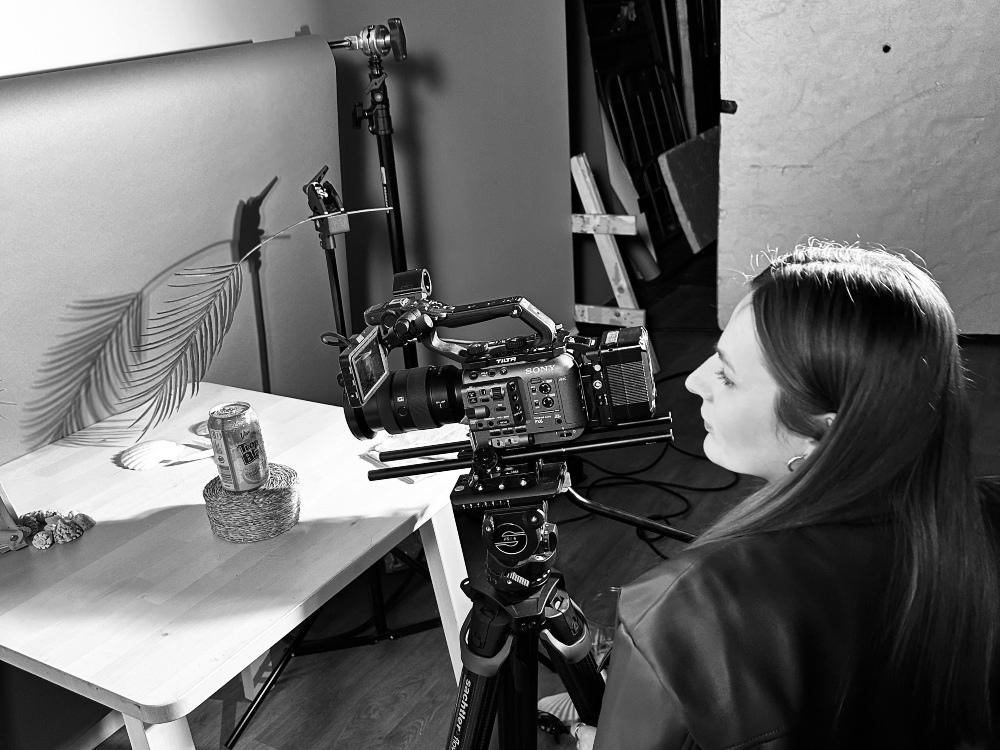
BA (Hons) Photography with Foundation Year graduate Charlotte Turnock landed a role as a content creator for creative advertising agency, McCann Manchester.
“During my time on the photography course at Sheffield Hallam, I really enjoyed the analogue module, especially working in the darkroom and developing my own film! It gave me a real appreciation and understanding for traditional photographic processes.
"I also loved the digital side of the course, from using the studios to experimenting with a wide range of cameras and equipment. Together, these experiences helped me explore different approaches to photography and grow my confidence across both mediums."
Applied learning
The foundation year has strong links across all Creative Industries degrees, offering opportunities to engage with live projects, competitions and work related learning. You’ll graduate from the year as an adaptable, collaborative and creatively confident learner, ready to apply your cross disciplinary experience to your future degree and career.
The BA Photography course you’ll progress into has been designed to embrace real-world challenges and provide you with the practical skills and knowledge to be successful.
We do this by developing your expertise in collaboration with the professional creative and cultural sectors – with commercial and creative practitioners, commissioners, clients and arts organisations.
Work experience
You’re encouraged and supported to undertake a full-time work placement between third and final year of your course. This gives you valuable additional work experience to prepare you for your future career – as well as an Applied Professional Diploma to add to your CV.
Your course has been designed to embrace real-world challenges and provide you with the practical skills and knowledge to be successful. We’ll develop your expertise in collaboration with various industry, commercial and creative practitioners, clients and organisations. We aim to provide a diverse range of work experience interactions throughout your time with us.
You’ll gain knowledge, skills and professional behaviours for your future career. You’ll become more confident, resilient and practised in professional interactions, better preparing you to succeed when you graduate.
Live projects
You’ll take part in live projects where you work with external partners or clients to respond to real-world challenges and opportunities, applying your skills in a professional setting and gaining valuable feedback.
Previous students have worked on projects such as Future Now, South Yorkshire Listening and Chaplaincy, and Heeley City Farm.
There may be photography opportunities for British Universities and Colleges Sports (BUCS) – and you could also volunteer at Sheffield events such as Doc Fest, Off The Shelf and the Festival of the Mind.
Network opportunities
You’ll be able to attend industry events, such as the Royal Photographic Society’s Research Symposium, the Association of Historical and previous students have had opportunities to visit the Fine Art Photographers conference. We encourage students to submit their work to the Source Graduate Online annual showcase, where it will be showcased to industry professionals.
You’ll be able to hear from guest speakers to gain further insights into the industry.
Previous speakers have included Sophy Ricketts, David Bate, Alana Lake, Gareth McConnel, Simon Norfolk, Rut Blees Luxemburg, Tom Lovelace, Güler Ates, Edgar Martins, Jonny Briggs, Dominic Hawgood and Village Books.
Field trips
You’ll have chances to visit museums and galleries, which previously have included Tim Flak studio, Net-A-Porter studio, David Short studio, and The Print Space professional printing lab. Previous students have taken field trips to the Peak District, Manchester, Derby Format Photography Festival, Yorkshire Sculpture Park, Liverpool Biennale, London, Paris Photo, Amsterdam, Berlin, Bilbao, Switzerland, Malta and Nepal.
Competitions
We’ll encourage you to enter national and international photography competitions and open calls.
Your course leader


View our students' work
View our gallery of student work and learn more about the exciting projects they've been working on this year.
Modules
Important notice: The structure of this course is periodically reviewed and enhanced to provide the best possible learning experience for our students and ensure ongoing compliance with any professional, statutory and regulatory body standards. Module structure, content, delivery and assessment may change, but we expect the focus of the course and the learning outcomes to remain as described above. Following any changes, updated module information will be published on this page.
You will be able to complete a placement year as part of this course. See the modules table below for further information.
Year 1
Compulsory modules
Module Aim:
This module provides the opportunity to apply and extend what you have learned in the first module. With a structured approach to project work you will be supported through a creative process to create an individual outcome to a brief. Workshops, seminars and studio practice help you to investigate, interrogate, research, test, trial and refine a project outcome. You extend this learning by developing strategies for organising independent study and time management.
You will be encouraged to consider the wider influences of history, environment, society and culture on Creative Industries disciplines as well as your own practice.
Indicative Content:
Theme based creative research
Choice of project briefs written in collaboration with Creative Industries degree route staff
Synthesising and communicating research
Core discipline specific vocabulary, terminology and some core discipline knowledge
Example independent study tasks to develop discipline specific knowledge
Technical inductions and other activities to support your project work
Creative process
Project proposal, management and planning strategies
Communication of work for different audiences and in different formats
Knowledge of other degree routes and broader creative and contextual awareness of the Creative Industries
This module introduces, and builds upon, core skills and techniques needed to develop creative work. Studio based activities promote an experimental approach to making which embrace risk-taking as part of the process. Curiosity, experimentation and exploration are core components of this module, developed through a wide range of workshops and practical activities.
Structured critical reflection alongside formative assessment throughout the module encourage independence and autonomy.
Applied learning strategies enable you to work alongside other students in an immersive studio environment. You learn from, and with, each other, while developing your own creative confidence.
INDICATIVE CONTENT
Creative thinking core skills: curiosity, enquiry, exploration and reflection
Drawing confidence: observational, effective sketching, technical/perspective drawing, life drawing, drawing from imagination
Workshops in: print, photography, laser cutting, sewing, woodwork and more
Group projects and tasks
Fundamental principles for all disciplines with freedom for interpretation, e.g. colour theory, form, structure and image making
Field trips and local visits
A range of additional support through the Learning Centre including, planning and managing your time, academic writing skills and digital literacy skills
Using SHU email account and the virtual learning environment (Blackboard) to help manage your time, work independently and communicate with your tutors
Use of, and exposure to, facilities across the city campus alongside meeting staff from across the Creative Industries Institute
How to access student support services offered by the university and connect with others
Year 2
Compulsory modules
Module Aim:
This module introduces you to creative photographic making and production. You will investigate fundamental analogue and digital techniques and processes, including different types of printing and presentation outputs.
The module will encourage an exploratory and experimental approach in the development of ideas and project outcomes. The creative application of photographic skills, technologies and materials forms the guiding principle for the remaining duration of your studies.
You will learn appropriate research methods and the importance of evaluation to help inform and extend your thinking. Your practice will be supported by an introduction to relevant photographic histories, concepts and theoretical debates.
Module Content:
-
Technical inductions and workshops
-
Safe working and risk assessments
-
Investigation through making and appropriate presentation methods and forms
-
Methods to develop, record and visualise ideas
-
Lecture and seminars introducing historical and contemporary practices, critical contexts and theoretical debates
-
Learn to communicate, evaluate and reflect on your work and that of others
Module Aim:
This is the level 4 work experience module and will enable you to work on an Applied Project.
The module introduces the development of key employability and communication skills, and creative strategies relevant to professional practice. You will continue to investigate contemporary photographic methods and processes, deepening your understanding of the approaches through which practitioners can work.
You will be supported to work with external partners and collaborators from industry and the cultural sector, to develop work in specific professional contexts and respond to real world challenges. You will consider client and audience requirements and explore the significance of diverse cultural, social and critical perspectives in developing an informed understanding of your field.
Indicative Content:
-
inductions and technical workshops
-
digital skills and workflow development
-
working with clients and industry professionals
-
research, communication, and presentation
-
critical visual analysis
-
ethical, sustainability, inclusivity, and diversity issues relevant to industry and practice
Year 3
Compulsory modules
Module Aim:
This project-based module will facilitate you to collaborate with others to tackle sustainable development challenges creatively. With the support of academics and external stakeholders, you will develop your collaborative, creative, communication, and presentation skills. Through multi-disciplinary project work, you will develop an informed and imaginative response to local and global sustainable development challenges.
Learning will be blended and delivered through teaching, workshops, doing, and independent study individually and in groups.
Indicative content:
-
Study and consideration of Sustainable Development
-
Exploration and utilisation of collaborative skills
-
Exploration and utilisation of design thinking and creative thinking tools
-
Project management
-
Creative research methods
-
Understanding audiences
-
Communication and presentation skills
-
Working with others, building relationship including with external stakeholders
-
Critical thinking and reflection
Module Aim:
This is the level 5 work experience module and will enable you to work on an enhanced Applied Project.
The module explores a range of contemporary contexts relating to the professional display, installation, and presentation of photographic work in the production of an externally public facing group exhibition. It applies the skills and knowledge developed through creative practice to real world contexts.
You will consider the various sites, spaces, platforms, and communities in which photographic work is made and shown, and consider the methods through which artists work with different communities, audiences, and participants. By engaging in public/peer review you will further your ability to situate and communicate your developing independent practice in a professional environment.
Indicative content:
-
development of individual photographic practice
-
activities working with others in particular sites and contexts
-
collaboration, cooperation, co-production, participation
-
exhibition practices – curation, design and dissemination
Module Aim:
This module will explore skills, develop knowledge, and expand your abilities in the thinking and making of expansive photographic practices.
You will consider a range of techniques, materials, and processes appropriate to diverse creative fields of photographic image culture. You will develop your understanding of contemporary photography’s relationship to other mediums, disciplines and forms and consider the critical debates underpinning such practices.
You will be empowered to subvert conventions, produce new forms of independent practice and work imaginatively, ethically, and sustainably in response to the rapidly evolving discipline of photography. You will analyse the potential of current and emerging technologies in the realisation of creative image production and presentation.
Indicative content:
-
technical workshops with materials, processes, and emerging technologies
-
refinement of core photographic skills and techniques
-
making in response to expansive practices
-
development of an independent creative practice
-
development of research in the consideration of relevant critical contexts
Elective modules
This module is for undergraduate students to study abroad in their second year, Semester 2 (only for courses that offer this option). With this module, you can spend a semester at one of the University’s approved partner institutions worldwide – from Europe to the Americas, Asia Australia or Canada.
Study Abroad plays an important role in the University's commitment to an engaging, challenging, and thriving learning culture. It offers opportunities to experience other academic cultures and foster intellectual maturity while enhancing co-curricular skills and students' long-term employability.
Study abroad for credit is permitted on existing university-approved courses only. Students are awarded credits and grades at the partner institution, which are converted into Sheffield Hallam credits and grades on return and included in the Sheffield Hallam degree classification.
Please check and refer to the webpage How study abroad works. You must submit a Learning Agreement outlining the modules you will be taking at the partner institution. The Learning Agreement will be signed off by your academic tutor to ensure that the Learning broadly covers the Learning Outcomes set out in your course curriculum during your study abroad.
Year 4
Compulsory modules
Module aim:
The aim of this module is to enhance students’ professional development through the completion of and reflection on meaningful work placement(s).
A work placement will provide students with opportunities to experience the realities of professional employment and experience how their course can be applied within their chosen industry setting. The placement will:
- Allow student to apply the skills, theories and behaviours relevant and in addition to their course
- Enable students to enhance their interpersonal skills in demand by graduate employers – communication, problem-solving, creativity, resilience, team work etc.
- Grow their student network and relationship building skills.
- Provide student with insights into the industry and sector in which their placement occurs
- Help student make informed graduate careers choices.
Indicative Content:
In this module students undertake a sandwich placement (min 24 weeks / min 21 hours per week) which is integrated, assessed and aligned to their studies.
Their personal Placement Academic Supervisor (PAS) will be their key point of contact during their placement and will encourage and support students to reflect on their experience, learning and contribution to the organisation they work for.
To demonstrate gains in professional development, students will be required to share their progress, learning and achievements with their Placement Academic Supervisor and reflect on these for the summative piece of work.
Final year
Compulsory modules
Module Aim:
This module extends and deepens your ability to work independently in the development, realisation, and positioning of a sustained and critically underpinned self-defined practice. You will consolidate knowledge, technical skills, creative and intellectual abilities, to produce a significant body of exhibition-ready photographic work, of a high professional standard.
The module will support the specific requirements of your practice and enable you to effectively present and disseminate it in a relevant context in the public domain. It will further prepare you for career readiness and life beyond university in the development of your personal and professional autonomy, integrity, and resilience.
Indicative Content:
-
practical workshops and technical surgeries
-
tutorial support of project development and realisation
-
group critique, peer review, and self-assessment
-
independent research and investigation
-
development and presentation of work for public dissemination
-
engagement with external opportunities, platforms and audiences
-
professional portfolios
Module Aim:
This is the Level 6 work experience module and will enable you to work on a professional and scholarly research project.
The module will focus on negotiating and defining a self-initiated practice-based research project which engages with critical thinking and creative testing and is situated in its relevant professional context. You will deepen your exploration of the connections between intention, process, outcome, and context.
The module will challenge you to develop and refine your personal and professional practice and associated workflows, within an independently driven creative sphere, thus supporting you to consider and explore professional futures, career aspirations and relevant pathways.
Indicative Content:
-
personal and professional identity and development
-
skills and ideation development
-
research and articulation of critical ideas
-
testing of work in different professional contexts
-
industry and career pathways including alumni/graduate engagement.
-
external visits to galleries, exhibitions and industry or cultural sector
-
methods and platforms for professional presentation and dissemination
Future careers
This course prepares you for a photography career in fine art, documentary, portraiture, fashion, editorial, advertising, commercial, photojournalism, music, sports, medical and clinical roles, including:
- photography art direction
- studio operation
- production and editing
- picture research
- public relations and marketing
- community arts
- education
- arts administration
- curation
- gallery management
- social media/content creation
- film making
- post-production
- arts festival coordination
- writing and publishing
Previous graduates of this course have gone on to work for:
- S1 Artspace
- Webber Agency
- Gill Turner Photo Agency
- The Lowry
- Wex Photo Video
- Ilford Photo
- Apple
- Salt-Street Productions
- American Golf
- Pinkbike
- Alpkit
- Regatta
- JD Official
- Size Official
- Boohoo
- Flannels
- THG Studios
- NHS England
- Mission Foodservice
- My-Furniture.com
- Frasers Group
- Northern Fix
- McCann Manchester
- AVIT Media
Many graduates work as freelancers and entrepreneurs, have established their own business, work as art and photography teachers, or have gone on to further postgraduate study.

All in on your career
We promise you’ll be ready to launch your career. With employer connections, hands-on learning and lifelong career support, we’ll help make your ambition a reality.
Equipment and facilities
You'll have access to a wide variety of facilities across the university campuses – including a 24-hour learning centre, Students’ Union, cafes and eateries, lecture theatres, exhibition spaces and more. On the Foundation Year, you have a dedicated studio space on City Campus, with access to all the facilities below.
On the Photography degree course you'll be based in a fully equipped and purpose-designed studio, with state-of-the-art facilities, including:
- industry-standard computer hardware and software
- a dedicated creative media centre with a range of photographic equipment
- two fully equipped photography studios with Profoto lighting
- black and white darkroom
- colour darkrooms
- specialist print facilities
- fully colour-calibrated digital printing
- screen-printing and risograph
- textile, etching and 3D printing
- wood, plastics, metal, mixed media, casting and ceramic workshops
- CNC equipment, including laser cutters
Media Gallery



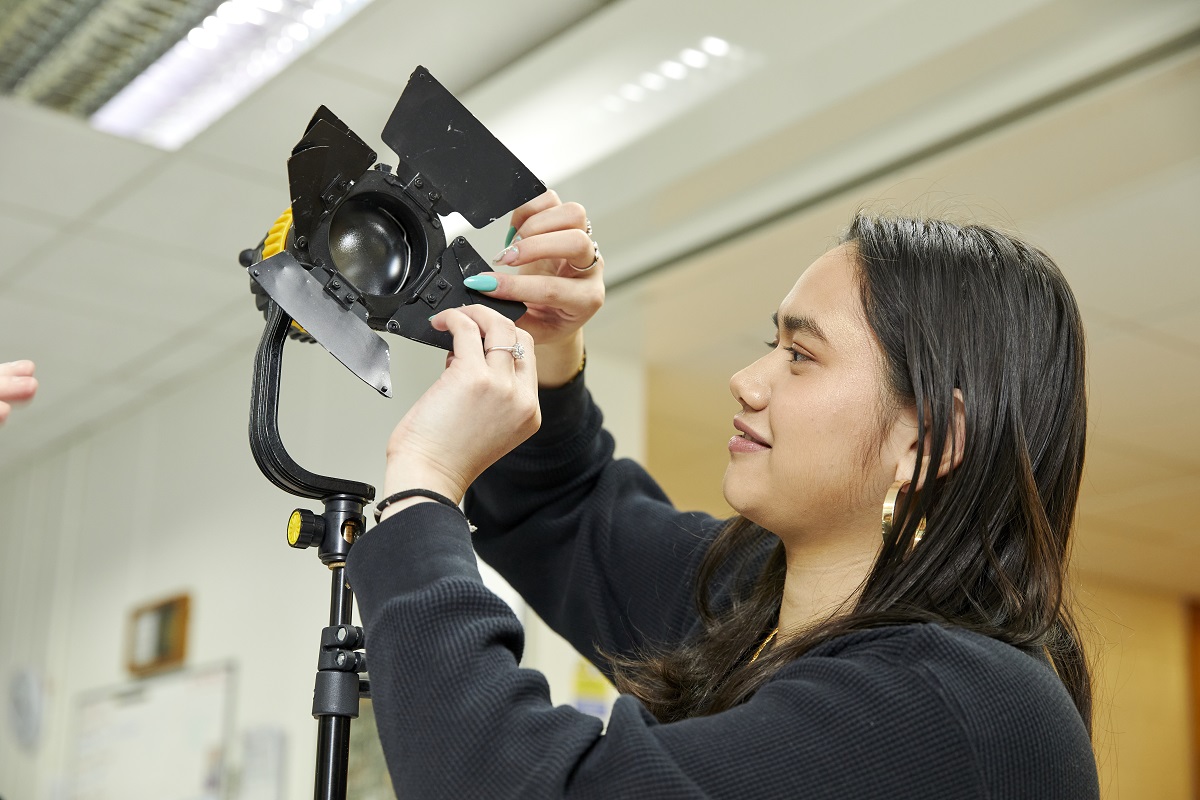
Learn more about your department
Media, Arts and Communications Facilities Tour
Take a look around the media, arts and communication facilities at Sheffield Hallam University with lecturer Saskia Wilson.
Where will I study?
You study at City Campus through a structured mix of lectures, seminars and practical sessions as well as access to digital and online resources to support your learning.
City Campus
City Campus is located in the heart of Sheffield, within minutes of the train and bus stations.
City Campus map | City Campus tour

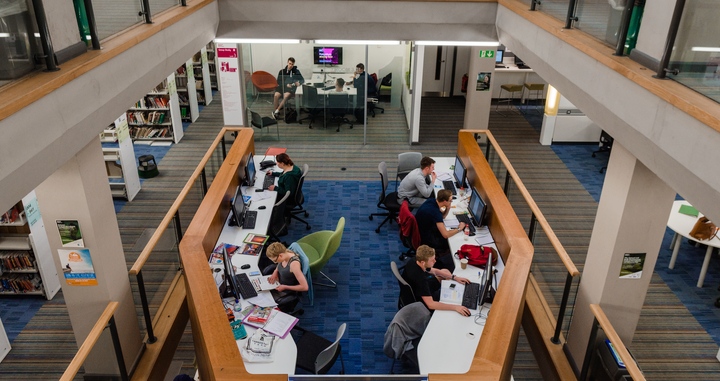
Adsetts library
Adsetts Library is located on our City Campus. It's open 24 hours a day, every day.
Explore the libraryEntry requirements
All students
UCAS points
- Standard offer: 64 UCAS points
With at least 32 points from one A level or equivalent BTEC National qualifications. For example:
- CC at A Level.
- MPP in BTEC Extended Diploma.
- Pass (D-E) overall from a T level qualification with D from core.
- A combination of qualifications which must include an A level grade C or BTEC grade M.
GCSE
- English Language or Literature at grade C or 4 or equivalents
You can find information on UCAS tariff points here and use the UCAS tariff calculator to work out your points.
• An Access to HE Diploma with at least 45 credits at level 3 and 15 credits at level 2. At least 15 level 3 credits must be at merit grade or above from a QAA-recognised Access to HE course, or an equivalent Access to HE certificate.
We may also accept you, if you have limited qualifications but can show evidence of ability and a genuine commitment to studying Media Arts and Communication.
We treat the foundation year as part of the Media Arts and Communication degree programme. Offers made to students will be for four years of study (or five years of study including a placement). This is made up of the foundation year plus one of our Media Arts and Communication degrees.
If English is not your first language, you will need an IELTS score of 6.0 with a minimum of 5.5 in all skills, or equivalent.
Portfolio Review
If your application is successful, you will receive an email inviting, you to submit a link to your portfolio.
The portfolio helps us understand whether we are able to offer you a place on the course you've applied for. Your UCAS statement and portfolio provide you with the opportunity to demonstrate your creative experience, potential ability and enthusiasm for the course you've applied for. Visit our portfolio review guidance.
Additional information for EU/International students
If you are an International or non-UK European student, you can find out more about the country specific qualifications we accept on our international qualifications page.
For details of English language entry requirements (IELTS), please see the information for 'All students'.
Fees and funding
Home students
Our tuition fee for UK students on full-time undergraduate degree courses in 2027/28 is £10,050 per year (capped at a maximum of 20% of this during your placement year). These fees are regulated by the UK government and therefore subject to change in future years.
If you are studying an undergraduate course, postgraduate pre-registration course or postgraduate research course over more than one academic year then your tuition fees may increase in subsequent years in line with Government regulations or UK Research and Innovation (UKRI) published fees. More information can be found in our terms and conditions under student fees regulations.
International students
Our tuition fee for International/EU students starting full-time study in 2027/28 is £18,900 per year (capped at a maximum of 20% of this during your placement year)

Financial support for home/EU students
How tuition fees work, student loans and other financial support available.
Additional course costs
The links below allow you to view estimated general course additional costs, as well as costs associated with key activities on specific courses. These are estimates and are intended only as an indication of potential additional expenses. Actual costs can vary greatly depending on the choices you make during your course.
General course additional costs
Additional costs for Sheffield Creative Industries Institute (PDF, 274.9KB)Legal information
Any offer of a place to study is subject to your acceptance of the University’s Terms and Conditions and Student Regulations.