
Everything you need to know...
-
Tuition fees
Home: £11,490 for the course
International/EU: £19,530 for the course -
Course duration
1 Year
-
Study location
-
Start date
September 2027
January 2028
Work Placement Route
For international students wishing to undertake a placement as part of this course, you must apply to MSc Data Science and Artificial Intelligence (Work Experience) route. Transferring to the work experience route later will not be possible due to visa restrictions.
Course summary
- Develop critical data science and AI skills for global sectors and businesses.
- Gain hands-on experience with real-world data, technologies and industry projects.
- Enhance your employability in the rapidly growing data science and AI landscape.
- Learn essential principles, methodologies and frameworks for hybrid professionals.
- Gain practical experience through project-based learning.
This course expands your programming knowledge with technical concepts across key areas of data science and AI. You’ll gain practical experience by creating learning models for data, while applying AI methods such as machine learning and neural networks. You’ll also learn from data, ethics and privacy issues related to deploying AI technologies to data.
Student satisfaction
This course scored 100% for overall student satisfaction in the Postgraduate Taught Student Satisfaction Survey 2026.

Come to an open day
Find out more at our postgraduate open days. Book now for your place.
How you learn
The course builds on your foundational knowledge by introducing programming for data analytics, data manipulation and visualisation, and machine learning foundations. You’ll also explore neural networks and their application to make decisions based on data.
We’ll consider ethics, security, privacy and AI-bias in data, alongside the fundamental data analytics and AI technologies, and responsible approaches to their use and applications.
You learn through:
- lectures
- tutorials and seminars
- regular feedback
- laboratory sessions
- real-world problem and practical activity-based sessions and assessment
- group and individual project work
Key themes
You’ll build on your core knowledge with larger projects that solve challenging real-world problems, collaborating with industry clients. During the projects you’ll have regular scrum meetings with academics and clients to identify narratives, learning needs and action plans. You’ll then enact these through independent study, combining support from academics and self-directed study.
As the course progresses, you’ll explore and research the hybrid domain of data science and AI. This further enhances your learning in the area and is the start of your individual dissertation project. Here you’ll tailor a significant piece of work of your choosing in the discipline.
Course support
You’ll receive support from academic advisers and regular guidance from a supervisor during your dissertation. You’ll also act as mentors for new students.
Applied learning
Work experience
This course has a work experience route that offers a placement in industry of up to 12 months. For further information, please see MSc Data Science and Artificial Intelligence (Work Experience).
Live projects
We have strong links with the data analytics and AI industry, making sure curriculum content is relevant and aligned with industry requirements. Our partners and collaborations across local and national research centres include Sheffield Hallam’s Advanced Wellbeing Research Centre, Sheffield Robotics, Advanced Manufacturing Research Centre, AstraZeneca and the British Machine Vision Association.
Collaborations with domain experts mean you get to see cutting-edge technologies and real-world applications. These collaborations include live projects, where you can work on real-world challenges in data science and the application of AI to data analysis. These projects encourage technical and professional skills that are essential for industry employment – such as creativity, critical thinking, collaboration, communication and leadership. The aim is to mirror the complexity of scenarios encountered in the professional realm.
Networking opportunities
Through networking events you’ll be able to connect with industrial professionals. Building these connections enhances your understanding of the AI landscape, opening doors to mentorship, internships and potential employment opportunities.
You’ll also be able to interact with our MSc Big Data Analytics and MSc Artificial Intelligence students. You can attend our AI Festival – which brings together different cohorts for an insightful day of presentations, networking opportunities and celebrations of completed projects. The events also include themed competitions, allowing you to showcase your skills and knowledge in AI, promoting innovation and development in this rapidly evolving field.
As part of your learning on the course, we also have regular guest lectures who are experts in their field of AI.
Your course leader

Vishal Parikh
Principal Lecturer in Information Systems and Data ManagementVishal is a senior lecturer in Information Systems, and teaching on both undergraduate and postgraduate courses run by the Department of Computing. He is also a Fina … Read more
Modules studied may differ depending on when you start your course.
Modules
Module and assessment information for future years is displayed as currently validated and may be liable to change. When selecting electives, your choices will be subject to the core requirements of the course. As a result, selections may be limited to a choice between one of two or more specified electives in some instances.
Modules studied may differ depending on when you start your course.
Final year
Compulsory modules
This module explores advanced artificial intelligence (AI) topics and applications, with a focus on deep learning and data science techniques. This includes data-driven approaches to analyse structured and unstructured data using neural networks and make decisions using data science frameworks and concepts. The module also covers techniques to process images, audio samples, unstructured text, data management and ethics.
You’ll study topics such as:
- Structured and unstructured data analysis
- Free text and human language data analysis
- Multimedia, image and video data analysis
- The ethics of AI and data management including use cases of data bias and machine learning model bias
- Artificial intelligence systems and solutions
- Testing, optimisation and evaluation of an AI project
- AI project proposal and management
- Present and demonstrate an AI project
This module will develop skills to effectively convey intricate artificial intelligence (AI) ideas to diverse audiences. Focused on enhancing presentation skills, the module places a strong emphasis on translating complex concepts into accessible explanations while fostering critical evaluation of peer-reviewed scientific publications.
You’ll study topics such as:
- Independent thought and learner autonomy
- Seminar presentations in the format of the 3MT (three minutes thesis)
- Research-based scientific communication
- Critical evaluation of research findings
- Effective presentations
This module will apply the technical knowledge and understanding developed across the course into an original research project. This will include critical and ethical analysis of literature, synthesising the findings and tailoring them to the specific context of their research projects using a suitable research methodology.
You’ll study topics such as:
- Critical and ethical review of the literature
- Selection and application of appropriate research tools, techniques, or methods
- Design and development of the artefact/prototype
- Testing and user evaluation
- Critical reflection – evaluating the project deliverables and project success/failure
- Legal, social, and ethical considerations in the design and development of computer-based systems
- Sustainable development and deployment
This module will explore foundational methodologies in data science and AI, tackling data management and analytics problems using various software tools and techniques to manage, explore, and model data.
You’ll study topics such as:
- Mathematics underpinning data science and AI principles and methodologies
- Use of appropriate technologies for data science and AI including financial and environmental sustainability of technologies
- Acquiring data sets
- Handling different types of data
- Data preparation and manipulation
- Data storage methods and ethics
- Statistical test and confidence intervals
- Supervised and unsupervised learning and dimension reduction techniques
- Evaluation of statistical and machine learning models and data science techniques
This module covers programming in Python and R, including key concepts of modern programming languages, such as object-oriented.
You’ll study topics such as:
- Fundamental programming concepts, such as variables, data types, operators, expressions, control structures, and loops
- Functions, methods, parameters, and arguments to organise and reuse your code
- Design and develop programmes using an algorithmic approach
- Data structures, such as lists, dictionaries, sets, and strings, to store and manipulate data
- Principles of object-oriented programming and implement classes, objects, methods, and inheritance
- Libraries and frameworks to create GUI, databases, or networking applications
This module develops skills to design and conduct rigorous research projects in computing.
You’ll study topics such as:
- Identify research problems: Explore current challenges and opportunities in computing to uncover relevant research areas
- Formulate research questions: Craft precise questions, aims, and objectives aligned with identified problems
- Review literature and artifacts: Critically analysing existing research to synthesize knowledge and identify gaps
- Propose research methods: Evaluate and select appropriate research techniques specific to your computing area
- Communicate research proposals: Craft comprehensive proposals that meet professional, legal, and ethical standards
Future careers
The course prepares you to develop a wide range of careers, including:
- AI data science consultancy
- data science and AI engineering
- financial data science
- machine learning
Equipment and facilities
On this course you’ll work with state-of-the-art IT labs and specialist equipment, including:
- platforms such as Azure
- software such as Python, R Studio and Tableau
- data management applications such as Hadoop EcoSystem
- high-spec computers and AI hardware accelerators
- GPUs for parallel processing and lower-power Neuromorphic compute modules
- machine learning software and application development environments
- Cloud computing and Edge computing platforms
Where will I study?
You study at City Campus through a structured mix of lectures, seminars and practical sessions as well as access to digital and online resources to support your learning.
City Campus
City Campus is located in the heart of Sheffield, within minutes of the train and bus stations.
City Campus map | City Campus tour

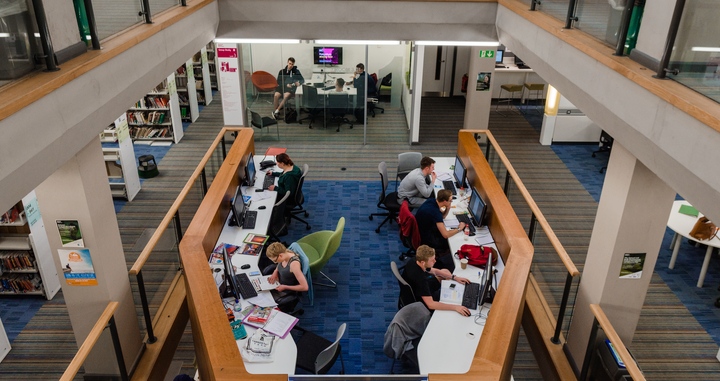
Adsetts library
Adsetts Library is located on our City Campus. It's open 24 hours a day, every day.
Explore the libraryExplore Strines
Explore Strines
Strines is where you’ll find our new Institute of Technology – a state-of-the-art learning space for manufacturing, engineering, construction, and creative and digital disciplines.
Entry requirements
All students
Undergraduate degree at 2:2 or above with evidence of some programming experience (work experience or degree).
If English is not your first language, you will need an IELTS score of 6.0 with a minimum of 5.5 in all skills, or equivalent.
Additional information for EU/International students
If you are an International or non-UK European student, you can find out more about the country specific qualifications we accept on our international qualifications page.
For details of English language entry requirements (IELTS), please see the information for 'All students'.
Fees and funding
Home students
Our tuition fee for UK students starting full-time study in 2027/28 is £11,490 for the course.
If you are studying an undergraduate course, postgraduate pre-registration course or postgraduate research course over more than one academic year then your tuition fees may increase in subsequent years in line with Government regulations or UK Research and Innovation (UKRI) published fees. More information can be found in our terms and conditions under student fees regulations.
International students
Our tuition fee for International/EU students starting full-time study in 2027/28 is £19,530 for the course.

Scholarships and financial support
Find information on scholarships, bursaries and postgraduate student loans.
International scholarships up to £3000 ›
Alumni scholarships up to £2000 ›
Postgraduate loans for UK students ›
Additional course costs
The links below allow you to view estimated general course additional costs, as well as costs associated with key activities on specific courses. These are estimates and are intended only as an indication of potential additional expenses. Actual costs can vary greatly depending on the choices you make during your course.
General course additional costs
Additional costs for School of Computing and Digital Technologies (PDF, 242.1KB)Legal information
Any offer of a place to study is subject to your acceptance of the University’s Terms and Conditions and Student Regulations.