
Everything you need to know...
-
Tuition fees
Home: £5,760 for foundation year; £10,050 per year for degree
International/EU: £18,900 per year -
Course duration
4/5 Years
-
Study location
-
Entry requirements
-
Course code
CC02
-
Start date
September 2027
-
Placement year available?
Yes
Course summary
- Study the fundamentals of global tourism and hospitality operations.
- Embrace the future challenges of cultural, digital and technological change.
- Apply your learning to placements and real-world consultancy.
- Explore business practices that consider ethics, culture and sustainability.
- Develop your industry insight through a funded visit to World Travel Market in London and support from an industry mentor.
Our BA (Hons) Business Management and Tourism degree develops your business knowledge and managerial skills to help you drive innovation in tourism. You’ll learn to analyse business performance, assess markets, and create commercial opportunities that support cultural and environmental sustainability. You’ll also gain the leadership abilities to build positive change and effective teams – in both local and international contexts.
Tourism subject group award
Our Tourism subject group is recognised as a Centre of Excellence by the Institute of Travel and Tourism (ITT), the membership organisation for tourism industry professionals and educators.
Get future, business and life ready.
Make Sheffield Business School your home. Learn in our brand new building with state of the art facilities, gold rated teaching, hands on industry partnerships and an experience ranked 5* by QS Top Universities. Build your skills, confidence and connections for the future. Make your move.
World top 100 for hospitality
We’re ranked in the world top 100 universities for Hospitality and Leisure Management in the QS World University Rankings 2026.
Come to an open day
Discover our TEF Gold rated teaching and see why students voted Sheffield Hallam a top five university in England at the prestigious Whatuni Student Choice Awards.
Accredited by

Association to Advance Collegiate Schools of Business (AACSB)
Sheffield Business School is accredited by the Association to Advance Collegiate Schools of Business (AACSB). This internationally recognised accreditation places us among the top business schools globally. After completing your foundation year, you'll progress onto an AACSB-accredited course.
How you learn
You’ll learn from industry-qualified tutors and active researchers who bring contemporary tourism practices into your learning experience. The course is practical and applied, incorporating live projects and real-world learning at every level.
You learn through:
- sessions led by industry experts and accrediting bodies
- problem-solving exercises
- live projects with external organisations
- class discussions and debates
- group activities
- independent study
- lectures, seminars and workshops
We’ll assess your learning in ways that mirror industry practice – often including options to tailor your work to your interests and career goals. Assessments are inclusive and designed to develop real-world skills.
Follow our Sheffield Business School Instagram to see real student life, course experiences, events and what it is like to study here.
Key Themes
You’ll explore global business strategies alongside core tourism management principles – such as tourism marketing, responsible planning and sustainability. You’ll also learn to make informed business decisions in a digital world, with an emphasis on ethical and socially responsible operations.
Course-Level Support
You’ll be supported in your learning journey towards highly skilled, graduate-level employment through a number of key areas. These include:
- your academic adviser, who’ll help you succeed academically and improve your performance
- student support and career resources to help you thrive short- and long-term
- our Skills Centre and online/physical library spaces
- networking opportunities through your academic student society
- regular feedback to approach your assessments with confidence
Applied learning
Work Placements
You’ll have the chance to complete a year-long sandwich placement between your second and third years – the gold standard for applied experience. This isn’t just fantastic preparation for the workplace, you’ll also gain an Applied Professional Diploma to add to your CV.
You’ll be comprehensively supported by our Careers and Employability Team. Previous students have undertaken placements with Jet2, Disney World, Marriott International and Hilton Worldwide.
Live Projects
You’ll work on live consultancy briefs for external clients, including accessibility audits, market research and strategy reviews. At Level 6, you’ll deliver a real-world consultancy project supported by experienced tutors. Past projects have included work for TUI UK, Access for All, Yorkshire Sculpture Park and various social enterprises.
Networking Opportunities
For students enrolling on this course in September 2027, we’re offering two valuable opportunities designed to support your development and help you build confidence, industry insight and professional connections during your course and beyond.
During your first or second year, you’ll have the opportunity to take part in a funded visit to World Travel Market in London, one of the leading global events in hospitality and tourism, where industry leaders, international brands and emerging innovations come together. It’s a chance to step outside the classroom, see the industry operating at scale and start building your professional network early in your studies. You’ll also receive support from an industry mentor throughout your course, offering professional insight, career advice and guidance as you explore your future career.
Your course leader

Natalie Haynes
Division HeadNatalie teaches across the hospitality curriculum focusing on revenue management, sales, marketing, front of house operations and service excellence. Natalie has ext … Read more
Modules
Module and assessment information for future years is displayed as currently validated and may be liable to change. When selecting electives, your choices will be subject to the core requirements of the course. As a result, selections may be limited to a choice between one of two or more specified electives in some instances.
You will be able to complete a placement year as part of this course. See the modules table below for further information.
Year 1
Compulsory modules
This module introduces you to university life and the behaviours and knowledge you’ll need to succeed internationally. In practical teaching sessions you’ll learn more about yourself, examine contemporary sources and debate current international perspectives.
You’ll study topics such as:
-
Introduction to university study
-
Career goal setting and professional behaviours
-
International business
-
Tourism
-
Sustainability and sustainable development
-
Corporate social responsibility
-
Business ethics
-
Living and working with others
-
Equality, diversity and inclusion
-
Values
This module develops your understanding of how to influence decision-making and the people that make them. Practice-led teaching sessions will be enriched by research and innovation through consideration of real-world organisational challenges.
You’ll study topics such as:
- Stakeholder mapping
- Regional and global relationship management
- Inspiring and motivating others
- Communication strategies
- Introduction to marketing
- Influencing and negotiation skills
- Decision-making theory and practice
- Business intelligence and analytics
- Equality, diversity and inclusion
This module prepares you for further success on the next level of your course, developing skills and knowledge to support your future career. Practical teaching sessions will enable you to reflect on your year so far, and your future personal strategies.
You’ll study topics such as:
-
Future sector trends
-
People resource planning
-
Global labour markets
-
Personal and organisational change
-
Resilience
-
Research and data analysis
-
Digital literacy
-
Life-wide and long-term career planning
-
Professional accreditation and credibility
-
Your learning practice
This module encourages and supports you in developing a viable business solution – applying technical, managerial and creative skills and knowledge. Your learning will be interactive, working alongside others as you plan and develop your business ideas.
You’ll study topics such as:
-
Generating creative, innovative and responsible business solutions
-
Digital innovation
-
Basic project management techniques
-
Business environment analysis and economics
-
Business ethics and sustainability
-
Data and financial management
-
Sector/organisational types
-
Business and events planning
Year 2
Compulsory modules
This module introduces contemporary issues in business management, developing your awareness and understanding of factors affecting people and organisations in an ever-changing world. Teaching sessions will examine contemporary sources and debate current issues.
You’ll study topics such as:
-
Ethics and sustainability in business management
-
Geopolitics and globalisation
-
Changing business cultures and the role of stakeholders
-
Smart technology and big data
-
Business management research and approaches
-
Shifting communication channels
-
Economic controversies
This module introduces different types of businesses and organisations, focusing on operations, supply chain and marketing – developing academic literacy, business skills and future aspirations. You’ll work independently, within groups and in a real-world applied project, developing and applying academic and professional behaviours.
You’ll study topics such as:
-
Organisational types, scale and span
-
Responsible and sustainable practice
-
Business functions
-
Marketing
-
Supply chain
-
Operations management
-
Excel
-
Academic skills and advising
-
Employability and entrepreneurial advice
-
Applied reflective practice
This module provides you with the knowledge and insight to lead, develop and engage with a diverse workforce, operating across varied business contexts. You’ll also take part in a simulated international collaboration.
You’ll study topics such as:
-
Organisational behaviour and development
-
Ethical/legal/business case for equality, diversity and inclusion
-
Role of HR and line managers in developing people
-
Inclusive working environments
-
Employee engagement
-
Responsible, inclusive and ethical leadership
-
Intercultural management
-
Working and studying in other cultures
An introduction into the global tourism and hospitality (T&H) industry, developing an understanding of global activity and economic value within operations, introducing contemporary issues, awareness and understanding of people and organisations.
Students will develop an understanding of operational management and key principles that underpin successful businesses. Learners will have developed a strong and comprehensive foundation in the discipline of operations management, theories, and concepts, in an applied context.
Indicative content:
- An overview of the T&H Industry Characteristics, Size and Shape
- Operations and Financial Performance metrics
- Stakeholders involved in T&H operations
- Key Operations, Lodging, F&B, Cruise, Events, Wellness, Airline, Tour Operation, Visitor Attractions and Third-Party Ancillaries.
- Theories of Operations Management
- Professional Bodies
- Quality Management
- Service Management
- The international, national, and regional nature of such factors and relationships.
- The relationships between private sector businesses, public sector organisations, SME’s, non-profit organisations etc.
- Value and operation of entrepreneurship and entrepreneurial skills within global tourism activity.
Year 3
Compulsory modules
This module enhances your professional development via work-related learning opportunities. You will gain interpersonal and business problem-solving skills that are key to successful graduate-level employment and learn about the business environment and the world of work.
The module will comprise teaching and individual supervision. Learners will undertake work-related activities e.g. work shadowing, volunteering, short placement, projects and so on.
Indicative content:
- Professional identity
- Reflective practice
- Problem-based research skills
- Teamwork
- Equality, Diversity and Inclusion
- Project management and report writing
- Networking
- Ethical practice
This module builds upon concepts and practical approaches introduced at level 4 and will prepare you for sandwich placement and for level 6 consultancy project.
Aims:
This module examines innovations in tourism and destination marketing. Although this industry employs established marketing approaches, the intangible nature of the product requires conceptualising services and experiential marketing. Furthermore, there is increasing consumer demand for sustainable and ethical products and experiences.
Indicative content:
- Marketing mix
- Marketing communications
- Innovative product development
- Digital marketing
- Experiential marketing
- Sustainable and responsible marketing
- Inclusive marketing
- Destination marketing
- Innovative tourism experiences
This module develops theoretical understanding of performance management in organisations and equips you with a range of practical tools and techniques. You’ll work independently and in groups, actively interpreting and analysing both financial and non-financial performance management information.
You’ll study topics such as:
-
Financial and non-financial performance management data
-
Internal and external reporting
-
Planning and control systems
-
Accounting and control tools
-
Risk management
-
Sources and availability of finance
-
Environmental and economic analysis
-
Market forces and fair trade in a global context
Aims:
To develop a sustainable, ethical, and responsible management philosophy in the design and development of hospitality and tourism facilities and evaluate how people, planet and profit impact and shape the design and delivery principles.
Indicative content:
- Facilities and design principles within multivenue outlets, independent business, branded hotels, SMEs, social enterprise, cost sector and related services in the day and night-time economy
- Designing and managing the complexity of different types of hospitality and tourism outlets within a single business
- Assessing service performance for operational excellence
- Managing cultural complexity, diversity, inclusion, and wellness of the hospitality and tourism labour force
- Exploring the role of creativity and innovation in sustainable hospitality and tourism businesses
- Mega trends impacting the future of the hospitality and tourism industry
- Understanding the cost and affordances of high technology versus the impact of high touch in delivering effective and memorable hospitality and tourism experience
- Ethics, responsibility, sustainability, and the implications of these practices
Elective modules
This module is for undergraduate students to study abroad in their second year, Semester 2 (only for courses that offer this option). With this module, you can spend a semester at one of the University’s approved partner institutions worldwide – from Europe to the Americas, Asia Australia or Canada. Study Abroad plays an important role in the University's commitment to an engaging, challenging, and thriving learning culture. It offers opportunities to experience other academic cultures and foster intellectual maturity while enhancing co-curricular skills and students' long-term employability. Study abroad for credit is permitted on existing university-approved courses only. Students are awarded credits and grades at the partner institution, which are converted into Sheffield Hallam credits and grades on return and included in the Sheffield Hallam degree classification. Please check and refer to the webpage “How study abroad works”. You must submit a Learning Agreement outlining the modules you will be taking at the partner institution. The Learning Agreement will be signed off by your academic tutor to ensure that the Learning broadly covers the Learning Outcomes set out in your course curriculum during your study abroad.
Year 4
Compulsory modules
Module aim:
The aim of this module is to enhance students’ professional development through the completion of and reflection on meaningful work placement(s).
A work placement will provide students with opportunities to experience the realities of professional employment and experience how their course can be applied within their chosen industry setting.
The placement will:
- Allow student to apply the skills, theories and behaviours relevant and in addition to their course
- Enable students to enhance their interpersonal skills in demand by graduate employers – communication, problem-solving, creativity, resilience, team work etc
- Grow their student network and relationship building skills
- Provide student with insights into the industry and sector in which their placement occurs
- Help student make informed graduate careers choices
Indicative Content:
In this module students undertake a sandwich placement (min 24 weeks / min 21 hours per week) which is integrated, assessed and aligned to their studies.
Their personal Placement Academic Supervisor (PAS) will be their key point of contact during their placement and will encourage and support students to reflect on their experience, learning and contribution to the organisation they work for.
To demonstrate gains in professional development, students will be required to share their progress, learning and achievements with their Placement Academic Supervisor and reflect on these for the summative piece of work.
Final year
Compulsory modules
This module applies your knowledge of contemporary business management, developing critical and analytical research skills to inform decision-making in a real-life setting. You’ll develop an individual research project with others in small groups – based on a live consultancy brief or your own venture – exploring relevant theories in large group sessions.
You’ll apply learning and skills such as:
-
Consultancy research
-
Entrepreneurial projects
-
Project design and management
-
Identifying discipline-relevant frameworks and concepts
-
Research methods, including ethics
-
Business report writing
-
Personal and professional reflection
This module aims to enable students to critically evaluate and consider the future developments of tourism industries within a range of societies, by facilitating a critical examination of the principles, practices, and current social and organisational issues.
Students will gain a comprehensive understanding of inclusive experiences, future and technological developments, personalisation, social and cultural identities and awareness of industry limitations.
Indicative content:
Accessible Tourism, accessibility needs, and the limiting impacts on the travel experience.
Key theories and concepts.
Future tourism and aviation principles and practices.
Sustainability Aviation Fuels (SAF)
Future modes of travel
Legal vs Ethical regulations and considerations.
Social issues and concerns (e.g. social awareness, communication, promotion, information, etc.).
Organisational Adaptation and Resilience (e.g. organisational awareness, best practise, EEDI, employee training and development etc.).
Exploring digital tools and technologies.
Stakeholders Groups (e.g. Regulatory bodies, Charities and Advocates, Government Agencies, etc.)
Contextualisation of tourism societies; Adventure Tourism; Food and drink Tourism; Heritage Tourism; Sustainable Tourism and Film Tourism.
Aviation societies and future planning
Aims:
This module aims to extend, develop understanding and knowledge of responsible governance of planning for global tourism destinations and the importance of policy and decision-making in relation to the UN Sustainable Development Goals.
Indicative content:
- UN Sustainable Development Goals and Tourism
- Global bodies and sustainable tourism (UNEP, UNWT)
- Over -tourism in destinations
- Sustainable Tourism Planning strategies, goals, methods.
- Innovative destinations and transitions to sustainability in destinations
- Public and private interactions for tourism destination management and planning.
Sustainable Tourism Planning: Objectives and Character - Tourism planning processes: Formal Planning & Adaptive Planning
- Tourism Growth Management
- Partnerships in tourism policy-making
- Planning for sustainable tourism in different contexts
This module enables you to critically evaluate how organisations develop and implement their strategies in a diverse, digital and global environment. We’ll look through the lens of real-life case studies that bring to life how organisations create their strategies, including applied environmental analysis in a volatile, uncertain, complex and ambiguous world.
You’ll study topics such as:
- Strategy process and its influencers in a global and digital environment
- Strategy development
- Complex organisational and environmental circumstances
- Risk analysis and mitigation
- Responsible and ethical decision-making
Future careers
This course prepares you for a variety of managerial roles in and beyond the tourism sector, such as:
- business consultancy
- tourism operations management
- destination marketing and management
- theme parks, visitor attractions and heritage sites
- manager, director or executive roles
Our Business School graduates have gone on to work for:
- Center Parcs
- Greencore
- Jet2
- Marks and Spencer
- Tesco
- TUI
- Visit Britain
- Walt Disney
Employability
95% of UK graduates are in work or further study 15 months after graduating (2023/24 Graduate Outcomes Survey).

All in on your career
We promise you’ll be ready to launch your career. With employer connections, hands-on learning and lifelong career support, we’ll help make your ambition a reality.
Equipment and facilities
Our new state-of-the-art Sheffield Business School will be your home, offering dedicated spaces to collaborate with peers, staff, industry partners, and the wider business community through our Business Hub.
You’ll also benefit from:
- varied small and large group teaching spaces
- access to our Virtual Learning Environment and media tools
- live online teaching and collaboration systems
Where will I study?
You study at City Campus through a structured mix of lectures, seminars and practical sessions as well as access to digital and online resources to support your learning.
City Campus
City Campus is located in the heart of Sheffield, within minutes of the train and bus stations.
City Campus map | City Campus tour

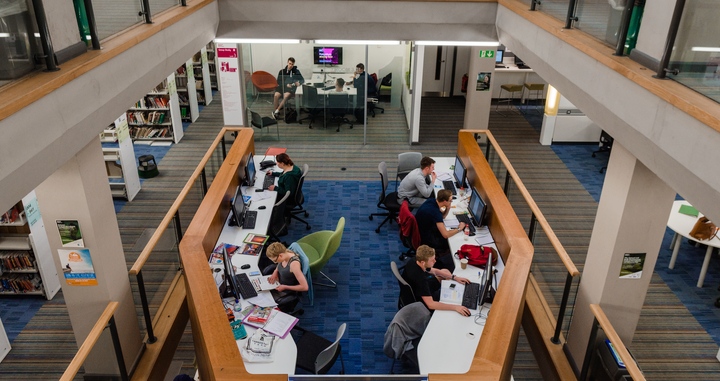
Adsetts library
Adsetts Library is located on our City Campus. It's open 24 hours a day, every day.
Explore the libraryExplore Langsett
Explore Langsett
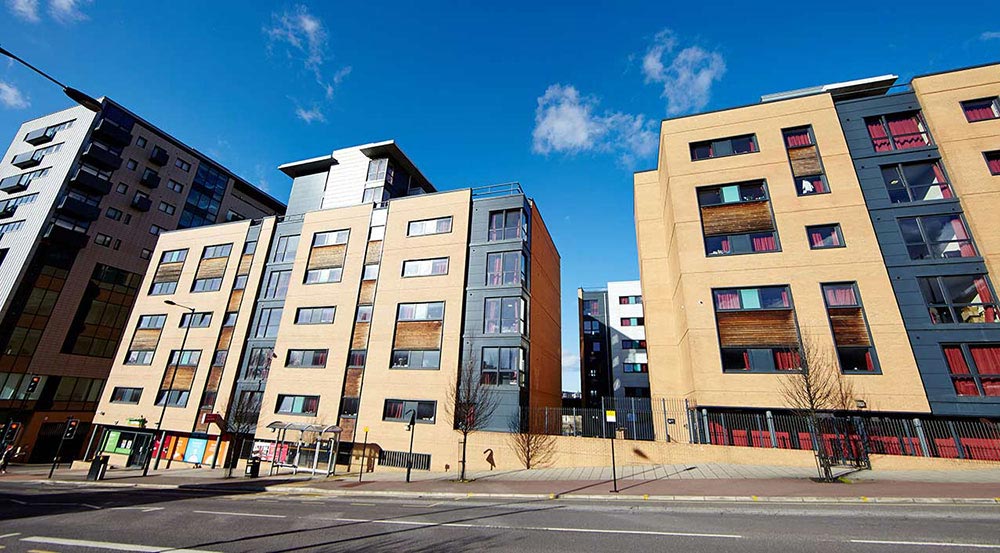
Make your move in our brand-new building at Sheffield Business School. Find a welcoming community where you can experience state-of-the-art facilities and gold-rated teaching.
Entry requirements
All students
UCAS points
- Standard offer: 64 UCAS Points
This must include at least 32 points from one A level or equivalent BTEC National qualifications excluding general studies For example:
- CC at A Level
- MPP in BTEC Extended Diploma.
- Pass overall from a T level qualification with D or E from core
- A combination of qualifications, which may include AS levels and EPQ.
You can find information on making sense of UCAS tariff points here and use the UCAS tariff calculator to work out your points.
- Access to HE Diploma, with at least 45 level 3 credits.
If English is not your first language, you will need an IELTS score of 6.0 with a minimum of 5.5 in all skills, or equivalent.
Additional information for EU/International students
If you are an International or non-UK European student, you can find out more about the country specific qualifications we accept on our international qualifications page.
For details of English language entry requirements (IELTS), please see the information for 'All students'.
Fees and funding
Home students
Our tuition fee for UK students on this course in 2027/28 is £5,760 for the foundation year and £10,050 per year for the degree (capped at a maximum of 20% of this during your placement year). These fees are regulated by the UK government and therefore subject to change in future years.
If you are studying an undergraduate course, postgraduate pre-registration course or postgraduate research course over more than one academic year then your tuition fees may increase in subsequent years in line with Government regulations or UK Research and Innovation (UKRI) published fees. More information can be found in our terms and conditions under student fees regulations.
International students
Our tuition fee for International/EU students starting full-time study in 2027/28 is £18,900 per year (capped at a maximum of 20% of this during your placement year)

Financial support for home/EU students
How tuition fees work, student loans and other financial support available.
Additional course costs
The links below allow you to view estimated general course additional costs, as well as costs associated with key activities on specific courses. These are estimates and are intended only as an indication of potential additional expenses. Actual costs can vary greatly depending on the choices you make during your course.
General course additional costs
Additional costs for Sheffield Business School (PDF, 256.9KB)Legal information
Any offer of a place to study is subject to your acceptance of the University’s Terms and Conditions and Student Regulations.