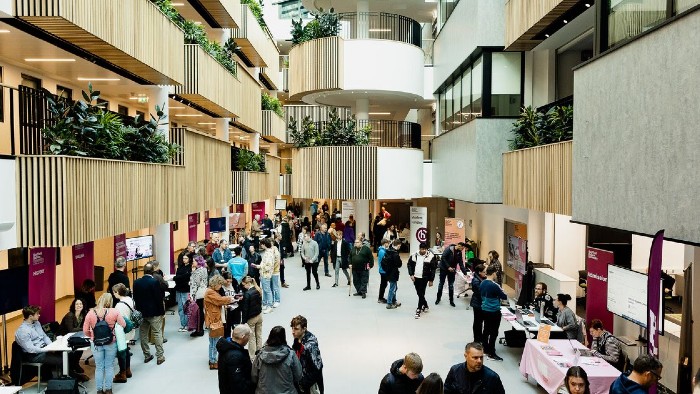

Everything you need to know...
-
Tuition fees
Home: £12,990 for the course
International/EU: £21,030 for the course -
Course duration
2 Years
-
Study location
-
Start date
September 2027
-
Placement year available?
Yes
Course summary
- Assess key trends in the hospitality and culinary arts sector,
- Emphasise sustainability and ethical business practices,
- Apply practical authentic real-world knowledge through hands-on techniques and culinary innovation,
- Analyse literature, theory, and global issues, applying this insight to complex culinary and hospitality challenges.
Managing hospitality and culinary businesses presents an exciting challenge, combining artistry, technique, and creativity with the responsibilities of management and business. Our MSc Hospitality and Culinary Arts Management will equip you with the advanced skills necessary for a successful career in the culinary sector of the hospitality industry.
This MSc Hospitality and Culinary Arts course offers a distinctive approach, connecting science, business, and culinary arts knowledge. It empowers learners to think critically, navigate group dynamics, strategise, and tackle challenges with innovation and integrity. The unique learning environment enables students to effectively translate ideas into practical, commercial solutions. By doing so, it meets the demand for competitiveness in the international culinary arts and hospitality industries, producing well-rounded, innovative graduates.
The course also includes a work experience opportunity with a 12-month placement.
Accredited by

Sheffield Business School is accredited by the Association to Advance Collegiate Schools of Business (AACSB). This internationally recognised accreditation places us among the top business schools globally.
Tourism subject group award
Our Tourism subject group is recognised as a Centre of Excellence by the Institute of Travel and Tourism (ITT), the membership organisation for tourism industry professionals and educators.
Get future, business and life ready.
Make Sheffield Business School your home. Learn in our brand new building with state of the art facilities, gold rated teaching, hands on industry partnerships and an experience ranked 5* by QS Top Universities. Build your skills, confidence and connections for the future. Make your move.
Student satisfaction
This course scored 100% for overall student satisfaction in the Postgraduate Taught Student Satisfaction Survey 2026.

World top 100 for hospitality
We’re ranked in the world top 100 universities for Hospitality and Leisure Management in the QS World University Rankings 2026.

Come to an open day
Find out more at our postgraduate open days. Book now for your place.
How you learn
You'll benefit from the expertise of our experienced lecturers and the excellent facilities on campus, including state-of-the-art kitchens, food development laboratory spaces and our training restaurant where teaching and real-world learning takes place.
We believe that aspiring culinary and hospitality professionals should master the art of creatively incorporating ingredients through various techniques suitable for specific contexts.
You will be supported by industry experienced academic staff. In addition to this you will be allocated an academic advisor, an employability advisor and a student support advisor. You will also be encouraged to collaborative with peers as part of your learning and through extra-curricular activities to allow you to benefit from a sense of course community.
You learn through:
- Applying our unique teaching methodology to on-site courses, we foster a comprehensive understanding by emphasising product knowledge, technology, and context.
- Empowering students with the ability to confidently navigate and manage diverse situations, our goal is to equip them for success.
- Emphasising food, drink and restaurant business entrepreneurship, our course promotes students’ thinking critically, innovating, creating, and developing to reshape the gastronomy industry into a responsible and forward-thinking sector.
- An on-site blended approach via lectures, seminars, workshops, practical sessions, live projects, case studies, conducting academic research and gamification/online simulation
We want our students to constantly look toward the future, and grasp that shaping it requires proactive innovation. As a result, our course covers a range of specialised subjects, including:
- Culinary management and service experiences
- Responsible food, drink and society
- Sustainable business strategy
- Global tourism and hospitality operations
- Research methods
You will also undertake kitchen laboratory research, a dissertation and an industry related project.
Follow our Sheffield Business School Instagram to see real student life, course experiences, events and what it is like to study here.
Course support
Our teaching is digitally-enriched, with opportunities to engage online with peers and tutors;
- In-person workshops welcome students onto the campus;
- Supported independent study builds confidence and resilience, shaping individual creative practice
- Collaboration with external partners gives students vital experience with the professional world of creative writing and builds their ambitions for their futures
- Student learning is assessed through coursework and workshops in modules provide regular points of feedback and development for assessment.
Applied learning
MSc Hospitality and Culinary Arts benefits from state-of-the-art facilities that allow you to apply theoretical knowledge in a practical way aligned to real-world challenges facing the hospitality and culinary arts sector. Our kitchens, laboratories and sensory suite mimic those found in the industry.
The work experience option is highly regarded by employers as the premier opportunity to cultivate practical skills within the hospitality and culinary arts sectors, whether domestically or internationally. We provide robust support in finding placements, via employability workshops and a dedicated placement team, though the onus on securing the opportunity rests with the student.
You will network with professionals in the industry through guest lectures from visiting academics, researchers, and other professionals, together with case studies and field visits. This will help you to further enhance your knowledge and understanding of the industry and to gain valuable experience that will be beneficial to your career.
Work placements
You’ll have the opportunity to source a work placement for up to 12 months, where you’ll apply academic theory and your skills in a real-world setting. This hands-on experience will enhance your professional development and help you to make informed career choices after graduation. Throughout your placement, you’ll be supported to reflect on your experience and contribution to the organisation you work for. You'll also share your progress and achievements with your Placement Academic Supervisor as part of your final assessment.
Work placements are competitive and will require you to make formal applications to employers and be successful in securing an opportunity. The application process for placements takes place while you are a student with us. To support you in applying for placements, you’ll complete an additional placement preparation program that introduces you to the UK employment landscape and prepares you for the recruitment and assessment activities you will experience during that process. We also maintain a large database of placement offers that you can search to find opportunities most relevant to your course that you can apply for.
Course leaders and tutors

Modules
Module and assessment information for future years is displayed as currently validated and may be liable to change. When selecting electives, your choices will be subject to the core requirements of the course. As a result, selections may be limited to a choice between one of two or more specified electives in some instances.
You will be able to complete a placement year as part of this course. See the modules table below for further information.
Year 1
Compulsory modules
This module will aim to provide students with the tools, techniques, and theory to analyse, critique and evaluate processes and systems within the culinary and food services industries.
Students will gain knowledge and the understanding of managing the key operational processes and systems to provide a unique service experience.
You’ll study topics such as:
- Culinary concepts: Restaurants, food trucks, dark kitchens and contract catering
- Kitchen and restaurant technology, enhancements and impact
- Food and service delivery and designing experiences
- Marketing and communication tools for the food service industry
- Exploring social media, consumer behaviours and loyalty
- Exploring unique experiences, the experience economy and memorable encounters
- Food product development, concept design, testing and plating
- Food safety and legislation
- Kitchen techniques, sous vide, molecular cuisine
- Luxury brand products and services
- Menu design, engineering, nudging and positioning, costing, financial planning, pricing and selling
This module equips you with the tools and critical insight to analyse, evaluate, and improve operational systems in global tourism and hospitality. You’ll explore how organisations respond to change, manage resources, and embed sustainability in operational strategy.
You’ll study topics such as:
- Global tourism and hospitality operations
- Sustainable destination and visitor attraction management
- Service design and operations strategy
- Forecasting, yield, and revenue management
- Financial planning and inventory control
- Supply chain and sales data analysis
- Capacity, queuing, and regulatory compliance
- Quality assurance and service recovery
- Food safety and legal frameworks
- Sustainability, ethics, and professional skill developmen
The aim of this module is to enhance students’ professional development through the completion of, and reflection on meaningful work experience.
A work experience will provide students with opportunities to experience the realities of professional employment and experience how their course can be applied within their chosen industry setting. The placement will:
Allow student to apply the skills, theories and behaviours relevant and in addition to their course.
Enable students to enhance their interpersonal skills in demand by graduate employers – communication, problem solving, creativity, resilience, team work etc.
Grow their student network and relationship building skills.
Provide students with insights into the industry and sector in which their placement occurs.
Help student make informed graduate careers choices.
In this module, students will undertake a work experience (minimum duration and expectations as per HESA regulations – clarified on assignment brief/Blackboard) which is integrated, assessed and aligned to their studies and appropriate for their level of study.
Their personal Placement Academic Supervisor (PAS) will be their key point of contact during their work experience and will encourage and support students to reflect on their experience, learning and contribution to the organisation they work for.
To demonstrate gains in professional development, students will be required to share their progress, learning and achievements with their Placement Academic Supervisor and reflect on these for the summative piece of work.
This module will aim to develop a contextual insight into the philosophical, social, economic, cultural, and ethical perspectives that drive and influence the contemporary food and drink service businesses outside of the operational management studies domain.
You’ll study topics such as:
- History of social dining, gastronomy, and current trends
- Connectivity of the supply chain, ethics, responsible production and the product offering
- Behavioural studies in the customer journey, staff and business interaction and the role of food and drink establishments in society
- Anthropological aspects and cultural constraints of dining
- An introduction to regional/national/international food and drink and the value of food and drink in society
- Sociology of food and drink consumption
- Food journalism, reviews, blogs and podcasts
- The transformation of the culinary and beverage product through experience and aesthetic consumption
This module develops your ability to make ethical, sustainable, and strategic business decisions. You’ll explore how to analyse environments, interpret data, and implement responsible strategies aligned with global priorities.
You’ll study topics such as:
- Analysing internal and external business environments
- Interpreting finance and business intelligence data
- Developing sustainable products and markets
- Designing international business strategies
- Ethical recruitment and inclusive workforce planning
- Evaluating strategic options responsibly
- Implementing strategic decisions effectively
- Aligning strategies with the United Nations Sustainable Development Goals
- Planning personal and professional development
- Enhancing sector awareness through reflection
Final year
Elective modules
This module develops your consultancy skills through a live project with a real client. You’ll investigate a specific organisational issue, apply research methods, and deliver practical insights. Alongside the project, you’ll reflect on its broader relevance to professional practice.
You’ll study topics such as:
- Defining project scope with your client
- Applying relevant theoretical frameworks
- Choosing appropriate research methods
- Addressing ethical research considerations
- Conducting a focused literature review
- Analysing and interpreting research data
- Drawing evidence-based conclusions
- Communicating findings clearly and professionally
- Managing your project effectively
- Reflecting on consultancy in professional practice
This module strengthens your critical research skills as you explore a current issue within your discipline. You’ll design and carry out an independent research project, generating insights that contribute to both academic knowledge and professional practice.
You’ll study topics such as:
- Defining your research question and focus
- Applying theoretical frameworks effectively
- Selecting appropriate research methods
- Addressing ethical research considerations
- Conducting a structured literature review
- Analysing and interpreting research data
- Drawing meaningful, evidence-based conclusions
- Managing your dissertation timeline
- Writing clearly and persuasively
- Reflecting on research in professional contexts
This module will enhance your critical research and analysis skills as you explore and reflect on a specific issue in relation to your work experience. You will investigate an organisational issue and provide valuable insights for organisational stakeholders, and you will also consider wider relevance to professional practice.
You’ll study topics such as:
- Working with stakeholders to formulate research purpose and focus
- Theoretical frameworks to inform research design
- Research methods including ethical considerations
- Literature review
- Analysis, interpretation, and evaluation of data
- Writing up/managing your research project
Future careers
This course prepares you for a career in:
- Food product development
- Food regulation and labelling
- Food industry policy
- Procurement and food supplier management
- Food quality management
Previous graduates of this course have gone on to work for:
- Retailers e.g., Morrisons
- Food Manufacturers e.g., Finsbury Food Group, Greencore
- NHS Trusts
- Local Council
- Voluntary, Community and Social Enterprises
Your course has embedded support from an academic to help prepare you for your future career. In addition to this there are other workshops and support sessions offered across the University to support you in this area.
Equipment and facilities
Our new state-of-the-art Sheffield Business School will be your home, offering dedicated spaces to collaborate with peers, staff, industry partners, and the wider business community through our Business Hub.
During this course, you will benefit from modern learning environments, including IT-equipped lecture halls, specialised hardware and software resources, interactive group workspaces, and a continuously expanding library.
On this course you will have access to:
- industry-standard professional development kitchens to support food product development in which you will be supported by specialist technicians
- ingredients provided to support your learning with assistance from our specialist procurement team
- our 12-booth specialist sensory suite, sensory kitchen and discussion room
- Specialist sensory analysis software
- nutrition laboratories in which you can measure, for example, anthropometric and biochemical markers of health
- food analysis laboratories to support measurement of the chemical and physical properties of foods
- specialist dietary analysis software. For example, previous students have used Nutritics to analyse diets or recipes or to produce nutrition panels/ labels
Where will I study?
You study at City Campus through a structured mix of lectures, seminars and practical sessions as well as access to digital and online resources to support your learning.
City Campus
City Campus is located in the heart of Sheffield, within minutes of the train and bus stations.
City Campus map | City Campus tour

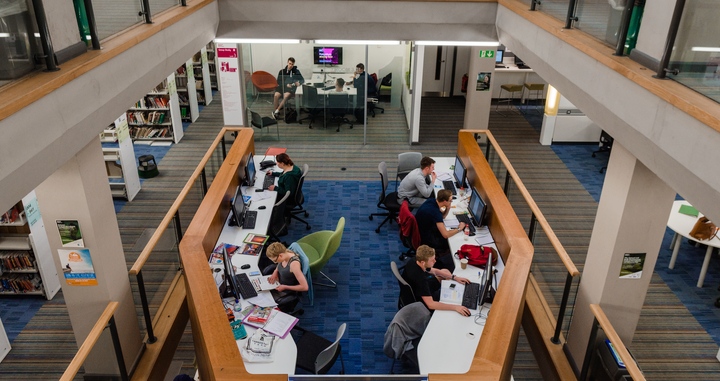
Adsetts library
Adsetts Library is located on our City Campus. It's open 24 hours a day, every day.
Explore the libraryExplore Langsett
Explore Langsett
Make your move in our brand-new building at Sheffield Business School. Find a welcoming community where you can experience state-of-the-art facilities and gold-rated teaching.
Entry requirements
All students
Normally an undergraduate degree at 2:2 or above, in a related field.
If English is not your first language, you will need an IELTS score of 6.0 with a minimum of 5.5 in all skills, or equivalent.
Additional information for EU/International students
If you are an International or non-UK European student, you can find out more about the country specific qualifications we accept on our international qualifications page.
For details of English language entry requirements (IELTS), please see the information for 'All students'.
Fees and funding
Home students
Our tuition fee for UK students starting full-time study in 2027/28 is £12,990 for the course. The tuition fee displayed above is for the full course. For this work experience route, your fees will be payable over two years, based on credits studied per year. The fee includes dedicated employability support to help you prepare for work experience. It does not guarantee you a placement and if a placement is not secured the work experience fee will still be charged. If a placement is not secured you will transfer to the standard version of the course to complete your remaining credits, where the balance of your course fees will be due in year one in line with completing the course.
If you are studying an undergraduate course, postgraduate pre-registration course or postgraduate research course over more than one academic year then your tuition fees may increase in subsequent years in line with Government regulations or UK Research and Innovation (UKRI) published fees. More information can be found in our terms and conditions under student fees regulations.
International students
Our tuition fee for International/EU students starting full-time study in 2027/28 is £21,030 for the course. The tuition fee displayed above is for the full course. For this work experience route, your fees will be payable over two years, based on credits studied per year. The fee includes dedicated employability support to help you prepare for work experience. It does not guarantee you a placement and if a placement is not secured the work experience fee will still be charged. If a placement is not secured you will transfer to the standard shorter version of the course to complete your remaining credits. We will inform the Home Office and the course end date on your visa will be adjusted accordingly. The balance of your course fees will be due in year one in line with completing the course.

Scholarships and financial support
Find information on scholarships, bursaries and postgraduate student loans.
International scholarships up to £3000 ›
Alumni scholarships up to £2000 ›
Postgraduate loans for UK students ›
Additional course costs
The links below allow you to view estimated general course additional costs, as well as costs associated with key activities on specific courses. These are estimates and are intended only as an indication of potential additional expenses. Actual costs can vary greatly depending on the choices you make during your course.
General course additional costs
Additional costs for Sheffield Business School (PDF, 256.9KB)Legal information
Any offer of a place to study is subject to your acceptance of the University’s Terms and Conditions and Student Regulations.